

Exercise practice: torque, magnetic dipole and the galvanometer
Moving Charges and Magnetism24 min readLesson 4 of 6
4.1 Torque and magnetic moment
A rectangular loop of N turns, area A and current I behaves as a magnetic dipole of moment N I A. In a uniform field it feels no net force, but it feels a torque whose size is m B sin theta, where theta is the angle between the loop normal and the field. The torque tends to align the loop normal with the field. The potential energy of the loop in the field is minus m dot B, lowest when the moment is along the field.
Take a loop of 14 cm radius with 0.4 A. The area is pi r squared, about 6.16 × 10^-2 m^2, so the moment is about 2.46 × 10^-2 A m^2. Multiplying by a field gives the torque, and the direction follows from the cross product of the moment and the field. Keep the area in square metres and the current in amperes before multiplying.
The magnetic field at the axis of a current loop falls off as the cube of the distance for far points, the same way the field of an electric dipole falls off. This similarity lets magnetic dipole problems reuse the electric dipole formulas with the replacements of p by m and the electric constants by magnetic ones.
4.2 Moving coil galvanometer
A coil of N turns and area A hangs in a radial magnetic field B, so the plane of the coil stays parallel to the field as it turns. The magnetic torque is N I A B and does not vary with the deflection. The spring supplies a restoring torque k phi. At equilibrium the two torques balance, so the deflection is phi = N I A B / k, which is proportional to the current. That proportional response is what makes the instrument a measuring device.
The radial field is produced by making the pole pieces concave and placing a soft iron cylinder at the centre, so the field lines are always parallel to the plane of the coil. Without the radial field the torque would vary as the cosine of the deflection, the scale would not be uniform, and the instrument would be harder to read. This is a standard three-mark question.
Slideshow, slide 1 of 3. Use the left and right arrow keys to change slides and the space bar to play or pause.
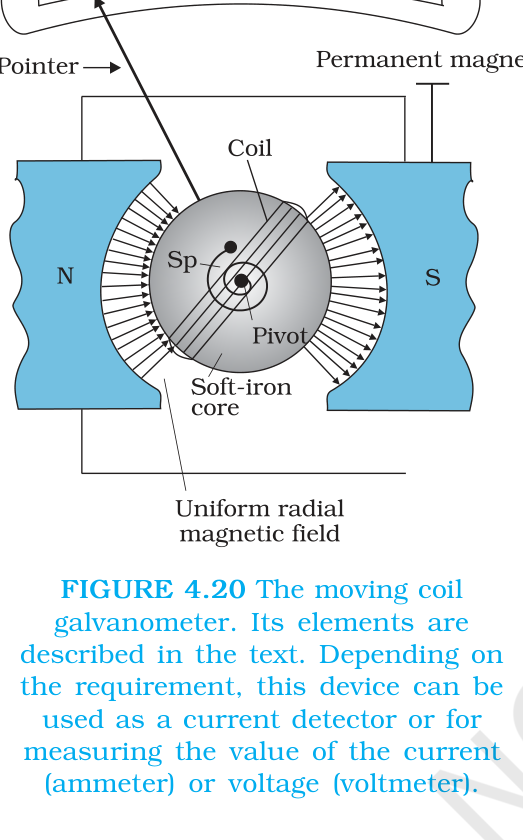
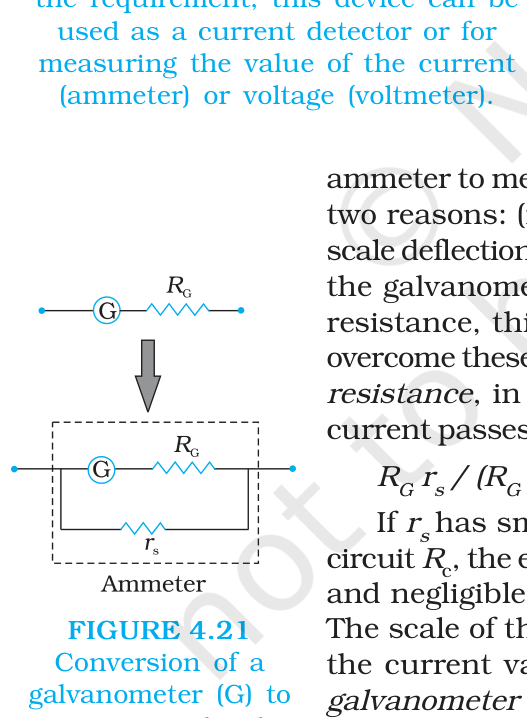
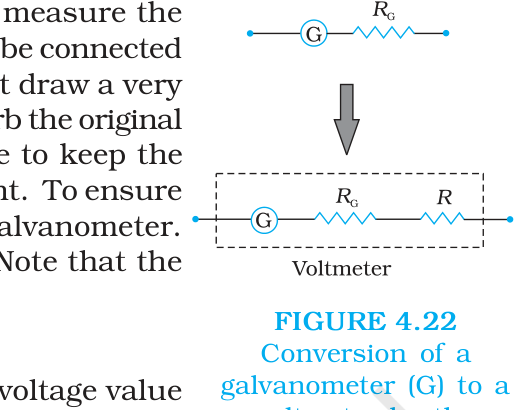
The moving coil galvanometer with its coil in a radial magnetic field, the soft iron core, the spring and the pointer, used to detect and measure small currents.
4.3 Ammeter and voltmeter conversion
To convert a galvanometer of resistance G and full scale current Ig into an ammeter of range I, connect a shunt resistance S in parallel. The shunt carries the excess current I minus Ig, and the voltage across the parallel combination is the same for both paths, which gives S = Ig G / (I - Ig). A good ammeter has a very small resistance so it does not change the circuit current.
To convert the same galvanometer into a voltmeter of range V, connect a resistance R in series such that the full scale current flows when V is applied: R = V / Ig - G. A good voltmeter has a very large resistance so it draws almost no current from the circuit. The two conversions are opposites in resistance: small in parallel for current, large in series for voltage.
A numerical: a galvanometer of resistance 20 ohm shows full scale deflection at 5 mA. For an ammeter of range 10 A, S = 5 × 10^-3 × 20 / (10 - 0.005), which is about 0.01 ohm in parallel. For a voltmeter of range 12 V, R = 12 / 0.005 - 20 = 2380 ohm in series. Both results are checked by substituting back the current and the voltage.
4.4 Current sensitivity and voltage sensitivity
Current sensitivity is the deflection per unit current, N A B / k. It rises with more turns, larger area and stronger field, and falls with a stiffer spring. Voltage sensitivity is the deflection per unit voltage, N A B / (k G), and for a fixed geometry it does not increase with more turns, because adding turns raises the resistance in the same proportion as it raises the current sensitivity. A question that asks how to increase voltage sensitivity expects this cancellation as the explanation.
Exam
For conversions, write the parallel or series condition first, then substitute. For torque and moment numericals, state the direction of the magnetic moment before calculating, because half the marks in these questions sit in the direction.
4.5 One galvanometer conversion numerical
A galvanometer of resistance 100 ohm needs 1 mA for full scale deflection. For a voltmeter of range 10 V, the series resistance is R = 10 / 0.001 - 100 = 9900 ohm. For an ammeter of range 1 A, the shunt is S = 0.001 × 100 / (1 - 0.001) ≈ 0.1 ohm. The voltmeter resistance is about 10 kohm, so it draws a small current; the ammeter resistance is about 0.1 ohm, so it barely changes the circuit current. Always check the order of magnitude of the converted instrument before moving on.
4.6 Common mistakes
Using the total current instead of the excess current in the shunt formula gives a wrong shunt. Mixing up series and parallel gives a meter with the wrong resistance scale. Forgetting to subtract G in the voltmeter formula is the most common slip, because the series resistance carries the full-scale current together with the coil.