

Derivations: Biot-Savart law, Ampere's law and their applications
Moving Charges and Magnetism24 min readLesson 3 of 6
3.1 Biot-Savart law
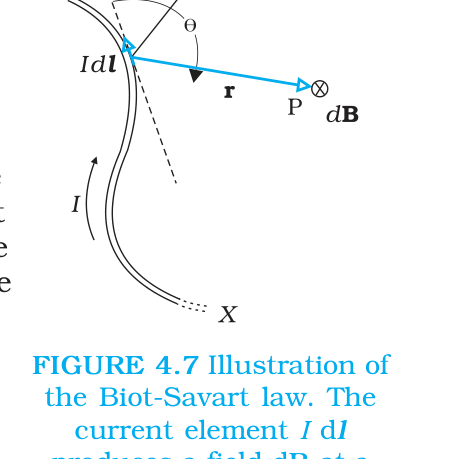
The magnetic field of a current element is The size grows with the current and with the length of the element, shrinks with the square of the distance, and changes with the angle the element makes with the line to the point. In vector form the field is the current element crossed with the unit vector toward the point, times the permeability constant over four pi. The field points at right angles to the plane that holds the element and the line to the point, so the lines around a straight wire come out as circles.
Integrate this expression to get the field of any current distribution. For a long straight wire the integration gives a field that circles the wire and has size mu0 I over two pi r. The field is tangential to circles centred on the wire at every point, so it has the same size on a circle and is perpendicular to the radial direction.
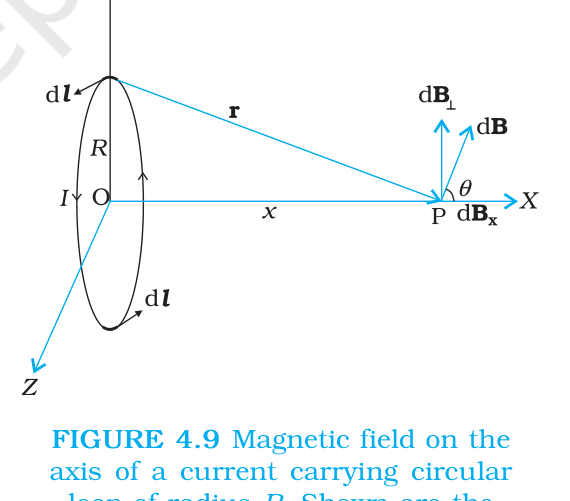
For a circular loop, the field at the centre is mu0 N I over two R, pointing along the axis. On the axis at distance x the field falls as the cube of the distance at large distances, which matches the field of a magnetic dipole. That is why a current loop is called a magnetic dipole, with moment N I A.
3.2 Ampere's law
Ampere's law says that the line integral of the magnetic field around a closed loop equals the permeability times the current passing through the loop. It plays the same role for magnetism that Gauss's law plays in electrostatics: choose a loop with the symmetry of the field and the integral becomes simple.
For the long straight wire, take a circular loop of radius r centred on the wire. The field is tangential and constant in size on the loop, so the integral is B times two pi r. That equals mu0 I, which reproduces the Biot-Savart result immediately. For a long solenoid, take a rectangular loop with one side inside the solenoid parallel to the axis and one side outside. The outside field is negligible, the perpendicular sides contribute nothing, and what remains gives B L = mu0 n I L, so B = mu0 n I inside. The field is uniform and parallel to the axis there.
3.3 Force between parallel currents
Two long parallel wires carrying currents feel forces on each other because each lies in the field of the other. The field of wire 1 at the position of wire 2 is mu0 I1 over two pi d, so the force per unit length on wire 2 is mu0 I1 I2 over two pi d. Parallel currents attract and antiparallel currents repel. That is the opposite of the familiar sign rule for charges, where like charges repel, and the contrast is worth remembering.
The attraction is magnetic, not electrostatic: the drift electrons in the two wires move in the same direction for parallel currents, and the moving charge picture plus the other wire's field gives an attractive force. The official definition of the ampere uses exactly this force: one ampere is the current that produces a force of two times ten to the minus seven newton per metre between two parallel wires one metre apart.
3.4 Solenoid and toroid
Inside a long solenoid the field is uniform and equals mu0 n I, with n the number of turns per unit length. Increasing the radius of the turns does not change the field, provided the solenoid stays long, because the field depends on turns per unit length and current only. Doubling both the length and the total number of turns keeps n the same, so the field stays the same.
A toroid has a field confined to its interior, with B = mu0 N I over two pi r inside the core and nearly zero outside. The field is not uniform across the core because r changes across it, which is the difference from a long solenoid.
3.5 Common mistakes
Do not apply Ampere's law to a shape that does not match the symmetry and expect the field to come out of the integral. Do not confuse the number of turns N with turns per unit length n; the solenoid formula uses n. And remember the direction of the field circles the wire according to the right hand grip rule, not radially outward.
Exam
For a derivation answer, draw the loop, mark the angle between the field and the path on each side, and write the integral side by side with the enclosed current. The examiner gives marks for the symmetry argument, not only for the final formula.
3.6 One numerical on fields
A long straight wire carries 5 A. At 20 cm from the wire the field is mu0 I / (2 pi r) = 2 × 10^-7 × 5 / 0.2 = 5 × 10^-6 T, and its direction follows the right hand grip rule. Now take a coil of 50 turns and 10 cm radius with 2 A through it; at the centre the field is mu0 N I / (2R) = 4 pi × 10^-7 × 50 × 2 / 0.2 = 6.3 × 10^-4 T. A long solenoid with 1000 turns per metre and current 1 A gives B = mu0 n I ≈ 1.26 × 10^-3 T inside. These three results cover most numericals from this section, so learn the conditions for each formula.