

Concepts: Proportional Reasoning-2 (part 1)
Proportional Reasoning-218 min readLesson 1 of 6
1.1 A quick recap of proportion
Two related quantities are in a proportional relationship when they change by the same factor. Idli batter is a familiar example: two measures of rice go with one of urad dal, giving the ratio 2 : 1. Viswanath mixes 6 measures of rice and 3 of dal, while Puneet mixes 4 and 2. The mixtures taste the same because the two ratios are proportional.
The cross products decide it: the pair a : b and c : d is proportional exactly when a × d equals b × c, which is the same as a/c = b/d. For the idli mixtures, 6 × 2 = 12 and 3 × 4 = 12, so the ratios match.
1.2 Ratios in maps
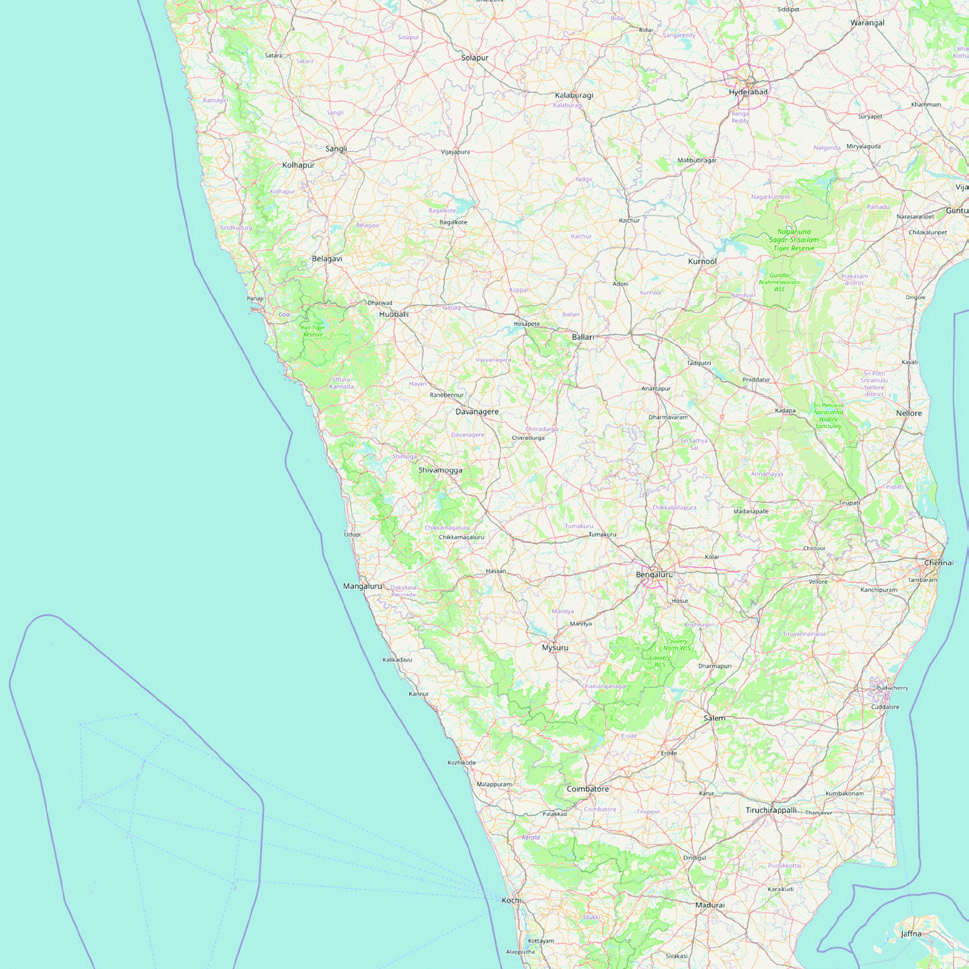
Maps usually print a scale in a corner as a ratio, for example 1 : 60,00,000. This printed ratio is called a Representative Fraction (RF). It compares a measured length on the map with the real length on the ground. An RF of 1 : 60,00,000 means that 1 cm measured on the map stands for 60,00,000 cm on the ground.
Convert the ground distance to kilometres. Since 1 km = 1,00,000 cm, we get 60,00,000 cm = 60 km. So 1 cm on this map represents 60 km of geographical distance, which is the straight-line distance on the ground and not the road distance.
To measure a distance on the map, measure the length between the two places with a ruler, then multiply by the scale. For example, if two cities are 4.5 cm apart on a map with RF 1 : 60,00,000, the geographical distance is 4.5 × 60 = 270 km. A careful measurement and a careful unit conversion are both needed.
1.3 Ratios with more than two terms
Viswanath's spice mix is measured in spoonfuls: fenugreek seeds 1, toor dal 2, red chillies 4 and coriander seeds 8. Read the other way round, the ratio is 8 : 4 : 2 : 1, with four terms. A ratio can have any number of terms as long as every quantity changes by the same factor.
Puneet has only 2 red chillies but wants the same taste. Viswanath used 4 chillies, so Puneet has half of that quantity. Every other ingredient must also be halved: 4 spoons of coriander, half a spoon of fenugreek and 1 spoon of toor dal. The new ratio is 4 : 2 : 1 : 0.5.
For four-term ratios the matching quotients must all agree. In the spice mix each ingredient divided by its partner gives 2: 8 by 4, 4 by 2, 2 by 1, and 1 by 0.5.
1.4 Dividing a whole in a given ratio
To divide a quantity in the ratio a : b : c, add the terms to get the number of parts, divide the whole by that sum to find one part, and multiply one part by each term.
Worked example 1 (purple paint). A purple shade mixes red, blue and white in the ratio 2 : 3 : 5. If 10 litres of white are available, what quantities of red and blue are needed?
Step 1. In the ratio, white is 5 parts, and 5 parts = 10 litres. Step 2. So 1 part = 10/5 = 2 litres. Step 3. Red is 2 parts = 4 litres, and blue is 3 parts = 6 litres. Step 4. Adding the three amounts gives 20 litres of purple paint.
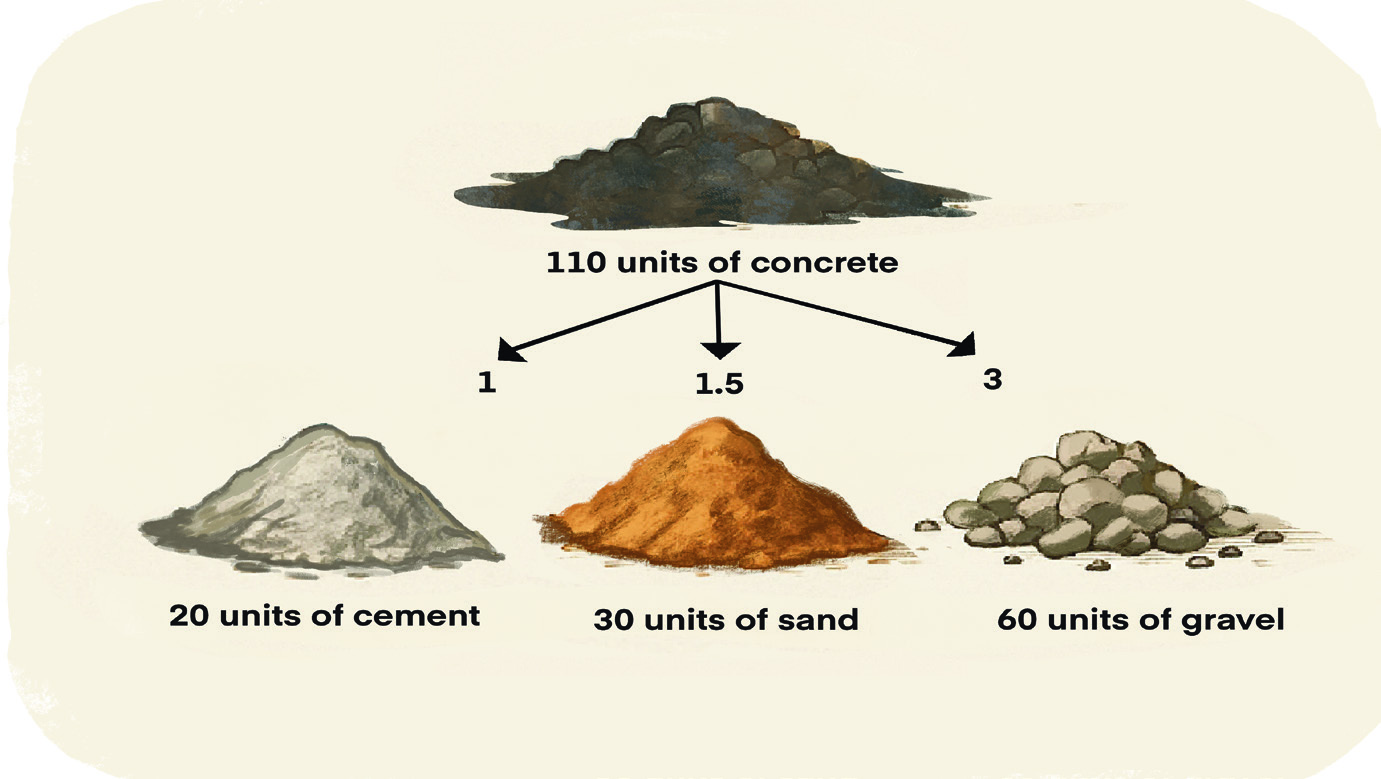
Worked example 2 (concrete). For strong structures, cement, sand and gravel go together as 1 : 1.5 : 3. A builder has 3 bags of cement. What total quantity of mixed concrete results?
Step 1. Multiply every term by 3, because cement goes from 1 to 3. Step 2. The new ratio is 3 : 4.5 : 9. Step 3. Adding gives 16.5 bags in all: 9 of gravel, 4.5 of sand and 3 of cement.
Worked example 3 (110 units of concrete). A job needs 110 units of concrete at 1 : 1.5 : 3. Find the amount of each ingredient.
Step 1. One batch of the ratio makes 1 + 1.5 + 3 = 5.5 units of concrete. Step 2. The number of batches is 110/5.5 = 20. Step 3. Cement = 1 × 20 = 20 units, sand = 1.5 × 20 = 30 units, gravel = 3 × 20 = 60 units. Step 4. Check: 20 + 30 + 60 = 110 units.
Worked example 4 (50 ml of purple paint). The same 2 : 3 : 5 shade is needed in a 50 ml batch. Find each amount.
Step 1. The sum of the terms is 2 + 3 + 5 = 10. Step 2. Red = 50 × 2/10 = 10 ml. Step 3. Blue = 50 × 3/10 = 15 ml. Step 4. White = 50 × 5/10 = 25 ml. The three amounts add to 50 ml.
In general, when x is divided in the ratio a : b : c, the parts are x times a/(a + b + c), x times b/(a + b + c) and x times c/(a + b + c).
Worked example 5 (triangle angles). The angles of a triangle follow the ratio 1 : 3 : 5. Find them and construct the triangle.
Step 1. The angles of a triangle add to 180 degrees, and the ratio has 1 + 3 + 5 = 9 parts. Step 2. One part is 180/9 = 20 degrees. Step 3. The angles are 20 degrees, 60 degrees and 100 degrees. Step 4. Check: 20 + 60 + 100 = 180. One angle is obtuse, so the triangle is obtuse angled.