

Exercise practice 2: Proportional Reasoning-2
Proportional Reasoning-226 min readLesson 4 of 6
4.1 Figure it Out: which table is inversely proportional? (page 65)
For inverse proportion, the product x × y must stay constant across the table. For direct proportion, the quotient y/x must stay constant. Compute both before deciding.
3.6 Question 1: Three tables
Statement. Decide which of these tables show inverse proportion. Table (a): x = 40, 80, 25, 16 with y = 20, 10, 32, 50. Table (b): x = 40, 80, 25, 16 with y = 20, 10, 12.5, 8. Table (c): x = 30, 90, 150, 10 with y = 15, 5, 3, 45.
Answer. Table (a) and table (c) are in inverse proportion. Table (b) is in neither inverse nor direct proportion.
Steps.
- Table (a): 40 × 20 = 800, 80 × 10 = 800, 25 × 32 = 800, 16 × 50 = 800. The product is constant, so (a) is inverse.
- Table (b): 40 × 20 = 800 and 80 × 10 = 800, but 25 × 12.5 = 312.5 and 16 × 8 = 128. The product changes, so (b) is not inverse.
- Check whether (b) is direct: 20/40 = 0.5, 10/80 = 0.125, so the quotient changes too. It is neither.
- Table (c): 30 × 15 = 450, 90 × 5 = 450, 150 × 3 = 450, 10 × 45 = 450. The product is constant, so (c) is inverse.
3.6 Question 2: Fill the empty cells
Statement. In the table, x and y are in inverse proportion. The table has x = 16, 12, blank, 36 and y = 9, blank, 48, blank. Fill the empty cells.
Answer. The constant is 16 × 9 = 144. The missing values are y = 12 when x = 12, x = 3 when y = 48, and y = 4 when x = 36. The completed table is x = 16, 12, 3, 36 and y = 9, 12, 48, 4.
Steps.
- Use the complete pair: k = x × y = 16 × 9 = 144.
- When x = 12, y = 144/12 = 12.
- When y = 48, x = 144/48 = 3.
- When x = 36, y = 144/36 = 4.
- Check every product: 16 × 9 = 144, 12 × 12 = 144, 3 × 48 = 144, 36 × 4 = 144.
4.2 Figure it Out: inverse proportion in real situations (pages 67 and 68)
The questions below mix direct and inverse relationships. For each one, decide the type first, then write the proportion.
3.6 Question 3: Six pairs of quantities
Statement. Which of these pairs are in inverse proportion? (a) How many taps fill a tank, and how many minutes the filling takes. (b) How many painters are hired, and how many days a wall of fixed size takes. (c) How far a car can go, and how much petrol is left in its tank. (d) A cyclist's speed, and the time for a route of fixed length. (e) How many metres of cloth are bought, and the rupees paid at a fixed rate. (f) A book's page count, and the hours needed to read it at a fixed pace.
Answer. (a), (b) and (d) are in inverse proportion. (c), (e) and (f) are in direct proportion.
Steps.
- (a) More taps fill the tank faster, so time falls as taps rise. Inverse.
- (b) More painters finish the fixed wall in fewer days. Inverse.
- (c) More petrol allows more distance at a fixed consumption. Direct.
- (d) Higher speed covers a fixed route in less time. Inverse.
- (e) More cloth at a fixed price per metre costs more. Direct.
- (f) More pages at a fixed reading speed take more time. Direct.
3.6 Question 4: Twenty pencils
Statement. If 24 pencils cost ₹120, what do 20 pencils cost?
Answer. ₹100.
Steps.
- The cost per pencil is 120/24 = ₹5.
- The cost of 20 pencils is 20 × 5 = ₹100.
- Or use direct proportion: 24 : 20 :: 120 : x, so x = 20 × 120/24 = 100.
3.6 Question 5: Water for twenty families
Statement. A full tank lasts 6 days for 20 families. Ten more families move in. For how many days will it last? State your assumptions.
Answer. 4 days. The assumptions are that every family uses the same quantity of water each day, that the tank is full at the start, and that no other water is added or used.
Steps.
- The total water supply is 20 × 6 = 120 family-days.
- With 10 more families the number becomes 30.
- 30 × d = 120, so d = 4 days.
- If families used different amounts, the total family-days would not be fixed and the answer would change.
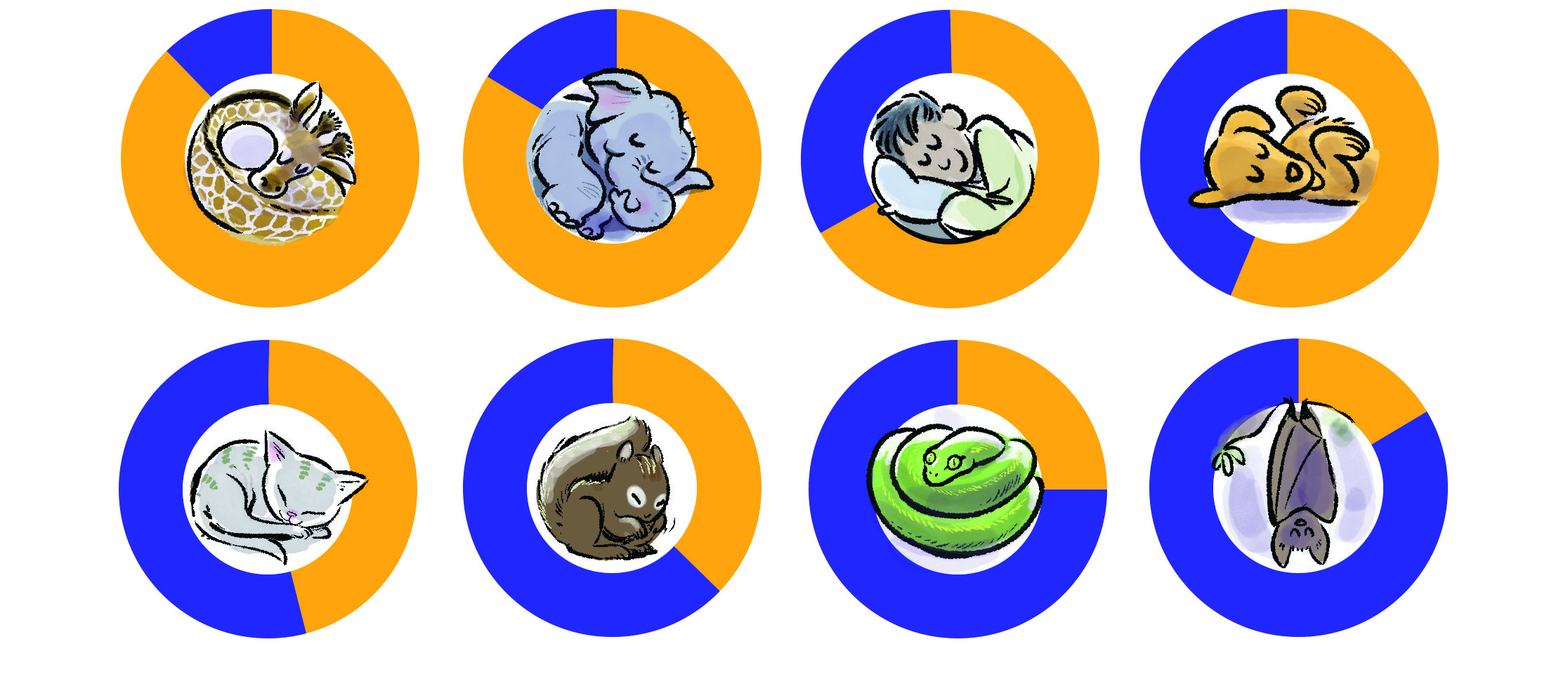
3.6 Question 6: Hours of sleep
Statement. The chapter gives eight donut charts, one for each living being, and a list of hours: 15, 20, 2.5, 8, 13, 3.5, 18 and 10.5. Each chart's coloured sector shows the share of the day spent asleep. Match the hours to the charts.
Answer. In reading order the eight charts give 2.5, 3.5, 8, 10.5, 13, 15, 18 and 20 hours.
Steps.
- The whole circle is 24 hours, so the sleeping share is the coloured fraction of the circle multiplied by 24.
- The first chart's sleeping sector is about 1/10 of the circle: 0.10 × 24 is about 2.4 hours, so 2.5 hours.
- The second is a little larger, about 3.5 hours.
- The third is exactly one third, 8 hours.
- The fourth is a little less than half, about 10.5 hours.
- The fifth is a little more than half, about 13 hours; the sixth is about 15 hours; the seventh is three quarters, 18 hours; the eighth is about five sixths, 20 hours.
- The eight values 2.5, 3.5, 8, 10.5, 13, 15, 18 and 20 each appear once in the list, which confirms the matching.
3.6 Question 7: Modes of transport pie chart
Statement. A pie chart shows how children travel to school. The slices are Walk 90 degrees, Bus 120 degrees, Cycle 60 degrees, Two-wheeler 60 degrees and Car 30 degrees. (a) Which mode is most common? (b) What fraction of children go by car? (c) If 18 children go by car, what was the survey size? How many use taxis? (d) Which two modes have equal numbers of children?
Answer. (a) Bus. (b) 1/12. (c) Total 216 children; the printed chart has no separate taxi sector, so the taxi number cannot be read from it (if taxis are grouped with the car sector, the number is 18). (d) Cycle and two-wheeler.
Steps.
- (a) The bus slice is the largest at 120 degrees.
- (b) Car = 30/360 = 1/12 of the children.
- (c) If 1/12 of the total is 18, the total is 18 × 12 = 216 children.
- (d) Cycle and two-wheeler both have 60-degree slices, so the numbers are equal.
- The angle sum confirms the data: 90 + 120 + 60 + 60 + 30 = 360 degrees. The printed pie chart labels only Walk, Bus, Cycle, Two-wheeler and Car, so a taxi figure cannot be read separately.
3.6 Question 8: Painting a fence
Statement. A fence needs 3 workers for 4 days. One extra worker joins the team. How long will the job take now, and what assumptions are you making?
Answer. 3 days. The assumptions are that all workers paint at the same rate, the fence is the same size, and no worker slows down or stops.
Steps.
- The fixed work is 3 × 4 = 12 worker-days.
- With 4 workers, 4 × d = 12, so d = 3 days.
- More workers on a fixed job means fewer days, so the quantities are inversely proportional.
3.6 Question 9: Filling five tanks
Statement. A pump fills 2 tanks of the same size in 6 hours. How long does it take to fill 5 such tanks?
Answer. 15 hours.
Steps.
- The time per tank is 6/2 = 3 hours.
- For 5 tanks, the time is 5 × 3 = 15 hours.
- This is direct proportion between the number of tanks and the time: 2 : 5 :: 6 : 15, and 2 × 15 = 5 × 6 = 30.
3.6 Question 10: Chairs in rows
Statement. A hall has 12 chairs in each of its 25 rows. The same chairs are regrouped into rows of 20. How many rows result?
Answer. 15 rows.
Steps.
- The number of chairs is 25 × 12 = 300.
- With 20 chairs in a row, the number of rows is 300/20 = 15.
- This is inverse proportion between chairs per row and the number of rows: 12 × 25 = 20 × 15 = 300.
3.6 Question 11: School periods
Statement. Each school day has 8 periods of 45 minutes. If the day is split into 9 periods of equal length, how long is one period?
Answer. 40 minutes.
Steps.
- The total teaching time is 8 × 45 = 360 minutes.
- With 9 periods, each period is 360/9 = 40 minutes.
- More periods in the same total time means shorter periods, so the quantities are inversely proportional.
3.6 Question 12: Two pumps filling one tank
Statement. A small pump fills a tank in 3 hours and a large pump fills the same tank in 2 hours. How long does the tank take if both run together?
Answer. 6/5 hour, which is 1 hour 12 minutes.
Steps.
- In one hour the small pump fills 1/3 of the tank and the large pump fills 1/2.
- Together they fill 1/3 + 1/2 = 2/6 + 3/6 = 5/6 of the tank in one hour.
- The time for the whole tank is 1/(5/6) = 6/5 hour = 1.2 hours.
- 0.2 hour is 12 minutes, so the tank fills in 1 hour 12 minutes.
3.6 Question 13: Machines making toys
Statement. A batch takes 63 days on 42 machines. Find the machine count needed to finish the same batch in 54 days.
Answer. 49 machines.
Steps.
- The fixed work is 42 × 63 = 2646 machine-days.
- With 54 days, the number of machines is 2646/54 = 49.
- Fewer days need more machines, so the quantities are inversely proportional: 42 × 63 = 49 × 54.
3.6 Question 14: The car's trip
Statement. At 60 km/h a car reaches its destination in 2 hours. What time does it need at 80 km/h?
Answer. 1.5 hours, or 1 hour 30 minutes.
Steps.
- The distance is speed × time = 60 × 2 = 120 km.
- At 80 km/h the time is 120/80 = 1.5 hours.
- A higher speed over the same distance means less time, so this is inverse proportion: 60 × 2 = 80 × 1.5 = 120.