

Concepts: The Baudhayana-Pythagoras Theorem (part 1)
The Baudhayana-Pythagoras Theorem18 min readLesson 1 of 6
1.1 Doubling a square
The chapter begins in the Sulba-Sutra of Baudhayana, composed in India around 800 BCE. Baudhayana asks a practical geometry question: how can a square be built with twice the area of a given one?
A natural first guess is to double the side. That fails. If a square has side 1, its area is 1. A square with side 2 has area 2 × 2 = 4, which is four times the original area, not double. Doubling the side always multiplies the area by 4, because area scales with the square of the side.
Baudhayana's verse 1.9 gives the true construction: build the new square on the diagonal of the original, and it holds twice the area of the first square.
1.2 Why the diagonal square has double the area
Draw the diagonal of the original square. It cuts the square into two congruent isosceles right triangles. Now draw the square on the diagonal (the tilted square in the chapter's figure). Its diagonals are the two sides of the original square, extended.
The original square is made of two small congruent triangles. The tilted square is made of four triangles of exactly the same size, so its area is double. Adding a few horizontal and vertical lines through the figure shows this: the sides of the original square lie along the diagonals of the tilted square, and each of the four corner triangles is congruent to the other three. Repeating the construction gives squares of 2, 4, 8, 16, ... small triangles, so each new square holds twice the area of the one before it.
1.3 Halving a square
The reverse construction gives a square of half the area. Inside a given square, draw a tilted square whose vertices are the midpoints of the sides. Now add the east-west and north-south lines through the centre. These lines cut the original square into four quarter squares, and the sides of the tilted square cut every quarter square into two congruent triangles. So the original square is eight congruent small triangles, and the tilted square contains four of them. Its area is exactly half.
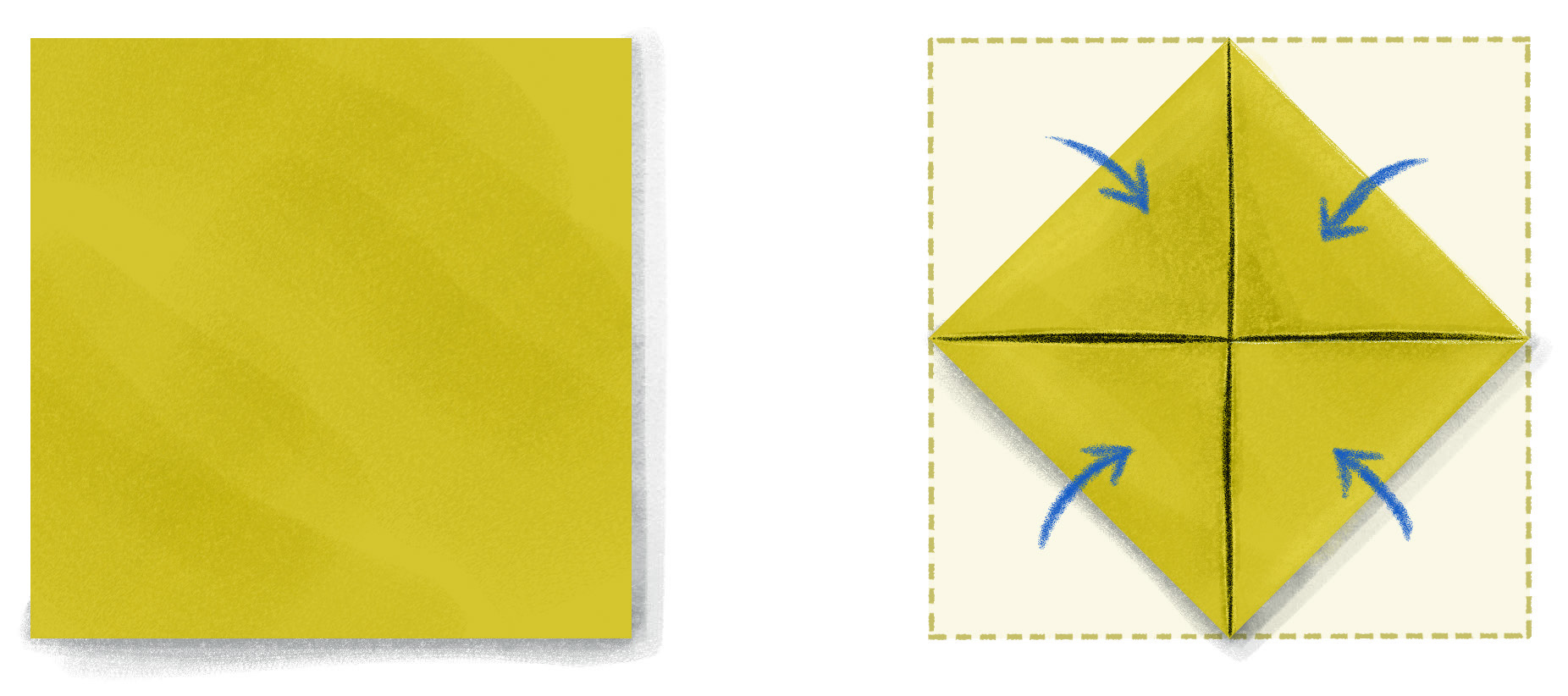
The paper method in the chapter makes this concrete. Fold the square along the lines that join the midpoints of opposite sides. The creases meet at the centre and the four corners fold inward to form a smaller square, labelled PQRS in the book, whose area is half the original.
A common mistake is to think the half-area square has half the side. It does not. A square with half the side has one quarter of the area, and four such squares fill the original. The half-area square has side 1/√2 times the original side, about 0.707 of it.
1.4 The hypotenuse of an isosceles right triangle
In a right triangle the side opposite the right angle is the hypotenuse. Take an isosceles right triangle with equal sides a, like the chapter's square PEAR of side 1. The square built on the hypotenuse ER is the tilted square REST, whose area is double the original square.
If c is the hypotenuse, then the area of REST is c × c = c². Since the area is also 2 × a², the relation is c² = 2a², so c = a√2.
For a = 1 this gives c = √2. The chapter's general solution states the same relation for any isosceles right triangle: the square on the hypotenuse has twice the area of the square on one of the equal sides.
Worked example 1 (hypotenuse from the equal sides). An isosceles right triangle has equal sides of length 12. Find the hypotenuse.
Step 1. Use c² = 2a² with a = 12: c² = 2 × 144 = 288. Step 2. So c = √288. Since 16² = 256 and 17² = 289, the value is just below 17. Step 3. The hypotenuse lies between 16 and 17 units. In exact form it is 12√2 units.
Worked example 2 (equal sides from the hypotenuse). An isosceles right triangle has a hypotenuse of √72. Find the two equal sides.
Step 1. Substitute c = √72 in c² = 2a²: (√72)² = 2a², so 72 = 2a². Step 2. Divide by 2: a² = 36. Step 3. a = 6, so each of the equal sides has length 6 units.
1.5 What is the value of √2?
The square of side 1 has area 1, and the square of side 2 has area 4. Since 1 < 2 < 4, the side whose square is 2 must lie between 1 and 2. So 1 is a lower bound for √2 and 2 is an upper bound.
Tighter bounds come from squaring decimals:
- 1.5² = 2.25 and 1.4² = 1.96, so 1.4 < √2 < 1.5.
- 1.42² = 2.0164 and 1.41² = 1.9881, so 1.41 < √2 < 1.42.
- 1.415² = 2.002225 and 1.414² = 1.999396, so 1.414 < √2 < 1.415.
The process can continue forever. A terminating decimal has a last non-zero digit, and squaring it produces a last non-zero digit after the decimal point, so its square can never be exactly 2. Therefore √2 is a non-terminating decimal, approximately 1.41421356...
1.6 Why √2 is not a fraction
Euclid proved that √2 cannot be written as m/n with m and n counting numbers, in his Elements around 300 BCE. The argument is short. Suppose √2 = m/n. Squaring both sides gives 2 = m²/n², that is 2n² = m².
In the prime factorisation of a square number every prime appears an even number of times. So the left side, 2n², contains the prime 2 an odd number of times (one from the factor 2, plus an even number from n²). The right side, m², contains 2 an even number of times. The same number cannot be both odd and even, so the assumption fails. Hence √2 is irrational.
This is why the chapter says √2 is neither a terminating decimal nor a fraction. It is a real number that can be approximated as closely as we like, but never written exactly as a ratio of integers.