

Methods and worked examples: The Baudhayana-Pythagoras Theorem
The Baudhayana-Pythagoras Theorem20 min readLesson 2 of 6
2.1 Combining two different squares
Baudhayana could also combine two unequal squares into a single square whose area equals the two areas added (verse 1.12). The construction: draw a right triangle whose perpendicular sides equal the sides of the two squares. The square on its hypotenuse then has the combined area.
Verse 2.1 explains why. Join the two squares, then mark off a rectangle inside the larger square whose shorter side matches the smaller square, and draw that rectangle's diagonal. This diagonal is the hypotenuse of a right triangle with legs a and b.
Now build the square on this hypotenuse and place three more copies of the same right triangle around it. The outer square has side a + b. Its area is split into the tilted square of side c plus four right triangles, each of area ab/2. Therefore
(a + b)² = c² + 4(ab/2).
Expanding the left side gives a² + 2ab + b², and the four triangles give 2ab, so c² = a² + b². The dissection is an argument: it derives c² = a² + b² from the areas.
2.2 The Baudhayana-Pythagoras theorem
For a right triangle whose shorter sides are a and b, with hypotenuse c,
a² + b² = c².
Baudhayana stated this result in general and essentially modern form, which is why the chapter calls it the Baudhayana-Pythagoras theorem. Pythagoras, who lived about two hundred years later, also studied it.
Using the theorem. In a 3 cm by 4 cm right triangle, the square of the hypotenuse is 3² + 4² = 9 + 16 = 25, so the hypotenuse is exactly 5 cm. The theorem predicts the length that measuring only estimates.
2.3 Applications of the theorem
The theorem turns a distance problem into an equation. Three standard applications are worth remembering.
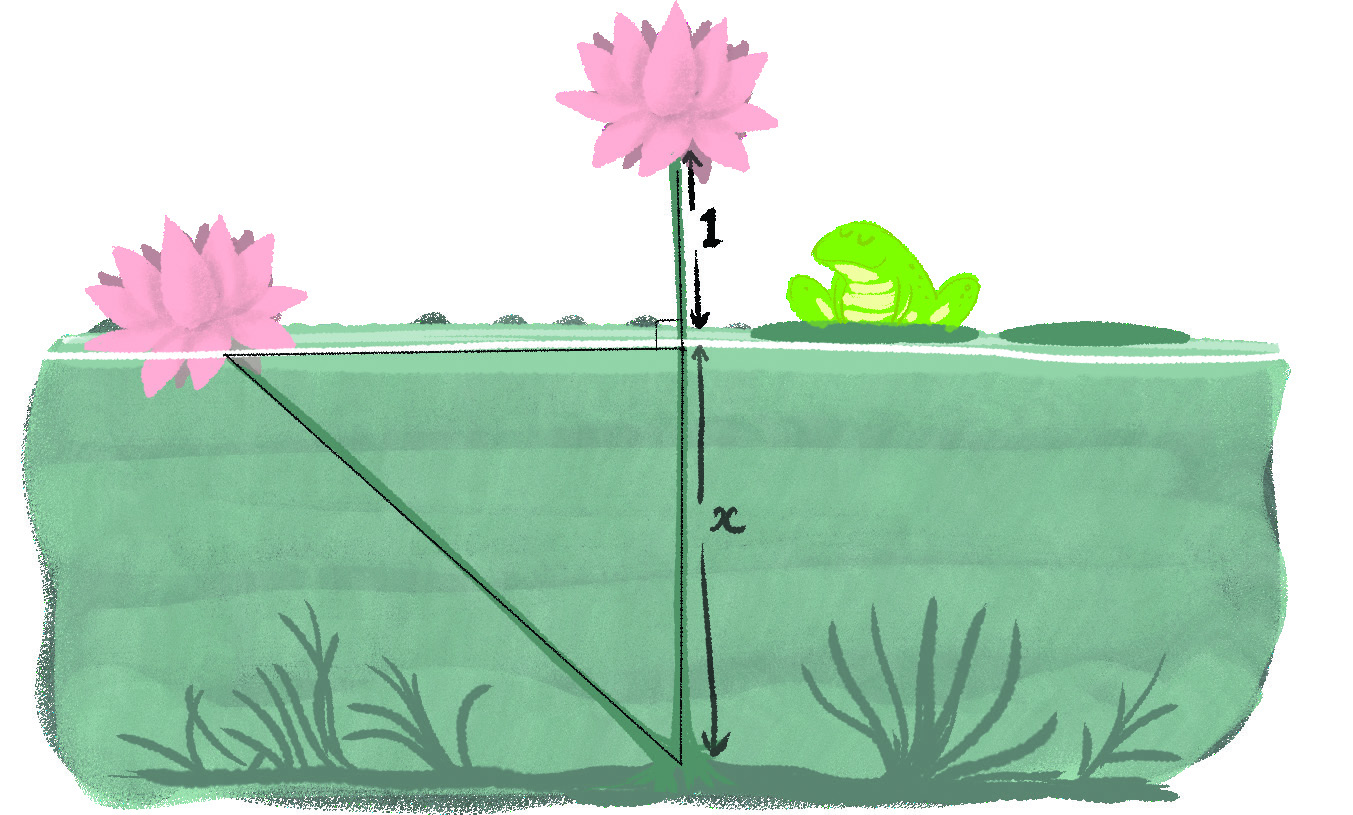
The lotus problem. A lotus stem stands 1 unit above the water. Swayed by the wind, its tip touches the water 3 units from the base. If the depth of water is x, the stem length is x + 1, and the tip, the base and the point where it touches form a right triangle. Then 3² + x² = (x + 1)². The x² cancels, leaving 9 = 2x + 1, so x = 4. The depth is 4 units.
Diagonals. A square of side s has diagonal d with d² = s² + s² = 2s², so d = s√2. A rhombus with diagonals p and q has side √((p/2)² + (q/2)²), because the diagonals bisect each other at right angles.
Heights. An equilateral triangle of side s has height h = √(s² - (s/2)²) = (√3/2)s, so its area is (√3/4)s².
2.4 Baudhayana triples
A Baudhayana triple, also called a Pythagorean triple, is a set of three positive whole numbers a, b, c with a² + b² = c². Baudhayana's list includes (3, 4, 5), (5, 12, 13), (7, 24, 25), (8, 15, 17), (12, 35, 37) and (15, 36, 39).
If (a, b, c) is a triple and k is any positive integer, then (ka, kb, kc) is also a triple:
(ka)² + (kb)² = k²a² + k²b² = k²(a² + b²) = k²c² = (kc)².
So every triple can be scaled up. A triple with no common factor greater than 1 is called primitive. (3, 4, 5) is primitive, while (9, 12, 15) is the scaled version 3 × (3, 4, 5). If a triple is non-primitive and f > 1 is a common factor, dividing each entry by f again gives an integer triple, because f² divides each of a², b² and c² in the equation.
2.5 Generating triples from odd squares
The first n odd numbers add up to n squared, because
1 + 3 + 5 + ... + (2n - 1) = n².
The nth odd number is 2n - 1. Removing the last odd number gives (n - 1)², so (n - 1)² + (2n - 1) = n². If the odd number 2n - 1 happens to be a perfect square, say m², then (n - 1)² + m² = n², and (n - 1, m, n) is a Baudhayana triple.
For example, 9 = 2 × 5 - 1 is an odd square, so n = 5 and the triple is (4, 3, 5). Next, 25 = 2 × 13 - 1, so n = 13 and the triple is (12, 5, 13). This method always gives a triple in which one leg is one less than the hypotenuse, and such a triple is always primitive, because consecutive integers have no common factor.

2.6 Fermat's Last Theorem
Baudhayana triples show that a square can be split into two squares, in infinitely many ways. Fermat wondered whether a cube could be split into two cubes, a fourth power into two fourth powers, and similarly at higher powers. In modern language, the equation
xⁿ + yⁿ = zⁿ
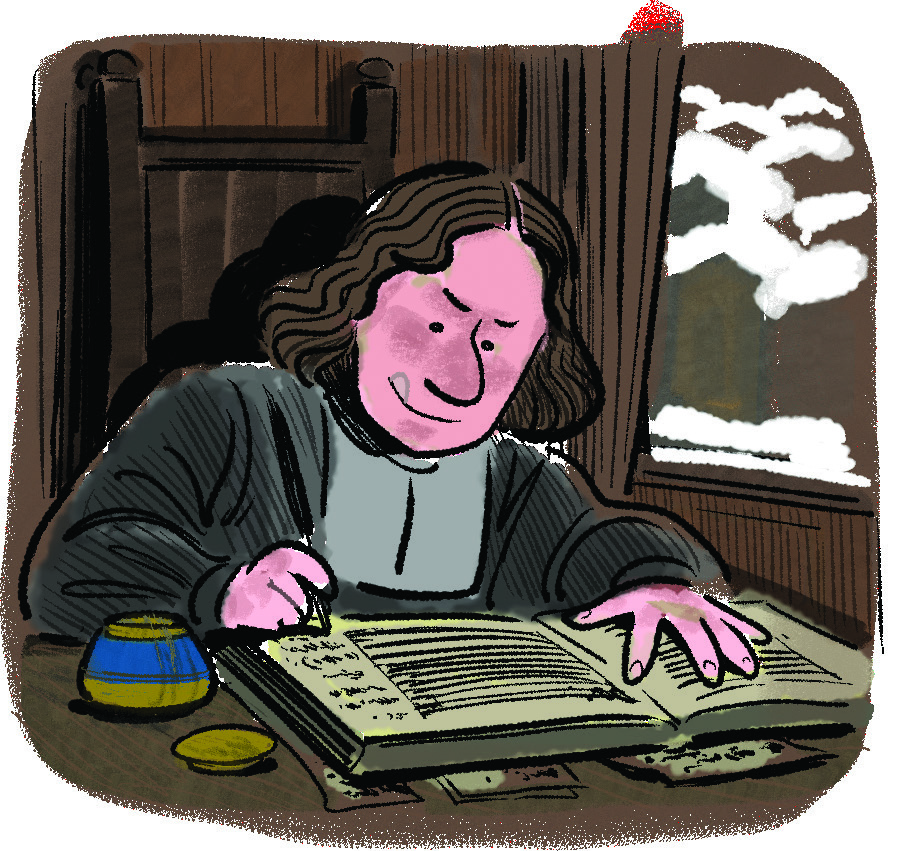
has no positive integer solutions when n > 2. Fermat claimed in a book margin that he had a marvellous proof, but the margin was too small to contain it.
No proof was found for over 300 years. Andrew Wiles, who had read about the problem as a ten year old, finally proved it in 1994. The result is known as Fermat's Last Theorem.