

Exercise practice 1: Exploring Some Geometric Themes
Exploring Some Geometric Themes26 min readLesson 3 of 8
3.1 Figure it Out, page 72: Sierpinski triangle
Question 1. Draw the first few steps (at least up to Step 2) of the sequence that leads to the Sierpinski triangle.
Answer. Step 0 is one equilateral triangle. Step 1 joins the midpoints, giving four congruent equilateral triangles, and the central one is removed. Step 2 repeats the same construction on each of the three remaining triangles. The drawing shows 3 triangles at Step 1 and 9 at Step 2, with holes between them.
Key steps. Mark the midpoints of all three sides, join them, shade the central triangle as removed, then repeat on the three corner triangles. The corner triangles are equilateral because each has a side half the original and two 60° angles.
Question 2. Work out how many holes appear at each step and how many triangles survive in the Sierpinski triangle sequence.
Answer. Remaining triangles Rₙ = 3ⁿ; holes Hₙ = (3ⁿ - 1)/2.
Key steps. Step 0: R₀ = 1, H₀ = 0. Each remaining triangle produces 3 new triangles and 1 new hole, and old holes stay. So Rₙ₊₁ = 3Rₙ and Hₙ₊₁ = Hₙ + Rₙ. Hence Rₙ = 3ⁿ and Hₙ = 1 + 3 + ... + 3ⁿ⁻¹ = (3ⁿ - 1)/2. Check step 2: R₂ = 9, H₂ = 4; the drawing has 9 small triangles and 4 holes.
Question 3. Find the area remaining at the nth step for each Sierpinski sequence, starting from area 1.
Answer. Sierpinski triangle: (3/4)ⁿ. Sierpinski carpet: (8/9)ⁿ.
Key steps. Each remaining triangle keeps 3 of 4 congruent parts, so the area is multiplied by 3/4 at every step. Each remaining square in the carpet keeps 8 of 9 parts, so its area is multiplied by 8/9. The area tends to 0 as n grows, but is positive at every finite step.
3.2 Figure it Out, page 73: Koch snowflake
Question 1. Draw the first few steps of the Koch snowflake.
Answer. Start with an equilateral triangle. On each side, mark the middle third and replace it with two sides of a smaller equilateral triangle built outward. Step 1 has 12 sides, and Step 2 repeats the operation on each of those.
Key steps. Divide every side into three equal parts. Build an outward equilateral triangle on the middle part and erase the middle part itself. The outline becomes a bump. Repeat on every segment of the new outline.
Question 2. Find the number of sides at the nth step of the Koch sequence.
Answer. Sₙ = 3 × 4ⁿ.
Key steps. One side becomes four sides at each step, so each step multiplies the count by 4. Starting with 3 sides at Step 0 gives 3 × 4ⁿ.
Question 3. Find the perimeter at the nth step, starting with side length 1.
Answer. Pₙ = 3 × (4/3)ⁿ.
Key steps. The number of sides is 3 × 4ⁿ, and each new side is one third of the side it replaced, so the length of a side at step n is (1/3)ⁿ. Multiply: Pₙ = 3 × 4ⁿ × (1/3)ⁿ = 3 × (4/3)ⁿ. The perimeter grows without bound, even though the snowflake stays inside a bounded region.
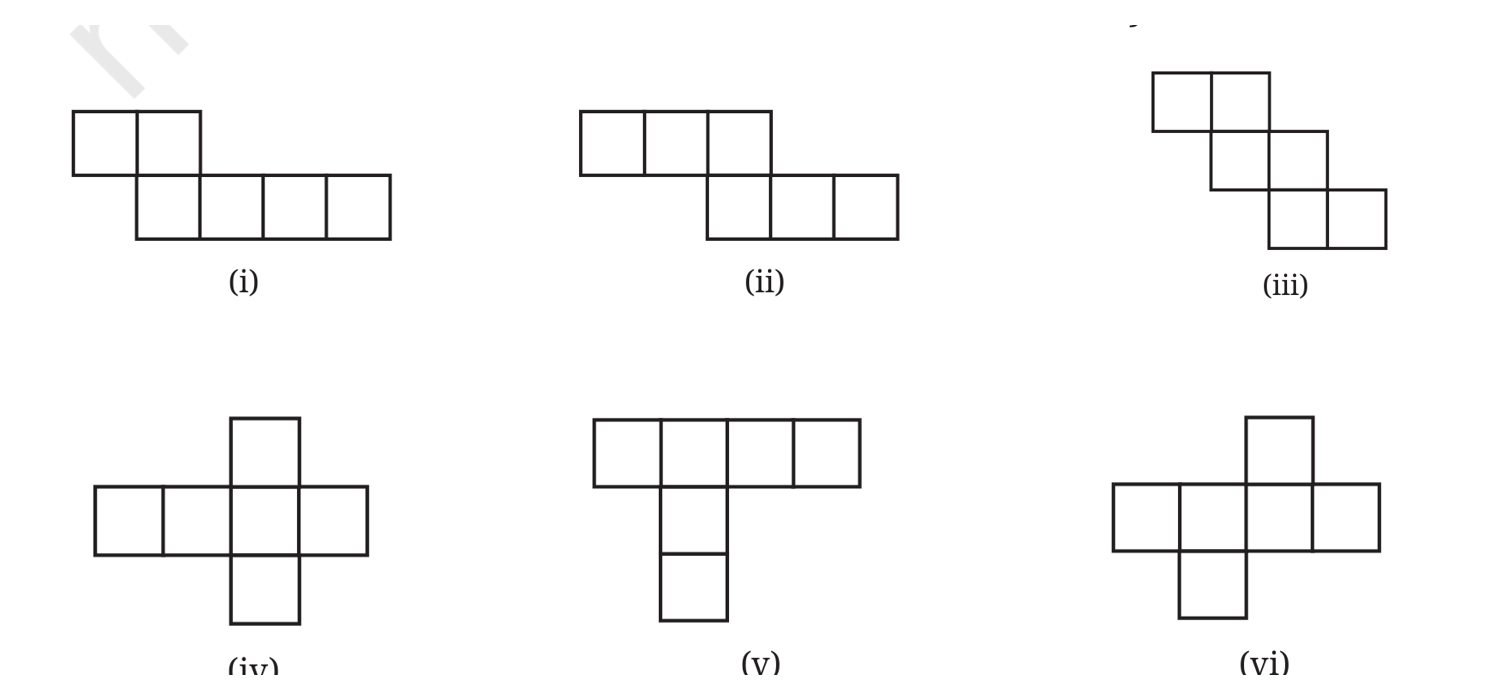
3.3 Figure it Out, page 80: nets of a cube
Question 1. Which of the six given arrangements are nets of a cube? First visualise, then check with cutouts.
Answer. The arrangements that fold into a cube are (ii), (iii), (iv) and (vi). Arrangement (i) puts two squares on the same side of a four-square row, so those two squares would land on the same face and another face would stay open. Arrangement (v) has a two-square tail on one side of a four-square row; the second square of that tail wraps onto a side that the row already covers, so two faces overlap.
Key steps. Pick a base square and fold its neighbours up by 90°. Continue around every edge. If two faces land on the same position, the arrangement is not a net. If every face reaches a different position and all six are used, it is a net. The 11 valid nets fall into four row patterns: 1-4-1, 2-3-1, 2-2-2 and 3-3.
Question 2. A cube has 11 nets up to rotation and reflection. Find all 11.
Answer. Six nets have the 1-4-1 pattern (one square above a row of four and one below, in the six valid positions). Three have the 2-3-1 pattern, one has 2-2-2, and one has 3-3.
Key steps. Draw a row of four squares. Attach one square above and one below in positions that do not overlap when folded; six distinct arrangements result. For 2-3-1, use a row of three with two squares on one side and one on the other; three arrangements. The 2-2-2 zigzag and the two rows of three are the remaining two.
Question 3. Draw a net of a cuboid with side lengths: (i) 5 cm, 3 cm, 1 cm; (ii) 6 cm, 3 cm, 2 cm.
Answer. Each net uses two rectangles of each pair of dimensions: (i) two 5×3, two 5×1 and two 3×1 rectangles; (ii) two 6×3, two 6×2 and two 3×2 rectangles.
Key steps. Draw the largest face in the centre, attach the side faces around it, then attach the top and bottom faces to opposite sides of the side faces. Check the matching dimensions: each edge of the cuboid must appear in exactly two rectangles, and folding must bring the pairs together.