

Exercise practice 2: Fractions in Disguise
Fractions in Disguise26 min readLesson 4 of 7
4.1 Figure it Out: Using percentages (pages 19 and 20)
These questions apply percentages to profit, discount, tax, price change and growth. In each one, decide first which quantity is the base, because the percentage is always taken of the base.
1.3 Question 1: The geometry box
Statement. A geometry box costs a shopkeeper ₹75 and is sold for ₹110. Calculate the profit percentage on the cost.
Answer. 46.67%, or 46 2/3%.
Steps.
- Profit = 110 - 75 = ₹35.
- Profit percentage on cost = 35/75 × 100.
- 35/75 = 7/15, and 7/15 × 100 = 700/15 = 46.67%.
- The base is the cost price, ₹75, not the selling price.
1.3 Question 2: The carpenter's chair
Statement. A carpenter spends ₹475 on materials for a chair and wants a profit margin of 50%. Find the selling price of a chair.
Answer. ₹712.50.
Steps.
- A 50% margin on cost means the selling price is 100% + 50% = 150% of the cost.
- 150% of 475 = 1.5 × 475.
- 1.5 × 475 = 712.5.
- So the chair should be priced at ₹712.50.
1.3 Question 3: The company's costs
Statement. A company's total sales (revenue) last year were ₹2.5 crore, with a healthy profit margin of 25%. What were its total costs?
Answer. ₹2 crore.
Steps.
- Let the cost be C. A profit margin of 25% on cost means revenue = C + 0.25C = 1.25C.
- 1.25C = 2.5 crore.
- C = 2.5/1.25 = 2 crore.
- Check: profit = 2.5 - 2 = 0.5 crore, and 0.5/2 = 25%.
1.3 Question 4: Anwar's shirt
Statement. A clothing shop offers 25% off all shirts. A shirt originally costs ₹300. How much does Anwar pay?
Answer. ₹225.
Steps.
- The discount is 25% of 300 = 75.
- Anwar pays 300 - 75 = 225.
- Shortcut: he pays 75% of the price, so 0.75 × 300 = 225.
1.3 Question 5: The petrol price
Statement. In 2015 a litre of petrol cost ₹60, and in 2025 it costs ₹100. Find the percentage rise. Options: 50%, 40%, 60%, 66.66%, 140%, 160.66%.
Answer. (iv) 66.66%.
Steps.
- Increase = 100 - 60 = ₹40.
- Base = the 2015 price, ₹60.
- Percentage increase = 40/60 × 100 = 66.66%, that is 66 2/3%.
- Options (v) and (vi) describe the 2025 price as a percentage of 2015, not the increase.
1.3 Question 6: Samson's car
Statement. After a 15% discount the price Samson paid for a car was ₹4,40,000. Find the price before the discount.
Answer. ₹5,17,647 approximately.
Steps.
- A 15% discount means Samson paid 85% of the original price.
- Let the original price be P. Then 0.85P = 4,40,000.
- P = 4,40,000/0.85 = 4,40,00,000/85 = 88,00,000/17.
- 88,00,000/17 = 5,17,647.06 approximately. Check: 15% of 5,17,647 is about 77,647, and 5,17,647 - 77,647 = 4,40,000.
1.3 Question 7: The election
Statement. In an election, 1600 votes were cast and the winner received 500 of them. What share of the votes did the winner get? Also work out the smallest possible number of candidates.
Answer. 31.25%. At least 4 candidates stood.
Steps.
- Winner's share = 500/1600 × 100 = 31.25%.
- The winner must have more votes than every other candidate, so each other candidate got at most 499 votes.
- The other 1600 - 500 = 1100 votes must be shared. Two others could take at most 499 + 499 = 998 votes, which is less than 1100, so two others are not enough.
- Three others can take 499 + 499 + 102 = 1100. So the winner plus at least 3 others means at least 4 candidates.
1.3 Question 8: Rice inflation
Statement. A kilogram of rice cost ₹38 in 2024 and ₹42 in 2025. By what percentage did the price rise? This kind of rise is the inflation rate.
Answer. 10.53% approximately.
Steps.
- Increase = 42 - 38 = ₹4.
- Base = the 2024 price, ₹38.
- Percentage increase = 4/38 × 100 = 400/38 = 10.53%.
- Estimate check: 4 is a little more than 10% of 38 (which is 3.8), so the answer is a little over 10%.
1.3 Question 9: A number increased by 20%
Statement. Adding 20% to a number gives 90. Find the original number.
Answer. 75.
Steps.
- Let the number be x. An increase of 20% gives 1.2x.
- 1.2x = 90.
- x = 90/1.2 = 900/12 = 75.
- Check: 20% of 75 = 15, and 75 + 15 = 90.
1.3 Question 10: The two buffaloes
Statement. Two buffaloes, each sold for ₹80,000, brought a 5% profit on the first and a 10% loss on the second. Find the overall profit or loss.
Answer. An overall loss of about ₹5,079, which is about 3.08% of his total cost.
Steps.
- First buffalo: selling price 80,000 at 5% profit means cost = 80,000/1.05 = 16,00,000/21 = 76,190.48.
- Second buffalo: selling price 80,000 at 10% loss means cost = 80,000/0.9 = 8,00,000/9 = 88,888.89.
- Total cost = 76,190.48 + 88,888.89 = 1,65,079.37. Total selling price = 1,60,000.
- Loss = 1,65,079.37 - 1,60,000 = 5,079.37.
- Loss percentage = 5,079.37/1,65,079.37 × 100 = 3.08% approximately. The trap is that a 5% profit and a 10% loss are taken on different cost prices, so they do not cancel.
1.3 Question 11: Elephant population
Statement. The elephant population in a national park rose by 5% in the last decade. If it was p last decade, what is it now? Options: (a) p × 0.5, (b) p × 0.05, (c) p × 1.5, (d) p × 1.05, (e) p + 1.50.
Answer. (d) p × 1.05.
Steps.
- An increase of 5% adds 0.05p to the original p.
- New population = p + 0.05p = 1.05p.
- Options (a) and (b) describe a decrease or a tiny fraction, and (e) adds a fixed number instead of a percentage.
1.3 Question 12: Camera demand
Statement. The claim is that camera demand dropped by 85% over the last ten years. Which of these statements say the same thing? (a) The current demand is 85% of the demand ten years ago. (b) The demand ten years ago was 85% of the current demand. (c) The current demand is 15% of the demand ten years ago. (d) The demand ten years ago was 15% of the current demand. (e) The demand ten years ago was 185% of the current demand. (f) The current demand is 185% of the demand ten years ago.
Answer. (c) only.
Steps.
- A fall of 85% leaves 100% - 85% = 15% of the old demand.
- So the new demand is 15% of the old demand, which is statement (c).
- Statement (a) would mean a fall of only 15%. Statements (b) and (d) read the comparison backwards. Statements (e) and (f) describe growth, not a fall.
4.2 Figure it Out: Growth and compounding (pages 22 to 24)
These questions compare simple interest with compound interest, and then apply the same multiplier idea to populations and bacteria.
1.4 Question 1: Bank of Yahapur
Statement. Bank of Yahapur pays 10% p.a. A sum of ₹20,000 is kept there for 2 years. Find the amount both with annual compounding and without it.
Answer. Without compounding ₹24,000; with compounding ₹24,200. Compounding gives ₹200 more.
Steps.
- Without compounding: interest = 20,000 × 0.10 × 2 = 4,000, so amount = 24,000.
- With compounding: amount = 20,000 × 1.1 × 1.1 = 20,000 × 1.21 = 24,200.
- Difference = 24,200 - 24,000 = 200. The extra comes from interest on the first year's interest of ₹2,000: 10% of 2,000 = 200.
1.4 Question 2: Bank of Wahapur
Statement. Bank of Wahapur pays 5% p.a. A sum of ₹20,000 is kept there for 4 years. Find the amount both with annual compounding and without it.
Answer. Without compounding ₹24,000; with compounding ₹24,310.13 approximately.
Steps.
- Without compounding: interest = 20,000 × 0.05 × 4 = 4,000, so amount = 24,000.
- With compounding: amount = 20,000 × 1.05⁴.
- 1.05² = 1.1025, so 1.05⁴ = 1.1025 × 1.1025 = 1.21550625.
- 20,000 × 1.21550625 = 24,310.125, which rounds to ₹24,310.13 (about ₹24,310).
- The compound amount is greater by about ₹310.13.
1.4 Question 3: Compare the two results
Statement. Do you notice anything interesting in the answers to the two questions above? Discuss.
Answer. In both cases the simple interest is the same, ₹4,000, because simple interest depends only on the principal, the rate and the total time. The compound amount is always larger, and the gap grows as the rate and time grow.
Steps.
- Q1: simple ₹24,000, compound ₹24,200, extra ₹200.
- Q2: simple ₹24,000, compound about ₹24,310, extra about ₹310.
- Q2 has a smaller rate but a longer time, and its compounding gap is larger. Compounding rewards time as well as rate, because each year's interest also earns interest in later years.
1.4 Question 4: Jasmine's expression
Statement. Jasmine invests an amount p for 4 years at 6% p.a. without compounding. Which expression gives the total amount she receives? (a) p × 6 × 4, (b) p × 0.6 × 4, (c) p × (0.6/100) × 4, (d) p × (0.06/100) × 4, (e) p × 1.6 × 4, (f) p × 1.06 × 4, (g) p + (p × 0.06 × 4).
Answer. (g) p + (p × 0.06 × 4).
Steps.
- The simple interest is p × r × t with r = 0.06 and t = 4, so the interest is p × 0.06 × 4.
- The amount is the principal plus the interest, p + p × 0.06 × 4, which simplifies to p(1 + 0.24) = 1.24p.
- Options (a) to (d) treat 6% wrongly or leave out the principal. Options (e) and (f) use a wrong multiplier. Only (g) keeps both the principal and the correct interest.
1.4 Question 5: The post office deposit
Statement. A post office pays 7% p.a. Find the simple interest on ₹50,000 left for 3 years. Then find the extra interest if the money is compounded every year.
Answer. Simple interest ₹10,500. With compounding the interest is about ₹11,252.15, so compounding adds about ₹752.15.
Steps.
- Simple interest = 50,000 × 0.07 × 3 = 10,500.
- Compound amount = 50,000 × 1.07³.
- 1.07² = 1.1449 and 1.07³ = 1.1449 × 1.07 = 1.225043.
- Amount = 50,000 × 1.225043 = 61,252.15, so compound interest = 61,252.15 - 50,000 = 11,252.15.
- Extra = 11,252.15 - 10,500 = 752.15, about ₹752.
1.4 Question 6: Two borrowers
Statement. Giridhar borrows ₹12,500 at 12% p.a. for 3 years, with no compounding. Raghava borrows the same sum for the same three years at 10% p.a., compounded each year. Compare the interest paid and state the difference.
Answer. Giridhar pays more, by ₹362.50.
Steps.
- Giridhar: simple interest = 12,500 × 0.12 × 3 = 4,500.
- Raghava: amount = 12,500 × 1.1³ = 12,500 × 1.331 = 16,637.50, so interest = 4,137.50.
- Difference = 4,500 - 4,137.50 = 362.50.
- Even though Raghava's interest is compounded, his rate is 2 percentage points lower, and that lowers the interest more than compounding raises it.
1.4 Question 7: Doubling ₹1000
Statement. An amount of ₹1000 grows at 10% p.a. How long does it take to double with compounding, and how long without compounding? Does compounding give exponential growth while simple interest gives linear growth?
Answer. Without compounding it takes 10 years. With compounding it takes about 7.27 years, so the money crosses ₹2000 during the 8th year. Yes, simple growth is linear and compound growth is exponential.
Steps.
- Without compounding: the interest needed is ₹1000. Solve 1000 × 0.1 × t = 1000, giving t = 10 years.
- With compounding: solve 1000 × 1.1ᵗ = 2000, so 1.1ᵗ = 2.
- Check by table: 1.1⁷ = 1.9487 and 1.1⁸ = 2.1436. So the amount passes ₹2000 between year 7 and year 8, at t = log 2 / log 1.1 = 7.27 years approximately.
- Without compounding the amount grows by a fixed ₹100 each year, which is a straight line. With compounding the amount is multiplied by 1.1 each year, which is exponential growth.
1.4 Question 8: The growing city
Statement. A city's population grows by about 3% every year. Its present population is 1.5 crore. Predict the population three years from now.
Answer. About 1.64 crore.
Steps.
- Each year multiplies the population by 1.03.
- After 3 years: 1.5 crore × 1.03³.
- 1.03² = 1.0609 and 1.03³ = 1.092727.
- 1.5 × 1.092727 = 1.6390905 crore, which is about 1.64 crore.
1.4 Question 9: Bacteria in a lab
Statement. In an experiment, bacteria grow by 2.5% every hour. Starting from 5,06,000 bacteria, what will the count be after two hours?
Answer. About 5,31,616.
Steps.
- Each hour multiplies the count by 1.025.
- After 2 hours: 5,06,000 × 1.025².
- 1.025² = 1.050625.
- 5,06,000 × 1.050625 = 5,06,000 + 5,06,000 × 0.050625 = 5,06,000 + 25,616.25 = 5,31,616.25.
- The count must be a whole number, so about 5,31,616 bacteria.
4.3 Figure it Out: Tricky percentages (pages 28 to 30)
These questions hide a percentage inside a comparison. Model each situation with a multiplier, then read off the answer.
1.5 Question 1: Bengaluru's growth
Statement. Bengaluru's population in 2025 is about 250% of its 2000 population. If the 2000 population was 50 lakh, what is the 2025 population?
Answer. 125 lakh, or 1.25 crore.
Steps.
- 250% means 250/100 = 2.5 times the base.
- 2.5 × 50 lakh = 125 lakh.
- 125 lakh = 1.25 crore.
1.5 Question 2: Countries and their share
Statement. The world population in 2025 is about 8.2 billion. Germany has about 83 million people, India about 1.46 billion, Bangladesh about 175 million and the USA about 347 million. Pair each country with its approximate share of the world's people. The cards offered are 18%, 1%, 2%, 13%, 35%, 0.1%, 8%, 2% and 10%.
Answer. Germany about 1%, India about 18%, Bangladesh about 2%, USA about 4%.
Steps.
- Write each population in standard form with the world population as 8.2 × 10⁹.
- Germany: 83/8200 = 0.0101, so about 1%.
- India: 1.46/8.2 = 0.178, so about 18%.
- Bangladesh: 175/8200 = 0.0213, so about 2%.
- USA: 347/8200 = 0.0423, so about 4%.
- The printed cards cover 1%, 18% and 2% for Germany, India and Bangladesh. The computed share for the USA is about 4%, so a 4% card is the correct match if your copy has one; the 8% card printed in the set does not match any of these four countries.
1.5 Question 3: GST on a mobile phone
Statement. A mobile phone costs ₹8,250 before tax, and 18% GST is added. Which expressions give the final price? Options: (a) 8250 + 18; (b) 8250 + 1800; (c) 8250 + 18/100; (d) 8250 × 18; (e) 8250 × 1.18; (f) 8250 + 8250 × 0.18; (g) 1.8 × 8250.
Answer. (e) and (f). The final price is ₹9,735.
Steps.
- GST = 18% of 8250 = 0.18 × 8250 = 1485.
- Final price = 8250 + 1485 = 9735.
- Expression (e) does the same in one step: 8250 × 1.18 = 9735. Expression (f) adds the tax explicitly.
- The other expressions add 18 rupees, use 1800 wrongly, divide by 100, forget to add the price, or multiply by 1.8 instead of 1.18.
1.5 Question 4: The mice population
Statement. A lab's mice population changes by +5% in month 1, then -2% in month 2 and -3% in month 3, each compared with the previous month. Starting from p, which statements are true? Options: (a) p × 0.05 × 0.02 × 0.03; (b) p × 1.05 × 0.98 × 0.97; (c) p + 0.05 - 0.02 - 0.03; (d) p itself; (e) more than p; (f) less than p.
Answer. (b) and (f).
Steps.
- A rise of 5% multiplies by 1.05. A fall of 2% multiplies by 0.98. A fall of 3% multiplies by 0.97.
- So the population after three months is p × 1.05 × 0.98 × 0.97, which is statement (b).
- Compute the multiplier: 1.05 × 0.98 = 1.029, and 1.029 × 0.97 = 0.99813.
- 0.99813p is slightly less than p, so statement (f) is also true. Statement (d) is false because the multiplier is not exactly 1, and (e) is false because the population fell.
1.5 Question 5: The worried shopkeeper
Statement. A shopkeeper set a product's price with a 35% profit margin, then offered a 30% discount because sales were poor. Will he end up with a profit or a loss? Justify your answer.
Answer. He makes a loss of 5.5%.
Steps.
- Take the cost price as 100. A 35% margin puts the marked price at 135.
- A 30% discount is taken on the marked price: 30% of 135 = 40.5.
- Selling price = 135 - 40.5 = 94.5.
- Compared with the cost of 100, the shopkeeper loses 5.5, so the loss is 5.5%.
- The percentage discount was smaller than the percentage margin, but it was taken on a larger base, which is why the result is a loss.
1.5 Question 6: Region E
Statement. A square is drawn on a dot grid of 8 by 8 small squares. Region A is the top-left rectangle, B the top-right rectangle, C the bottom-right rectangle, D the triangle above the diagonal in the bottom-left rectangle, and E the triangle below that diagonal. What percentage of the square's area is occupied by region E?
Answer. 12.5%.
Steps.
- The square is 8 by 8, so it contains 64 small unit squares and its area is 64 units.
- The vertical line divides the square 4 units from the left. The left horizontal line is 4 units from the top, and the right horizontal line is 6 units from the top.
- Region B is 4 wide and 6 tall, so its area is 24 units. Region C is 4 wide and 2 tall, so its area is 8 units.
- Region A is 4 wide and 4 tall, so its area is 16 units.
- The diagonal runs from the bottom-left corner to the point where the left horizontal line meets the vertical line. The bottom-left rectangle is 4 by 4, and the diagonal splits it into two triangles, D and E, each of area 8 units.
- E as a percentage of the whole square = 8/64 × 100 = 12.5%.
- Check: 16 + 24 + 8 + 8 + 8 = 64, so the five regions cover the square exactly.
1.5 Question 7: A pattern in percentages
Statement. Find 5% of 40, 40% of 5, 25% of 12, 12% of 25, 15% of 60 and 60% of 15. What do you notice? State a general rule and prove it with algebra.
Answer. Each pair gives the same value: 2 and 2, 3 and 3, 9 and 9. In general, x% of y equals y% of x.
Steps.
- 5% of 40 = 0.05 × 40 = 2, and 40% of 5 = 0.4 × 5 = 2.
- 25% of 12 = 0.25 × 12 = 3, and 12% of 25 = 0.12 × 25 = 3.
- 15% of 60 = 0.15 × 60 = 9, and 60% of 15 = 0.6 × 15 = 9.
- Algebra: x% of y = (x/100) × y = xy/100. Also y% of x = (y/100) × x = xy/100.
- Both expressions equal xy/100, so they are always equal. The order of the two numbers does not change the product.
1.5 Question 8: The school excursion
Statement. On a school excursion, 40% of the students are from Grade 8 and the rest are from Grade 9. Among the Grade 8 students, 60% are girls. What percentage of the whole group are Grade 8 girls? If 160 students go, how many Grade 8 girls are there?
Answer. (i) 24%. (ii) 38.4, which rounds to about 38, so the printed data cannot give a whole number of girls.
Steps.
- Take the total number of students as 100 units. Grade 8 has 40 units.
- 60% of those 40 units are girls: 0.6 × 40 = 24 units.
- So Grade 8 girls are 24% of all the students.
- With 160 students, 24% of 160 = 0.24 × 160 = 38.4.
- A number of students must be a whole number, so 160 and the given percentages cannot all be exact. The nearest whole number is 38, and 38/160 = 23.75%, which is close to 24%.
1.5 Question 9: The pencil seller
Statement. The money a shopkeeper gets from selling 3 pencils equals what he paid for 5 pencils. Is it a profit or a loss, and what is the percentage?
Answer. A profit of 66.67%, or 66 2/3%.
Steps.
- Let the cost of one pencil be c and the selling price of one pencil be s.
- The condition says 3s = 5c, so s = 5c/3.
- Profit per pencil = s - c = 5c/3 - c = 2c/3.
- Profit percentage on cost = (2c/3)/c × 100 = 2/3 × 100 = 66.67%.
- Check with numbers: if a pencil costs ₹3, the cost of five is ₹15, so three pencils sell for ₹15, which is ₹5 each. The profit is ₹2 on ₹3, which is 66.67%.
1.5 Question 10: Bus fares
Statement. Last year bus fares rose by 3%, and this year they rose again by 4%. What is the overall percentage increase over the two years?
Answer. 7.12%.
Steps.
- A 3% rise multiplies the fare by 1.03, and a 4% rise multiplies the new fare by 1.04.
- Combined multiplier = 1.03 × 1.04 = 1.0712.
- This is an increase of 0.0712, that is 7.12%.
- The answer is more than 7% because the second increase also applies to the first year's increase.
1.5 Question 11: The rectangle
Statement. A rectangle's length grows by 10% while its area stays unchanged. Find the exact percentage decrease in the breadth.
Answer. By 1/11, which is 9.09%, or 9 1/11%.
Steps.
- Let the original length and breadth be l and b, and the new breadth be b'.
- The new length is 1.1l. For the area to stay the same, 1.1l × b' = l × b.
- Cancel l: 1.1b' = b, so b' = b/1.1 = 10b/11.
- The decrease in breadth is b - 10b/11 = b/11, which is 1/11 of the original breadth.
- As a percentage, 1/11 × 100 = 9.09% approximately. The exact value is 9 1/11%.
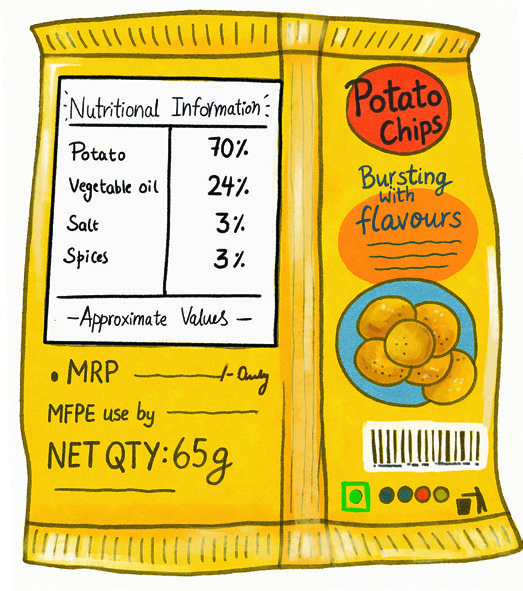
1.5 Question 12: The chips packet
Statement. A 65 g packet of chips lists potatoes 70%, vegetable oil 24%, salt 3% and spices 3%. Find the weight of each ingredient.
Answer. Potatoes 45.5 g, vegetable oil 15.6 g, salt 1.95 g, spices 1.95 g.
Steps.
- Potatoes = 70% of 65 = 0.7 × 65 = 45.5 g.
- Vegetable oil = 24% of 65 = 0.24 × 65 = 15.6 g.
- Salt = 3% of 65 = 0.03 × 65 = 1.95 g.
- Spices = 3% of 65 = 1.95 g.
- Check: 45.5 + 15.6 + 1.95 + 1.95 = 65 g, and the percentages add to 100%.
1.5 Question 13: Three shop deals
Statement. Three shops sell the same item at the same price. Shop A offers buy 1 get 1 free, Shop B offers buy 2 get 1 free, and Shop C offers buy 3 get 1 free. If one item is priced at ₹100, work out what a single item effectively costs at each shop, and rank the shops from cheapest to costliest. Also find each shop's percentage discount. Which shop gives the best deal if you need 4 items?
Answer. (i) Shop A ₹50 per item, Shop B ₹66.67, Shop C ₹75. Cheapest to costliest: A, B, C. (ii) A 50%, B 33.33%, C 25%. (iii) Shop A: ₹200 for 4 items.
Steps.
- Shop A: pay for 1, get 2, so ₹100 for 2 items gives ₹50 each.
- Shop B: pay for 2, get 3, so ₹200 for 3 items gives ₹66.67 each.
- Shop C: pay for 3, get 4, so ₹300 for 4 items gives ₹75 each.
- The discount is the share of free items: A gives 1 free out of 2 = 50%, B gives 1 out of 3 = 33.33%, C gives 1 out of 4 = 25%.
- For 4 items, Shop A needs two "buy 1 get 1" deals, paying ₹200. Shop B can buy 2 get 1 free plus one more at full price, which is ₹300. Shop C pays ₹300 for 4 items. So Shop A is cheapest.
1.5 Question 14: Left-handed people
Statement. A room holds 100 people, and 99 of them write with the left hand. What number of left-handers must leave the room so that their share falls to 98%?
Answer. 50 left-handed people must leave.
Steps.
- At the start there are 99 left-handed people and 1 right-handed person.
- Only left-handed people leave, so the right-handed person stays. After the exits, 98% are left-handed, so 2% are right-handed.
- If 1 person is 2% of the room, the room has 1/0.02 = 50 people.
- So 100 - 50 = 50 people leave, and all of them are left-handed.
- Check: 49 left-handed out of 50 is 98%.
1.5 Question 15: The computer ability graph
Statement. A bar graph shows the ability to use computers by age group and gender in 2023. Female percentages are Children 4%, Teenage 24%, Twenties 26%, Thirties 14%, Forties 7%, Fifties 4% and Seniors 2%. Male percentages are Children 4%, Teenage 29%, Twenties 37%, Thirties 25%, Forties 14%, Fifties 9% and Seniors 4%. Which claims are valid? The claims are: (a) the twenties group is the most computer literate; (b) across age groups, women do worse than men; (c) teenagers are fewer in number than people in their twenties; (d) over a quarter of thirty-somethings use computers; (e) under a tenth of people aged 60 and above use computers; (f) half of the twenties group uses computers.
Answer. (a), (b) and (e) are valid.
Steps.
- (a) The twenties bars, 26% for women and 37% for men, are the tallest pair, so this claim is true.
- (b) In every age group the female bar is shorter than the male bar, so this is true.
- (c) The graph reports percentages, not counts, so it cannot tell us the size of each group. This claim is not supported.
- (d) In their thirties, 14% of women and 25% of men use computers. 25% is exactly one quarter and the women's figure is lower, so "over a quarter" is false.
- (e) For seniors the figures are 2% for women and 4% for men, both below 10%, so this claim holds.
- (f) Half means 50%. The twenties figures are 26% and 37%, both well below 50%, so this claim fails.