Methods and worked examples: Fractions in Disguise
Fractions in Disguise18 min readLesson 2 of 7
2.1 Comparing proportions
When two wholes are different, raw parts cannot be compared. Eesha scored 42 out of 50 in English and 70 out of 80 in Science. She lost fewer marks in English, but that does not settle it, because the papers had different maximum marks. Converting both to percentages puts them on one scale:
- Science: 70/80 × 100 = 87.5%
- English: 42/50 × 100 = 84%
The Science score is higher, so Eesha did better in Science.
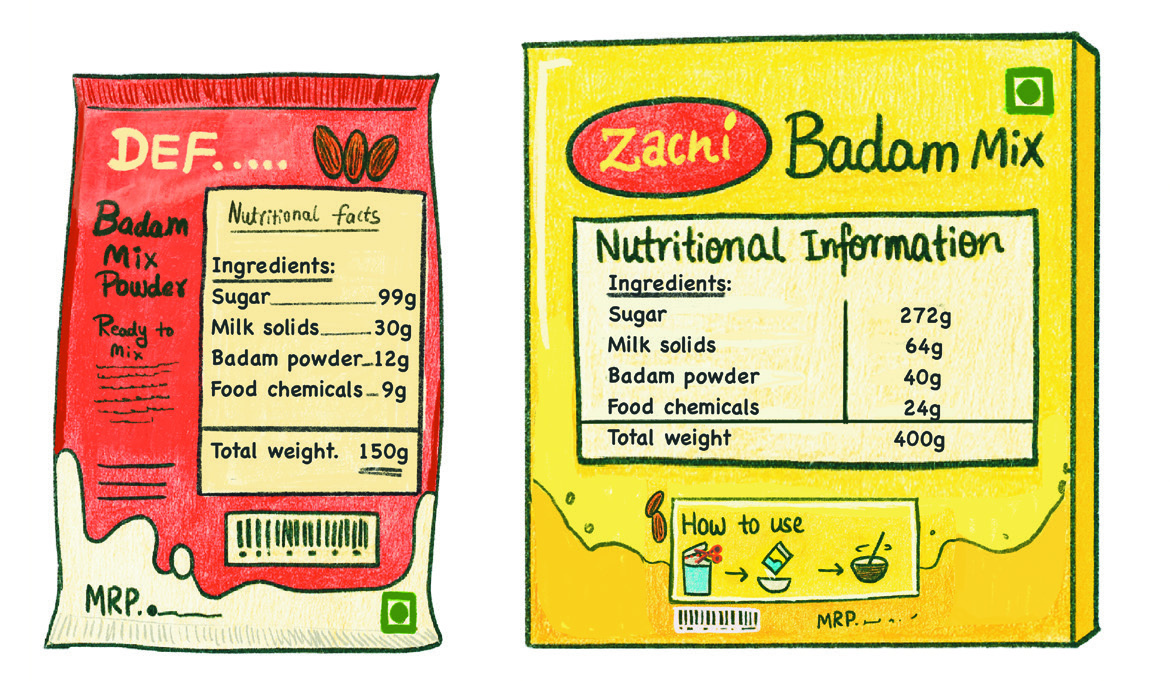
The same idea works on food labels. Two badam drink mixes, DEF and Zacni, list ingredients in grams, and the shares become comparable only after each weight is converted to a percentage of the pack. A 150 g DEF pack with 99 g of sugar works out to 66%, and checking that the shares add to 100 catches slips.
2.2 Percentage increase and percentage decrease
A change is always measured against the starting value, also called the base.
Percentage increase = (amount of increase / original amount) × 100. Percentage decrease = (amount of decrease / original amount) × 100.
If the price of 1 kg of tomatoes was ₹30 three years ago and is ₹42 now, the increase is ₹12, so the percentage increase is 12/30 × 100 = 40%. If a theatre's average footfall fell from 160 to 100, the decrease is 60, so the percentage decrease is 60/160 × 100 = 37.5%.
The statements "the 1991 population is 165% of the 1961 population" and "the population grew by 65% between 1961 and 1991" describe one situation. With p as the 1961 figure, the second gives q = p + 0.65p = 1.65p, which is exactly the first.
2.3 Cost price, marked price and selling price
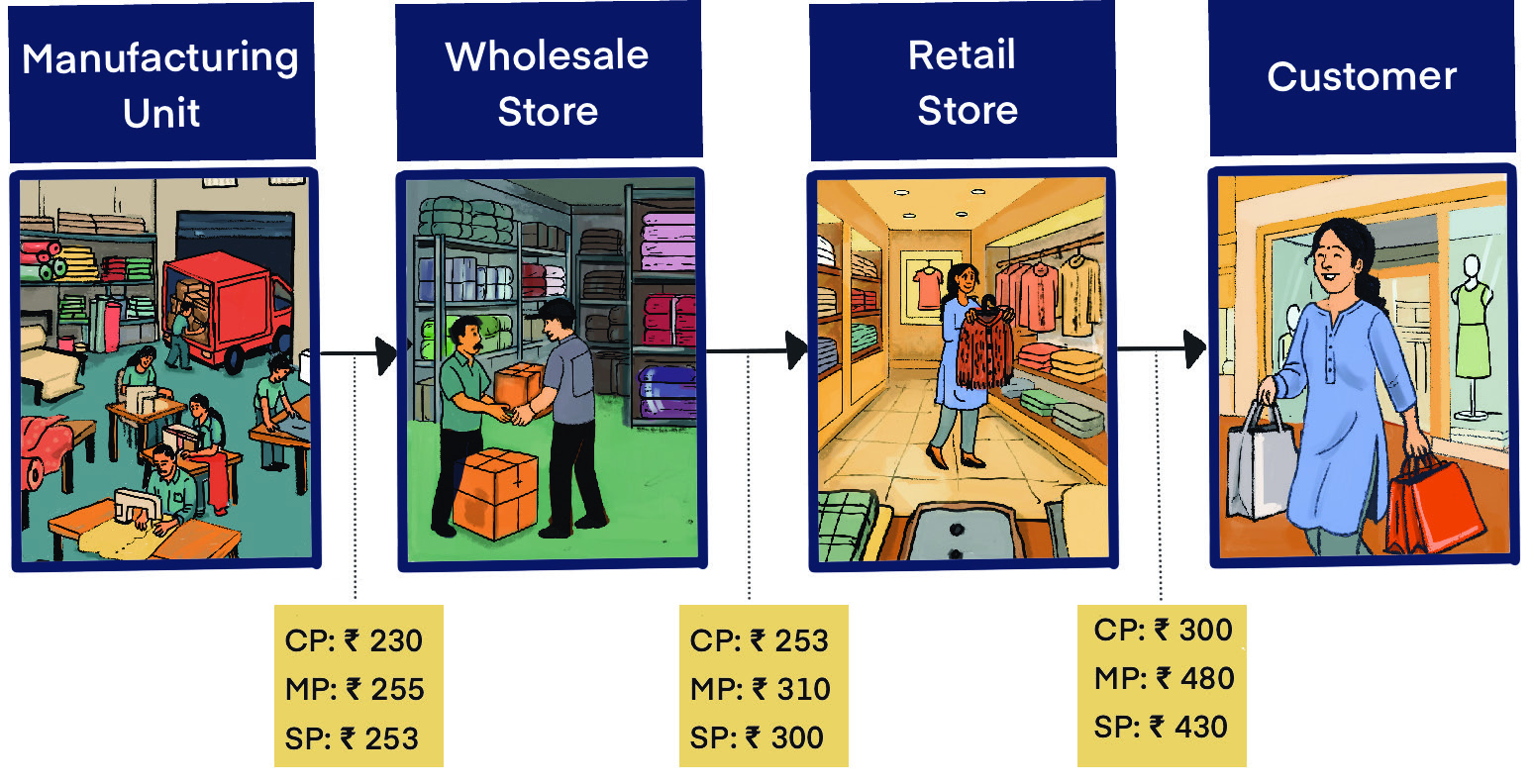
The price a shopkeeper pays for an item is the cost price (CP). The price printed or quoted to customers is the marked price (MP). The price actually paid after bargaining or a discount is the selling price (SP). If SP is larger than CP the difference is profit; if SP is smaller the difference is loss. Profit is normally compared with the cost price, because that is the money the shopkeeper invested.
Kishanlal buys sweaters at ₹300 each, marks them at ₹480, and sells one at ₹430 after bargaining. Profit = ₹130. As a share of the cost, that is (130 / 300) × 100 = 43.3%.
Worked example 1 (a loss sale). Shyamala bought a decorative vase for ₹2650. It was slightly damaged, so she sold it at a loss of 18%. What did she get for it?
Step 1. The cost price is the base, 100%. A loss of 18% means the selling price is 82% of the cost. Step 2. 82% of 2650 = 0.82 × 2650 = 2173. Step 3. Check the other route: the loss is 18% of 2650 = 477, and 2650 - 477 = 2173. She received ₹2173.
Worked example 2 (discount and profit together). A utensil store offers 35% off a cooker marked at ₹1800. The store bought the cooker for ₹900. What is the selling price, and what is the profit percentage?
Step 1. A 35% discount means the customer pays 65% of the marked price: 0.65 × 1800 = 1170. Step 2. The profit is 1170 - 900 = 270. Step 3. Profit percentage on cost = 270/900 × 100 = 30%. The store sold at ₹1170, a 30% gain on cost.
2.4 Taxes
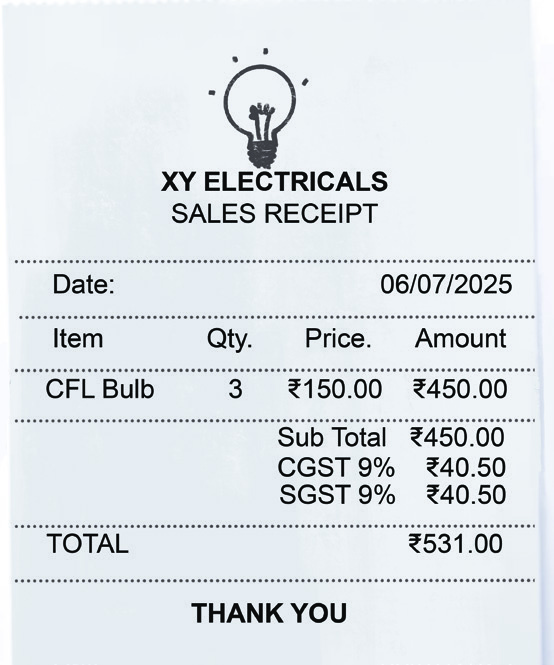
Tax rates such as GST and income tax are percentages. On a bill the tax is usually added to the price of the goods. The chapter's bill for three CFL bulbs has a subtotal of ₹450, CGST at 9% and SGST at 9%. Each tax is 9% of 450 = ₹40.50, so the total is 450 + 40.50 + 40.50 = ₹531, which matches the printed bill. Each percentage on the bill can therefore be checked directly.
2.5 Growth: simple interest and compound interest
Interest is quoted as a rate per annum (p.a.), meaning for each year. The deposit is the principal p and the decimal rate is r.
Without compounding, the interest is paid out each year and the principal never changes. In t years the interest is p × r × t, so the total is p(1 + rt).
With compounding, the interest is added back to the deposit, so the principal grows each year. After one year the amount is p(1 + r), after two years p(1 + r)², and after t years p(1 + r)ᵗ.
For ₹6000 at 10% p.a. over 3 years, the simple route gives 6000(1 + 0.1 × 3) = 6000 × 1.3 = ₹7800. The compound route gives 6000 × 1.1³ = 6000 × 1.331 = ₹7986.
Without compounding the amount is 130% of the deposit; with compounding it is 133.1%, and the extra 3.1% is interest earned on interest.
2.6 Decline: depreciation
Items such as vehicles and televisions lose value with use and age. This fall is called depreciation, and the calculation is a repeated percentage decrease. A television bought for ₹21000 loses 5% of its value in a year, so it is worth 21000 × 0.95 = ₹19950 after one year. A village whose population falls by 10% each decade shrinks by the multiplier 0.9 each decade, so after three decades the population is 1250 × 0.9³ = 1250 × 0.729 = 911.25, about 911 people.
2.7 Successive percentage changes
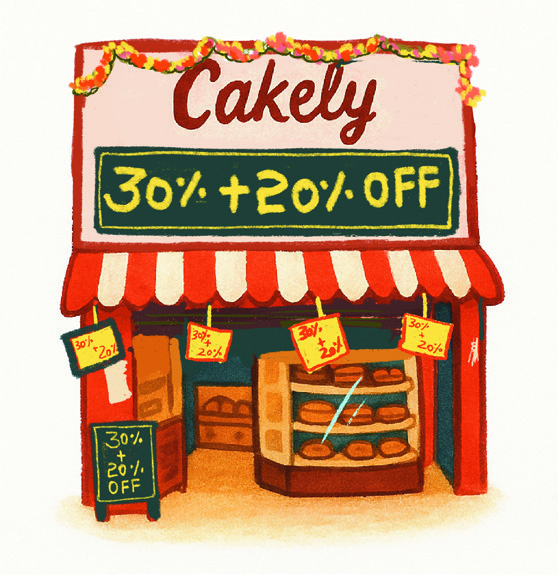
Percentages that are applied one after another do not add. Cakely offers 30% plus 20% off a cake that costs ₹200. After the first discount the price is 200 × 0.7 = ₹140. The second discount applies to ₹140, not to ₹200, so the price becomes 140 × 0.8 = ₹112. Cakify offers a single 50% discount, which gives ₹100. Cakify is cheaper.
The combined multiplier is 0.7 × 0.8 = 0.56, a total discount of 44%, not 50%. The same trap appears when a shop adds a 50% margin and then gives a 50% discount. If the cost is x, the marked price is 1.5x, and the discounted price is 0.5 × 1.5x = 0.75x, which is a 25% loss, not a break-even sale. To return to the cost price, the discount d must satisfy 1.5x(1 - d) = x, so d = 1/3 = 33.33%.