

Compounds and compounds versus mixtures
Nature of Matter: Elements, Compounds, and Mixtures15 min readLesson 3 of 5
3.1 Water is a compound
Hydrogen and oxygen in water are held together so tightly that they cannot be separated by physical methods. A substance formed when different elements combine chemically in a fixed ratio is called a compound. The properties of a compound are different from those of the elements that form it, and the compound is a new substance.
Water molecules contain two hydrogen atoms and one oxygen atom, so the ratio of hydrogen atoms to oxygen atoms is 2:1. This is why the gas volumes collected in the electrolysis activity appeared in a 2:1 ratio. The elements are joined chemically rather than simply mixed.
3.2 Salt and sugar are compounds too
Sodium is a soft metal and chlorine is a hazardous gas, yet the two combine to form sodium chloride, the harmless substance we use as common salt. Each sodium atom is paired with one chlorine atom, so the ratio is 1:1. Dissolved salt can be separated from water by evaporation, but the sodium and chlorine in the salt cannot be separated from each other by physical methods.
Sugar also turns out to be a compound. Heated gently in a boiling tube, sugar first turns brown and then chars to a black mass. Small droplets of water collect inside the tube, and charcoal (carbon) is left behind. The water cannot have come from the air because the tube was heated; it must have come from the sugar itself. Since water is a compound of hydrogen and oxygen, sugar must contain carbon, hydrogen and oxygen. Sugar is therefore a chemical compound, not an element.
3.3 The iron-and-sulfur experiment
Iron filings and sulfur powder are mixed to make Sample A. The sample is non-uniform: black iron and yellow sulfur particles can still be seen. A magnet brought near Sample A attracts the iron filings, so the two components can be separated. Adding dilute hydrochloric acid gives a colourless odourless gas that burns with a pop, because iron reacts with the acid to give iron chloride and hydrogen. The sulfur is left behind and does not react.
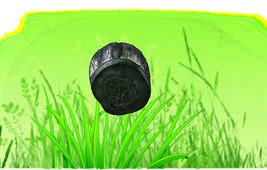
Sample A is then heated strongly in a china dish until a black mass forms. The cooled mass, labelled Sample B, is ground into a powder. Its colour and texture are uniform, a magnet has no effect on it, and adding acid now gives a colourless gas with a rotten-egg odour, hydrogen sulfide. The iron and sulfur in it can no longer be separated by a magnet or by other physical means.

Sample B is iron sulfide, a compound formed when iron and sulfur combined chemically. The properties of the compound are different from those of both elements, and the elements are present in a fixed ratio. Heating, not stirring or sieving, was needed because the change is chemical.
| Feature | Mixture (Sample A) | Compound (Sample B) |
|---|---|---|
| What it contains | Two or more substances, each keeping its properties | Different elements combined chemically |
| Ratio | Components may be present in any proportion | Elements combine in a fixed ratio |
| Separation | Can be separated by physical means such as a magnet | Elements cannot be separated by physical means |
| Properties | Those of the components remain visible | New properties appear |
| Example | Iron filings mixed with sulfur | Iron sulfide |
The reactions can be summarised in words: iron + sulfur gives iron sulfide; iron + dilute hydrochloric acid gives iron chloride + hydrogen; iron sulfide + dilute hydrochloric acid gives iron chloride + hydrogen sulfide.
3.4 Why compounds have a fixed composition
The ratio of the elements in a compound is fixed by the way the atoms join. In water the ratio of hydrogen atoms to oxygen atoms is 2:1, and in sodium chloride the ratio of sodium atoms to chlorine atoms is 1:1. A compound therefore has a definite composition by mass as well as by particle count, which is why its properties are predictable.
A mixture has no such fixed ratio. Iron and sulfur can be mixed in any proportion, and the mixture will still be a mixture. Heating changes this: once the elements combine, the product has the fixed composition of iron sulfide.
3.5 More familiar compounds
Carbon dioxide is a compound of carbon and oxygen, and magnesium oxide is a compound of magnesium and oxygen. Glucose and sugar are compounds of carbon, hydrogen and oxygen. In every case, the compound is a new substance: carbon dioxide does not behave like carbon or like oxygen, and magnesium oxide does not look like the shiny metal magnesium.
The properties of a compound can be very different from those of its elements. Sodium is a soft metal and chlorine is a poisonous gas, but sodium chloride is the harmless salt on the dining table. This contrast is one of the strongest arguments for treating a compound as a new substance rather than as a mixture.
3.6 Tests that distinguish a mixture from a compound
The iron-and-sulfur activity uses three tests. The appearance shows whether separate particles can be seen. The magnet test shows whether a magnetic component can be removed. The acid test shows whether the components react differently from the product. A mixture of iron and sulfur responds to the magnet and gives hydrogen with acid; the compound iron sulfide does neither.
Together the tests show that the mixture and the compound are different kinds of material. A single test might be misleading, but several independent observations point to the same conclusion.