

Mixtures all around us
Nature of Matter: Elements, Compounds, and Mixtures15 min readLesson 1 of 5
1.1 Matter everywhere
The stairs you climb, the drink you carry, the food in your lunch box, your clothes and shoes, the book you read, the trees outside and the ball you play with are all examples of matter. Matter is made of tiny particles. Most things around us contain more than one substance mixed together.
1.2 What makes a mixture
Poha and sprout salad look different, but both are made by mixing several ingredients. Sugar dissolved in water is a mixture, and so are soup and lemonade. Whenever two or more substances are combined and each keeps its own properties, the result is a mixture. The individual substances in it are its components, and they do not combine chemically; they only share the same space.
In a sprout salad the components, such as green gram, chickpeas, onion and tomato, are easy to see. A mixture like this, where the different parts can generally be seen with the naked eye or a magnifying device, is non-uniform. In sugar water, the sugar particles and water particles cannot be seen separately even under a microscope; the components are evenly distributed, so the mixture is uniform.
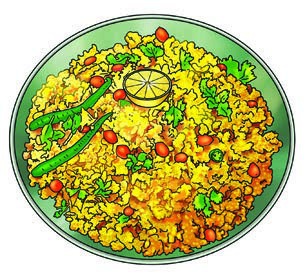
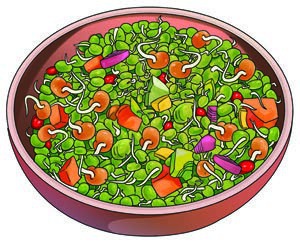
In science, the components of a mixture must themselves be pure substances. Everyday dishes such as poha and sprout salad are mixtures whose ingredients may themselves be mixtures. For a scientist, though, the starting substances in a mixture are elements or compounds, not other mixtures.
1.3 Air is a mixture
Air is a uniform mixture of nitrogen, oxygen, argon and carbon dioxide, with water vapour and traces of other gases. Nitrogen makes up about 78% of the air and does not take part in combustion. Oxygen supports life and combustion. Water vapour in warm air condenses into tiny droplets when it touches a cool surface.
The presence of carbon dioxide can be shown with lime water. Calcium oxide reacts with water to form calcium hydroxide, whose clear solution is lime water. When carbon dioxide from the air reacts with this solution, insoluble white particles of calcium carbonate are formed and the lime water turns milky.
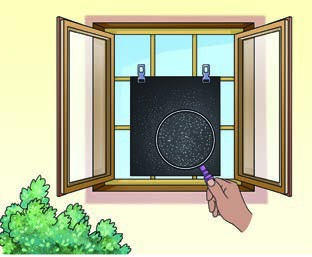
Dust particles also float in the air. When a clean black sheet is left near an open window for a few hours, tiny particles settle on it. These particles are not part of the air itself; they are pollutants. Particulate matter such as dust and soot, and gases such as sulfur dioxide, carbon monoxide, ozone and nitrogen dioxide, are major air pollutants, and the Air Quality Index is a tool used to describe air quality.
1.4 Alloys are uniform mixtures
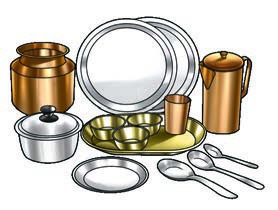
Stainless steel mixes iron with nickel, chromium and a little carbon, blended so evenly that the whole material looks the same throughout. Solid mixtures of this kind are called alloys. Brass mixes copper with zinc, while bronze mixes copper with tin. Old Indian works, including the Charaka Samhita and the Susruta Samhita, describe such alloys; bronze was called Kamsya and was traditionally made from four parts copper and one part tin for medicinal use.
| Type of mixture | Examples |
|---|---|
| Gas and gas | Air |
| Gas and liquid | Aerated water, oxygen dissolved in water |
| Solid and gas | Carbon particles in air |
| Liquid and liquid | Vinegar, oil and water |
| Solid and liquid | Sand and water, seawater |
| Solid and solid | Baking powder, alloys |
1.5 Separating a mixture
The components of a mixture can be separated by physical methods, and the choice of method depends on the difference between the components. Handpicking removes large visible pieces, sieving separates particles of different sizes, filtration traps an insoluble solid while a liquid passes through, and evaporation removes a liquid and leaves a dissolved solid behind. A magnet can separate iron from a mixture that contains it.
In everyday life, separation is often done to obtain one useful component and discard the rest. In science, the purpose is different: separating a mixture is a way to obtain pure substances. That is why the study of mixtures is closely tied to the study of elements and compounds.
1.6 More examples of mixtures
Lemonade is a mixture of water, sugar, lemon juice and flavourings, and it is uniform. Soup usually contains visible pieces of vegetables and is non-uniform. Soil is a mixture of mineral grains, humus, air and water, while milk contains water, fat, protein and other substances. Stainless steel looks like a single material but is a uniform mixture of several elements.
Classifying these examples by whether the components can be distinguished makes the idea of a mixture clearer than any single definition.
1.7 Why mixtures matter
Most of the materials we use are mixtures. Foods combine ingredients, the air we breathe combines gases, and construction materials such as concrete and steel combine substances chosen for their properties. A mixture can be designed by varying the components and their proportions, which is why material scientists work with mixtures as much as with pure substances.