

Concepts: Appendicular skeleton and joints
Locomotion and Movement26 min readLesson 4 of 7
4.1 The girdles
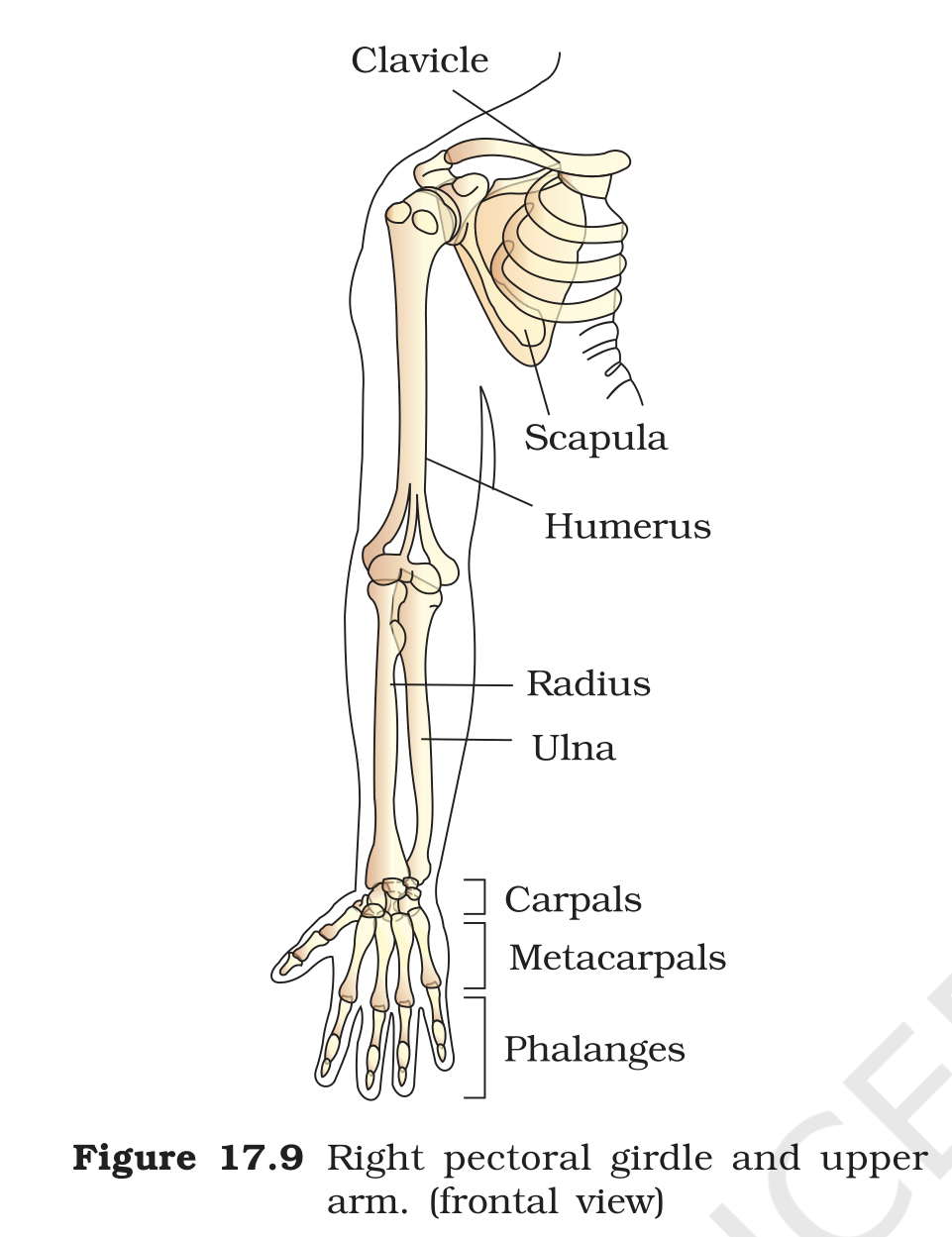
The appendicular skeleton hangs the limbs from the axial skeleton. The pectoral girdle, or shoulder girdle, attaches the upper limb to the thorax, and the pelvic girdle attaches the lower limb to the vertebral column. Each girdle is made of two halves.
Each side of the pectoral girdle has one clavicle and one scapula. The scapula is a flat bone, roughly triangular, that rests over the back of the rib cage. A raised ridge called the spine crosses its outer surface and ends in the flat expanded acromion. Below the acromion there is a depression, the glenoid cavity, and this cavity receives the head of the humerus and forms the shoulder joint. A slender bone with two curves, the clavicle, is the collar bone. It articulates with the sternum at its inner end and with the acromion at its outer end, so it holds the shoulder out from the chest.
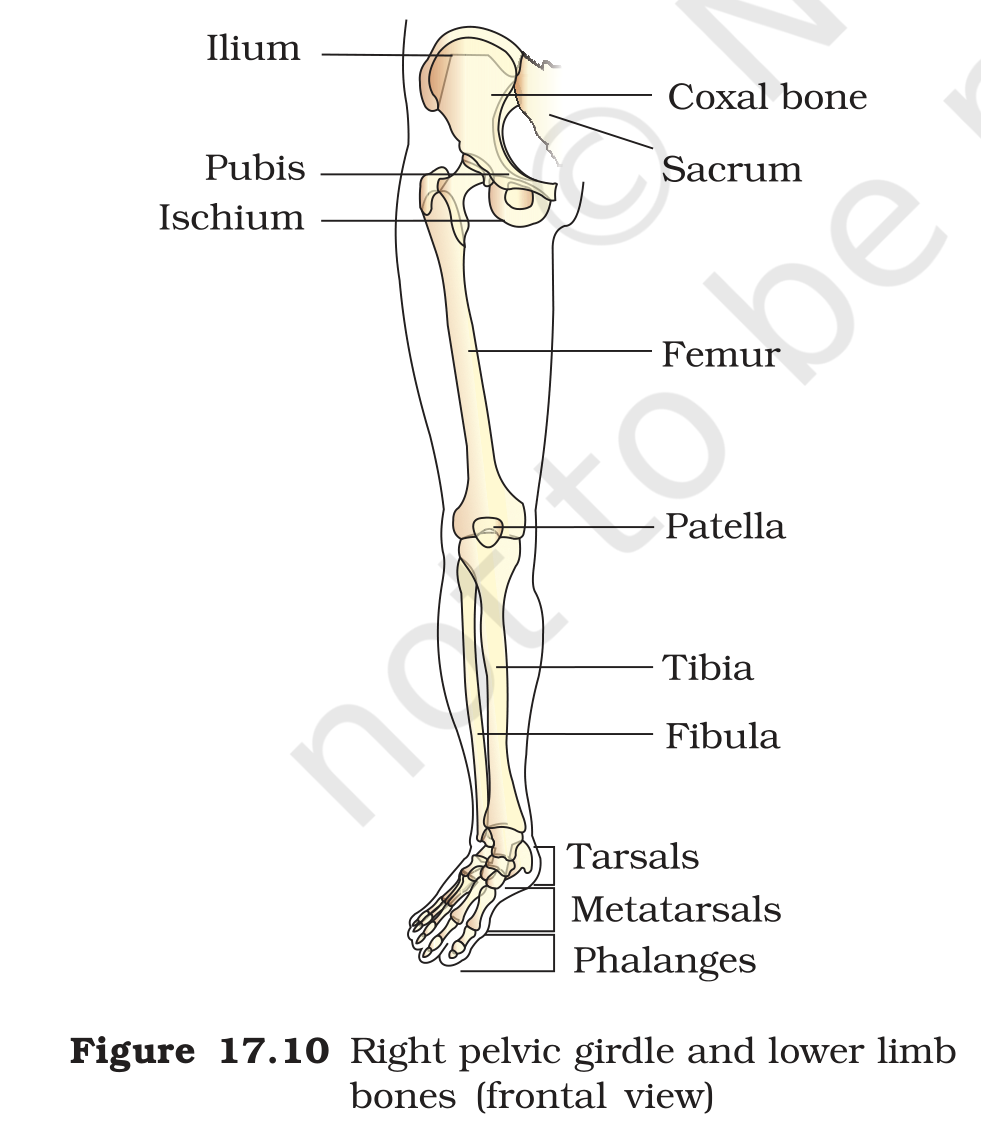
Two coxal bones make up the pelvic girdle, and each of them is a fusion of three bones, the ilium, the ischium and the pubis. At the point where the three meet there is a cavity called the acetabulum, and the head of the femur fits into it to make the hip joint. In front, the two halves are tied to each other at the pubic symphysis, a cartilaginous joint, and at the back each side is joined to the sacrum. The pelvic girdle carries the weight of the upper body and protects the organs of the lower abdomen.
4.2 The limbs
Each limb is made of 30 bones. The forelimb has the humerus in the upper arm, the radius and the ulna in the forearm, the carpals in the wrist, the metacarpals in the palm and the phalanges in the fingers. The numbers are fixed: 8 carpals, 5 metacarpals and 14 phalanges. The hindlimb has the femur in the thigh, the tibia and the fibula in the lower leg, the patella covering the knee ventrally, the tarsals in the ankle, the metatarsals in the foot and the phalanges in the toes. There are 7 tarsals, 5 metatarsals and 14 phalanges. The femur is the longest and strongest bone of the body.
4.3 Joints and their types
A joint is a point where two or more bones meet, and it decides how much and in which direction the bones can move. Joints are grouped by structure into three forms.
Fibrous joints join the bones with dense fibrous connective tissue, and they allow no movement. The sutures between the cranial bones are fibrous joints. Cartilaginous joints join the bones with cartilage and allow only a small amount of movement, as in the joint between the two pubic bones and between the vertebrae. Synovial joints have a fluid filled space, the synovial cavity, between the ends of the bones, and the fluid lubricates the surfaces so that they move without grinding. Most of the movable joints of the body are synovial.
The synovial joints are further divided by the kind of movement they allow. In a ball and socket joint a rounded head fits into a cup, and movement is possible in all planes; the shoulder joint between the humerus and the pectoral girdle and the hip joint between the femur and the acetabulum are of this kind. In a hinge joint the movement is in one plane only, like the opening and closing of a door; the knee joint and the elbow joint are hinge joints. In a pivot joint one bone turns about another, as the atlas turns around the axis at the top of the vertebral column. In a gliding joint the surfaces slide over one another, as between the carpals of the wrist. In a saddle joint the surfaces are shaped like a saddle and a rider, as between the carpal and the metacarpal of the thumb. Ligaments are the strong bands that join bone to bone at a joint, and tendons join muscle to bone, so the joint stays stable while the muscle pulls.
4.3.1 Mobility against stability
The two girdles show a trade-off that is easy to remember. The pectoral girdle is lightly built and loosely attached, so the shoulder can move through a wide range of positions; that freedom is bought at the cost of stability, which is why the shoulder is the joint most often dislocated. The pelvic girdle is heavy and firmly tied to the sacrum and to the other half, so the hip joint is deep and stable and it carries the weight of the body, but its range of movement is smaller. The same trade-off appears in the joints themselves: a ball and socket joint gives the greatest freedom, a hinge gives strength in one plane, and a suture gives almost no movement at all. A question that asks why a particular joint is so built is really asking which of these two needs the body has favoured at that site.
Exam
For the girdle comparison, write the bones, the cavity that receives the limb, and the joints formed: the pectoral girdle has the clavicle and scapula, its glenoid cavity receives the humerus, and its clavicle meets the sternum; the pelvic girdle has two coxal bones of ilium, ischium and pubis, its acetabulum receives the femur, and it meets the sacrum and the pubic symphysis. For joints, learn fibrous, cartilaginous and synovial first, then the five synovial types with one example each.
Common mistake
Do not mix up the glenoid cavity and the acetabulum: the glenoid holds the humerus and the acetabulum holds the femur. Do not say the knee is a ball and socket joint, because it is a hinge. Do not confuse ligaments with tendons. Also do not call the pubic symphysis a synovial joint, since it is cartilaginous and allows only a little movement.