

Concepts: The skeleton and the axial skeleton
Locomotion and Movement26 min readLesson 3 of 7
3.1 The framework of the body
The human skeleton is made of 206 bones and a few cartilages. It gives the body its shape, supports it against gravity, protects the internal organs, provides surfaces to which the muscles attach, and stores calcium and phosphate. The skeleton is divided into two principal parts, the axial and the appendicular skeleton.
The axial skeleton lies along the central axis of the body and has 80 bones. It includes the skull, the vertebral column, the sternum and the ribs. The appendicular skeleton has 126 bones and includes the girdles and the limbs. This division matters in the examination because every bone must be placed in one of the two groups, and because the numbers of the two groups add up to the total.
3.2 The skull
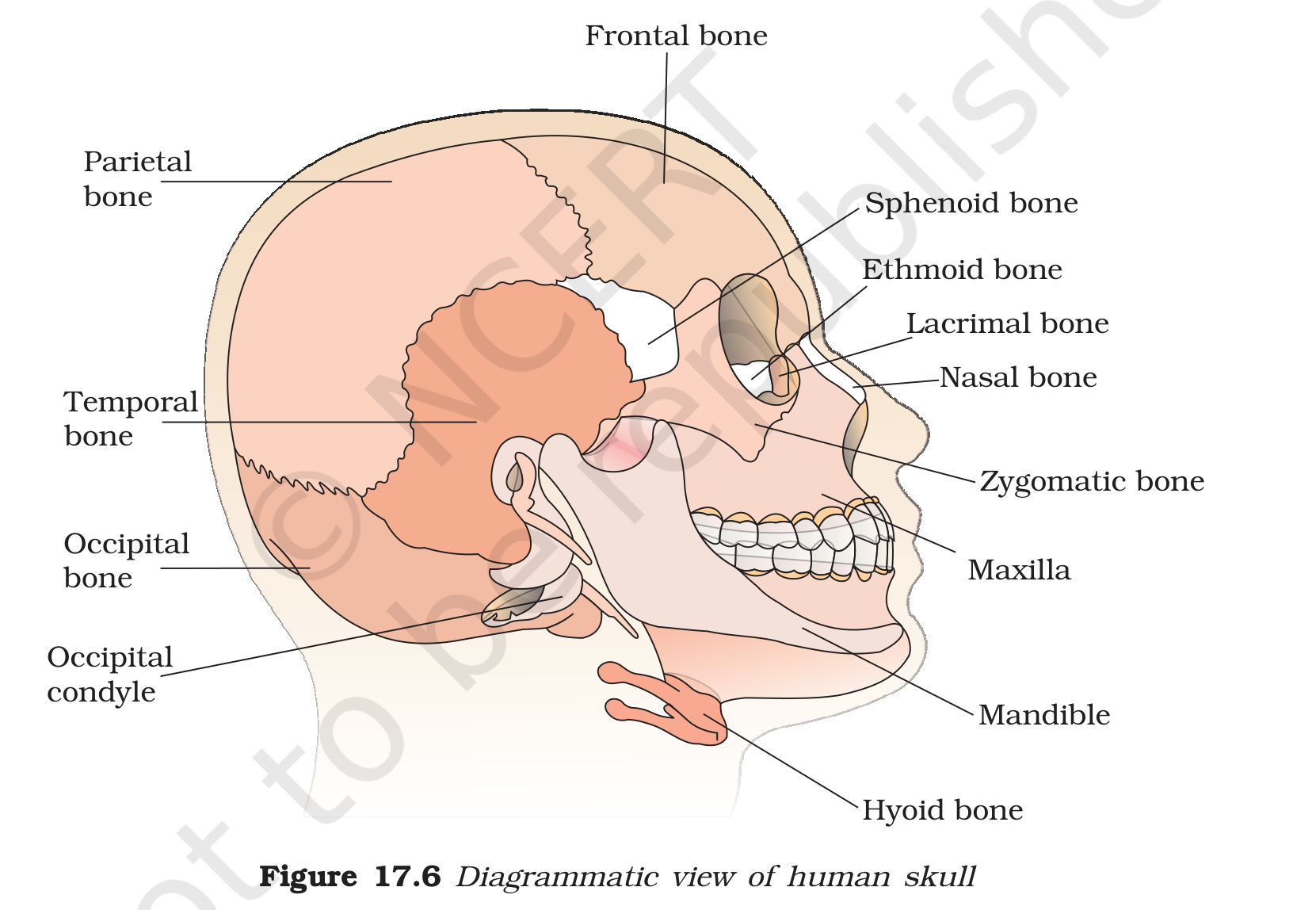
The skull is made of two sets of bones, the cranial and the facial, that together add up to 22 bones. The cranial bones form the box that surrounds the brain, and the facial bones build the face and guard the openings of the sense organs. The bones of the cranium are joined to one another by fibrous connective tissue in the form of sutures, so the skull forms a strong, almost rigid case with only a few small gaps for nerves and vessels. A single U shaped bone, the hyoid, lies in the neck below the skull, and it supports the tongue and helps in the movements of swallowing.
3.3 The vertebral column
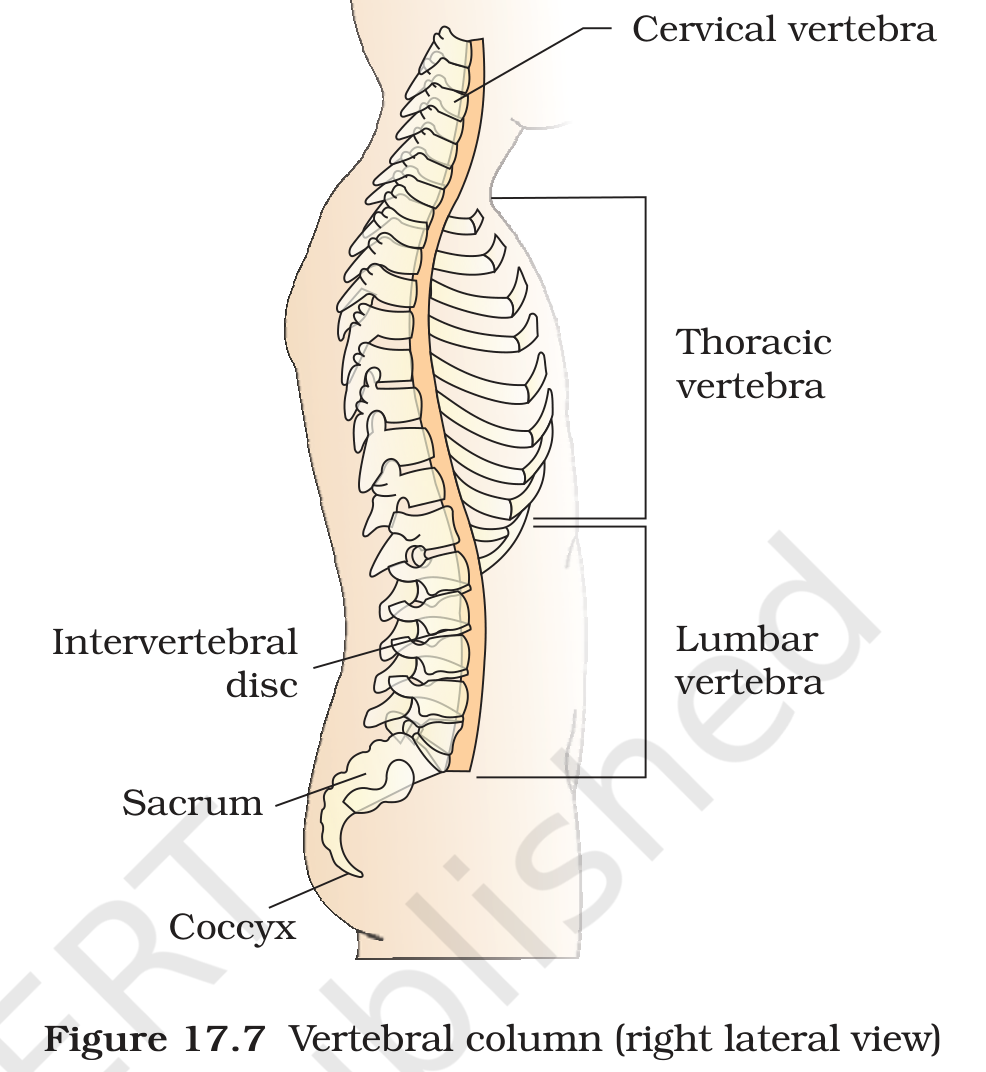
The vertebral column forms the central axis of the body and protects the spinal cord. It is made of serially arranged bones called vertebrae, and the number of each kind is fixed: 7 cervical, 12 thoracic, 5 lumbar, one sacral group in which the vertebrae are fused, and one coccygeal group in which the vertebrae are also fused. The total in an adult is usually quoted as 26 because the sacral and the coccygeal units are counted as single bones.
The column has four curves when seen from the side: a cervical curve, a thoracic curve, a lumbar curve and a sacral curve. These curves make the column stronger and act as a spring that absorbs shocks during walking and running. Between two adjacent vertebrae there is a disc of cartilage, the intervertebral disc, which cushions the bones, allows a limited rocking movement, and prevents them from rubbing against each other. The discs become thinner with age, which is one reason old people become shorter.
3.4 The rib cage
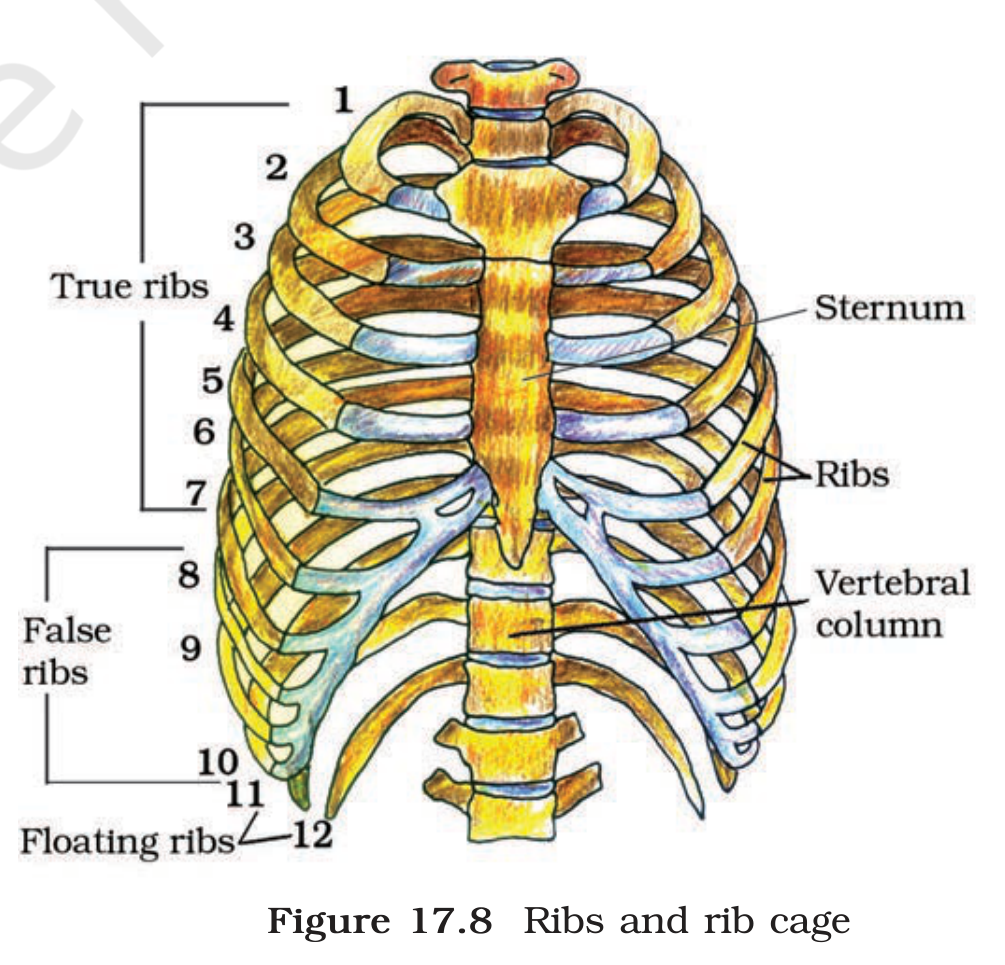
The rib cage guards the heart, lungs and other thoracic organs, and it takes part in breathing as well, since the ribs follow the respiratory muscles. Twelve pairs of ribs make up the cage. Every rib is a thin flat curved bone, joined at its rear end to a thoracic vertebra. The first seven pairs attach directly to the sternum and are called true ribs. The next three pairs, 8, 9 and 10, do not reach the sternum directly; they join the cartilage of the rib above them, and they are called false ribs. The last two pairs, 11 and 12, are attached only to the vertebrae and lie free at their front ends, so they are called floating ribs. The sternum, or breast bone, lies on the ventral side of the body in the middle of the chest and forms the front wall of the rib cage.
3.4.1 Why the axial bones are counted as one group
The axial bones share one job: they build the central frame of the body and protect the nervous system and the organs of the thorax. The skull protects the brain, the vertebral column protects the spinal cord, and the rib cage protects the heart and lungs. Because these bones lie along the axis, they move little relative to one another and they give the body its stable central support. The appendicular bones, by contrast, are built for movement, and they hang from the axial frame through the girdles. Keeping this functional split in mind makes the two lists of bones easier to remember than learning the names in a single long sequence.
3.4.2 Numbers that add up
The counts in this section are worth checking against each other. The skull contributes 22 bones and the hyoid adds one more bone of the head and neck region. The vertebral column contributes 26 units in the adult, and the rib cage contributes 12 pairs of ribs along with the sternum. Adding these gives the axial total of 80, and the rest of the skeleton, the girdles and the four limbs, makes up the appendicular total of 126. A learner who can rebuild the two totals from the regional counts will not be thrown by a question that asks for the number of bones in one region.
Exam
Keep three sums ready: 206 total bones, 80 axial and 126 appendicular; 22 skull bones from 8 cranial and 14 facial; and 26 units in the adult vertebral column with 7 cervical, 12 thoracic and 5 lumbar. For the ribs, write 12 pairs, 7 true, 3 false and 2 floating, and attach one function to the rib cage besides protection, namely its part in breathing.
Common mistake
Do not count the sacrum and the coccyx as many separate vertebrae when the question asks for the number of bones in the adult column, because they are fused. Do not say that all 12 pairs of ribs reach the sternum, since only the true ribs do. Do not call the sternum a dorsal bone; it lies on the ventral side. Also do not write that the vertebral column is straight, because its four curves are what make it strong.