

Concepts: Cell wall and the endomembrane system
Cell: The Unit of Life20 min readLesson 4 of 8
4.1 The cell wall
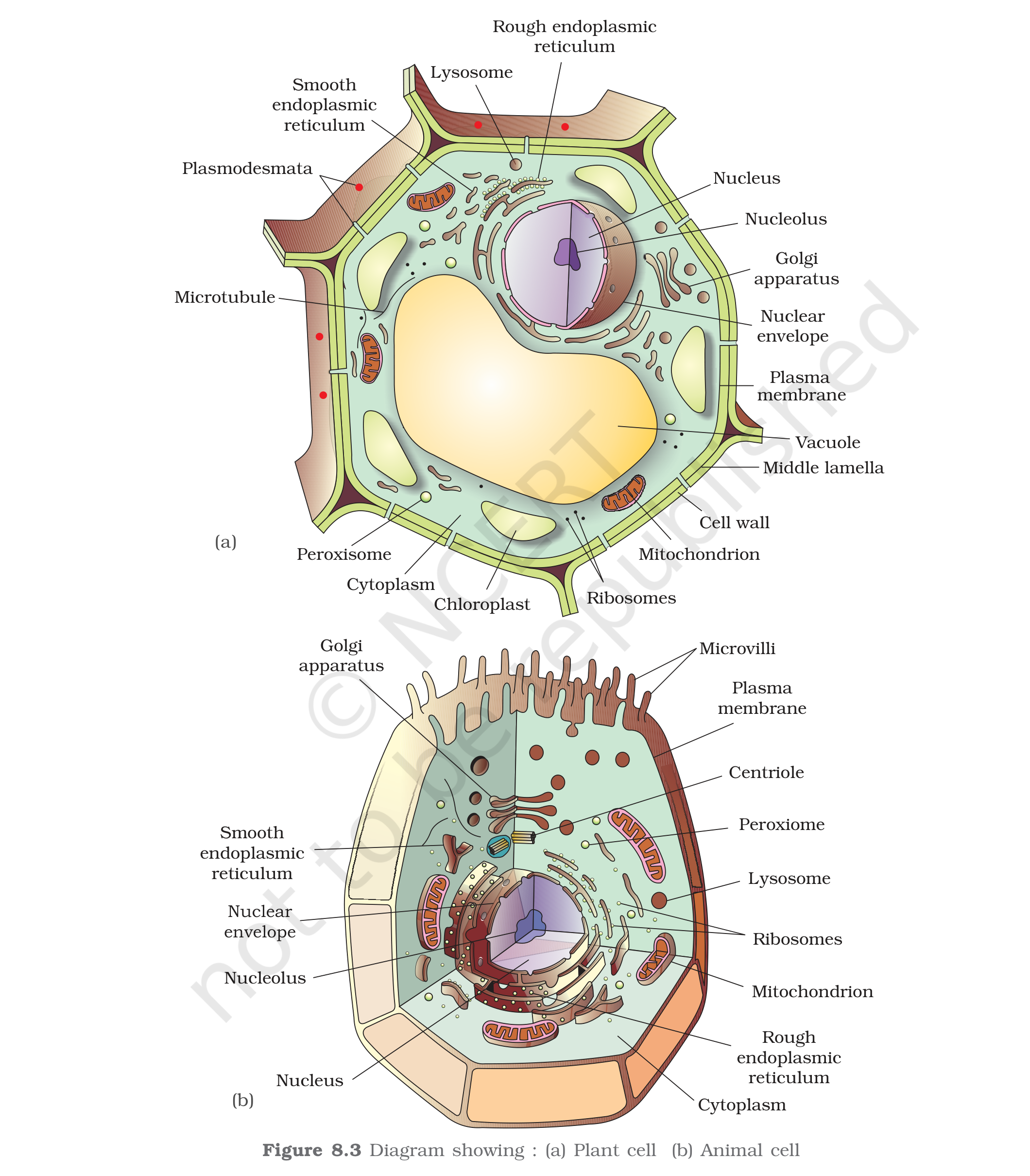
In plants and fungi a rigid non-living wall covers the plasma membrane from outside. Shape, mechanical protection, defence against infection, help in cell interaction and a barrier against unwanted macromolecules all come from it. Algal walls contain cellulose, galactans, mannans and minerals such as calcium carbonate, while other plant walls contain cellulose, hemicellulose, pectins and proteins.
A young cell has a primary wall that still grows; as maturity arrives growth slows and a secondary wall appears inside it, next to the membrane. Between neighbours lies the middle lamella, mostly calcium pectate, acting as glue. The wall and the middle lamella may be crossed by plasmodesmata, thin channels that connect the cytoplasm of neighbouring cells and let materials pass between them.
4.1.1 The endomembrane system
Several membranous organelles form one functional group, the endomembrane system, since their work is coordinated: endoplasmic reticulum, Golgi complex, lysosomes and vacuoles. Mitochondria, chloroplasts and peroxisomes are left out of the group because their functions are not coordinated with the rest in the same way. The grouping is functional, not a claim that these organelles are physically joined.
4.1.2 Endoplasmic reticulum
Electron microscopy shows a network of tiny tubular structures scattered through the cytoplasm, the endoplasmic reticulum. It divides the intracellular space into two compartments, the luminal space inside the ER and the extra-luminal cytoplasm outside. Ribosomes may sit on its outer surface. ER bearing ribosomes is rough endoplasmic reticulum, and ER without them is smooth. Cells busy with protein secretion carry plenty of rough ER, which joins the outer nuclear membrane. Lipid synthesis happens mainly on smooth ER, and steroid hormones of the lipid kind are made there in animal cells.
4.1.3 Golgi apparatus
Near the nucleus, Camillo Golgi saw heavily stained reticular bodies in 1898, and later they took his name. A Golgi body is a parallel stack of flat disc-like sacs, the cisternae, each 0.5 to 1.0 micrometre wide. A Golgi complex has a convex cis or forming face and a concave trans or maturing face, and the two faces are different but interconnected.
Packaging is the Golgi's chief work, sending material either to targets inside the cell or out of it. ER vesicles join the cis face, cargo travels to the trans face, and proteins made on the ER get modified while passing through the cisternae, then leave from the trans side. The Golgi is the main site for making glycoproteins and glycolipids.
4.1.4 Lysosomes and vacuoles
Lysosomes are membrane-bound vesicles formed by packaging in the Golgi apparatus. They are rich in hydrolytic enzymes such as lipases, proteases and carbohydrases, which work best at acidic pH and can digest carbohydrates, proteins, lipids and nucleic acids. They are the digestion and clean-up system of the cell.
A vacuole is a membrane-bound space in the cytoplasm, bound by a single membrane called the tonoplast. It holds water, sap, excretory products and other material not needed by the cell, and in plant cells it may occupy up to 90 per cent of the cell volume. In plants the tonoplast moves ions and other materials into the vacuole against their concentration gradients, so the sap is more concentrated than the cytoplasm. In Amoeba a contractile vacuole carries out osmoregulation and excretion, and in many protists food vacuoles form by engulfing food particles.
4.1.5 One pathway, from gene to outside
The endomembrane system can be followed as one continuous route. A protein is made on a ribosome attached to the rough ER and enters the ER lumen. From there a vesicle carries it to the cis face of the Golgi apparatus. Inside the cisternae the protein is modified, often by the addition of sugar chains, and then leaves from the trans face in a vesicle. That vesicle may fuse with the plasma membrane and release the protein outside, or it may become a lysosome. A plant cell may send the material into the vacuole instead. Following this route explains why rough ER, Golgi, lysosomes and vacuoles are grouped together: each one passes material to the next, and a defect at any step blocks the ones after it. The cis and trans faces of the Golgi are different in structure and in function, and that difference is what makes the organelle directional rather than a simple bag. The packaging role also explains why the Golgi sits near the ER and near the nucleus in a secretory cell. Storage and secretion both depend on this directionality.
Exam
The endomembrane system is best answered as a chain: ER makes and transports, Golgi modifies and packages, lysosomes digest and vacuoles store. Each organelle gets one line for its structure and one for its job, and the answer names the four members and the three organelles that stay outside the group.
Common mistake
Do not put mitochondria or chloroplasts in the endomembrane system, because the chapter keeps them out. Do not say the cell wall is living, since it is a non-living secretion. And do not write that lysosomes are formed by the ER directly: their enzymes are packaged in the Golgi apparatus.