

Concepts: The plasma membrane and transport
Cell: The Unit of Life18 min readLesson 3 of 8
3.1 The membrane and its model
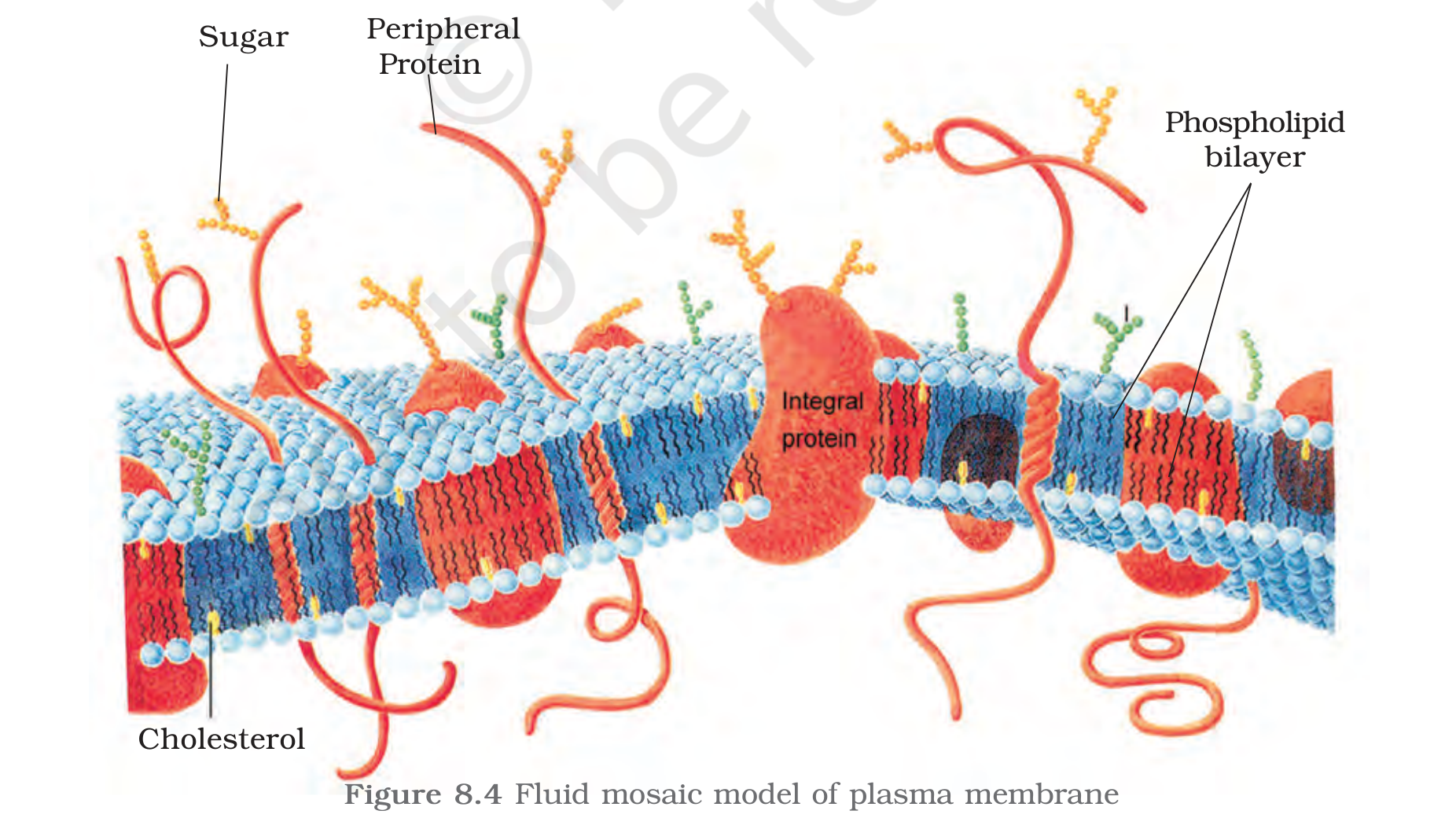
The detailed structure of the plasma membrane became visible only after the electron microscope arrived in the 1950s. Chemical studies on human red blood cells showed that the membrane is mainly lipids and proteins. The lipids are mostly phospholipids arranged as a bilayer, with the polar heads facing the outer sides and the hydrophobic tails facing the inside, so that the nonpolar tails are protected from the surrounding water. Cholesterol is also present. Biochemical work showed that proteins and carbohydrates are part of the membrane too, and the ratio of protein to lipid varies with the cell type: in the human erythrocyte membrane, protein is about 52 per cent and lipid about 40 per cent.
Membrane proteins are classified by how easily they can be extracted. Peripheral proteins sit on the surface, while integral proteins are partly or wholly buried in the membrane. Singer and Nicolson proposed the fluid mosaic model in 1972, and it remains the accepted picture. In this model the quasi-fluid lipid lets proteins move sideways within the bilayer, and that ability to move is measured as the fluidity of the membrane. Fluidity matters for cell growth, the making of intercellular junctions, secretion, endocytosis and cell division. The mosaic word refers to the protein molecules scattered through the lipid sea, and the fluid word refers to their lateral movement.
3.1.1 Transport across the membrane
The membrane is selectively permeable: some molecules cross easily and others do not. Passive transport needs no energy. A neutral solute may cross by simple diffusion along its concentration gradient, from where it is more concentrated to where it is less concentrated. Water follows the same rule, and water diffusion over a membrane takes the name osmosis. Because polar molecules meet a nonpolar bilayer, they cannot cross unaided; a carrier protein must help, and that route is facilitated transport.
A few ions or molecules are moved against their concentration gradient, from lower to higher concentration. That work needs energy, and the cell spends ATP to do it; this is active transport. The sodium-potassium pump is the standard example, because it moves sodium and potassium ions against their gradients and keeps the ionic balance of the cell. A membrane that could do all this by simple diffusion would lose selectivity, so the three routes together give the cell both speed and control.
3.1.2 Why the membrane matters
Every exchange between a cell and its surroundings passes through the plasma membrane, so the membrane is the cell's gatekeeper. Its lipid bilayer blocks free movement of polar and charged molecules, and its proteins decide which molecules get help. Because the lipid is fluid, proteins can cluster where they are needed and vesicles can pinch off or fuse without tearing the sheet. A cell that loses membrane integrity loses its internal order, which is why the membrane is treated as a living boundary and not as a passive bag. The same design appears in the internal membranes of organelles, so the plasma membrane is also the model for understanding the endomembrane system in the pages that follow.
3.1.3 Transport in the life of a cell
Transport is not an abstract list; it is how a cell feeds itself. A root hair cell takes in water and mineral ions from the soil, and the ions must be moved against their concentration gradient, which is active transport. An intestinal cell takes up glucose and amino acids after digestion, and those molecules need carrier proteins because they are polar. A kidney tubule cell reabsorbs useful material and lets waste pass out. In each case the membrane chooses which molecules cross, how fast they cross and in which direction. Without that choice a cell would either lose its contents to the surroundings or fill up with material it does not need, so the three transport routes together are as important as the membrane itself.
3.1.4 A summary table for the membrane
| Feature | What the model says |
|---|---|
| Main lipid | phospholipid bilayer |
| Heads and tails | polar heads out, hydrophobic tails in |
| Other lipid | cholesterol |
| Proteins | integral and peripheral |
| Movement | lateral movement of proteins, measured as fluidity |
| Transport | passive, osmosis, facilitated, active |
A one-mark question often asks for the model by name, a two-mark question asks the components, and a three-mark question asks why the membrane is called fluid and mosaic. The table covers all three. Water moves by osmosis until the solute concentrations on the two sides balance, and a cell that cannot control that movement either swells or shrinks, so the membrane and its transport proteins together keep the cell steady. The three routes are not alternatives but layers of control: a cell uses each one where it fits.
Exam
For the membrane, learn the model name and its authors, the bilayer with polar heads out and tails in, cholesterol and protein as the other components, and the two protein classes. Then add the three transport routes with one example each. The fluid mosaic answer is worth full marks when it has the picture, the components and the reason for the word fluid.
Common mistake
Do not say the membrane is rigid, because the fluid mosaic name marks its lateral movement. Do not say active transport goes down the concentration gradient, since it goes against the gradient and needs ATP. And do not write that water needs a carrier protein for ordinary osmosis, because water moves by diffusion.