

Concepts: What is a cell and the cell theory
Cell: The Unit of Life20 min readLesson 1 of 8
1.1 The basic unit of life
Some living things are a single cell and others are many cells, but every organism is built of cells. A unicellular organism carries out all its life functions inside one cell, so a cell is the smallest structure that can live independently. That is what makes the cell the structural and functional unit of life: it is both the brick of the body and the smallest working machine in it. The first person to see and describe a living cell was Antonie van Leeuwenhoek, working with his simple microscopes. Robert Brown later found the nucleus inside plant cells. The light microscope, and then the electron microscope, revealed the internal details that a chapter on cell structure depends on.
1.1.1 How the cell theory was built
In 1838 Matthias Schleiden, a German botanist, examined many plants and concluded that plant tissues are made of different kinds of cells. At the same time Theodore Schwann, a German zoologist, studied animal cells and described a thin outer layer that we now call the plasma membrane. Plant work convinced him that a wall is a plant-cell character. He then argued that animal and plant bodies consist of cells together with what cells produce.
Schleiden and Schwann together gave the cell theory, but their theory could not explain how new cells arise. Rudolf Virchow supplied that part in 1855. He showed that cells divide and that new cells come from cells that already exist, the rule written as Omnis cellula-e cellula. With his addition the cell theory reached the form we use today: all living organisms are made of cells and the products of cells, and all cells arise from pre-existing cells. Modern understanding adds a third point, that the cell is the basic unit of structure and function in all organisms, and energy flow and heredity both run through cells.
1.1.2 Looking at a cell
The onion peel cell is a typical plant cell: a firm cell wall forms the outer boundary and the cell membrane lies just inside it. A human cheek cell has a membrane as its outer boundary but no wall. Inside both kinds of cell is a nucleus, a dense body enclosed in a membrane, and the nucleus holds chromosomes, which hold the genetic material DNA. Cells with a membrane-bound nucleus are eukaryotic, and cells without one are prokaryotic. Both kinds have cytoplasm, the semi-fluid matrix in which the chemical reactions of the cell take place.
Membrane-bound structures, or organelles, appear in the eukaryotic cell: ER, Golgi complex, lysosomes, mitochondria, microbodies and vacuoles. A prokaryote has none of these; the ribosome is the organelle it does have, and ribosomes carry no membrane. Ribosomes are not bound by a membrane and appear in all cells, free in the cytoplasm, on the rough endoplasmic reticulum, and inside chloroplasts and mitochondria. Animal cells carry one more non-membrane organelle, the centrosome, which helps in cell division.
1.1.3 Size and shape
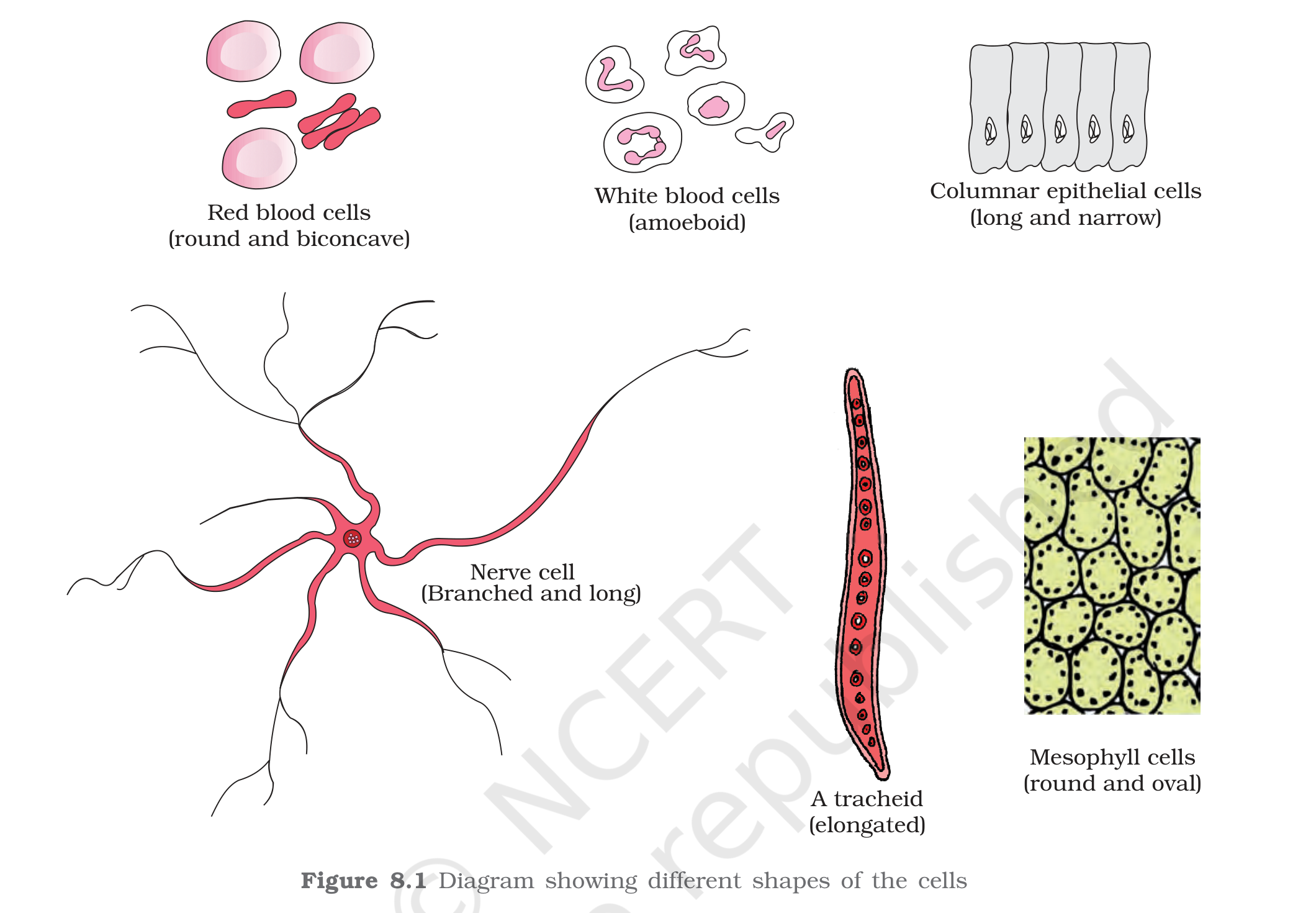
Cells differ enormously in size, shape and activity, and the shape usually suits the work. Mycoplasmas are the smallest cells, around 0.3 micrometre, while a bacterium can measure 3 to 5 micrometres. An ostrich egg is the largest isolated single cell on record. A human red cell measures about 7 micrometres, and nerve cells are among the longest cells known. Shapes range from disc-like and polygonal to columnar, cuboid, thread-like and irregular. Red cells are round and biconcave, muscle cells long and branched, columnar epithelial cells tall and narrow, and a tracheid elongated. The same basic plan serves all of them, and the variation shows how structure follows function at the level of a single cell.
1.1.4 Why cells stay small
A cell cannot grow without limit, because its surface grows more slowly than its volume. The plasma membrane brings in food and oxygen and sends out waste, and when the volume outruns the surface, exchange can no longer keep up with the needs of the interior. Small cells therefore exchange efficiently, and large organisms solve the problem by making many small cells instead of one big one. The same reasoning explains why a cell that specialises in absorption, such as a root hair cell or an intestinal lining cell, is long and thin: the shape adds surface without adding much volume. Mycoplasma sits at one end of the scale as the smallest cell, an ostrich egg at the other as the largest single cell, and both remain single cells because their exchange needs are met in different ways.
Exam
Cell theory answers are marked on three names and one rule. Schleiden and Schwann gave the first two points, Virchow added the third, and the Latin rule Omnis cellula-e cellula is the phrase an examiner looks for. Add the modern third point about the cell as the basic unit of structure and function and the answer is complete.
Common mistake
Do not write that Robert Brown discovered the cell, because Leeuwenhoek first saw a living cell and Brown found the nucleus. Do not say Schleiden and Schwann explained cell division, because that came from Virchow. And do not call prokaryotic cells acellular: they are cells without a membrane-bound nucleus, not cells without structure.