

Concepts: Nucleus and chromosomes
Cell: The Unit of Life20 min readLesson 6 of 8
6.1 The nucleus
Robert Brown described the nucleus as an organelle in 1831, and Flemming later named the material that stains with basic dyes chromatin. Look at a nucleus between divisions and three features show: stretched nucleoprotein fibres known as chromatin, a nuclear matrix, and one or more round nucleoli. Electron microscopy reveals an envelope of two parallel membranes separated by 10 to 50 nanometres, the perinuclear space. That envelope is the barrier between the nucleus and the cytoplasm. The outer membrane is usually continuous with the endoplasmic reticulum and carries ribosomes on it.
At many points the two membranes fuse to leave minute pores, and through them RNA and proteins travel both ways between nucleus and cytoplasm. One nucleus per cell is the usual case, though numbers vary, and some mature cells lose the nucleus altogether: the red blood cells of many mammals and the sieve tube cells of vascular plants are examples.
The nuclear matrix, or nucleoplasm, holds the nucleolus and chromatin. A nucleolus is a spherical body without a membrane, so its contents are continuous with the nucleoplasm. It is the site of active ribosomal RNA synthesis, and cells that make a lot of protein carry larger and more numerous nucleoli. The nucleus controls the activities of the organelles and plays the central role in heredity, because the genetic material sits inside it.
6.1.1 Chromosomes
During interphase the chromatin is a loose, indistinct network of nucleoprotein fibres. During cell division the chromatin condenses into structured chromosomes. DNA, histones, non-histone proteins and RNA make up chromatin. One human cell packs about two metres of DNA thread into 46 chromosomes, 23 pairs.
Every chromosome, visible only in dividing cells, has a primary constriction called the centromere, and on its sides sit disc-shaped structures called kinetochores. The centromere holds the two chromatids of a chromosome together. The position of the centromere divides chromosomes into four types. A metacentric chromosome has the centromere in the middle, making two equal arms. A sub-metacentric chromosome has the centromere slightly away from the middle, giving one shorter and one longer arm. When the centromere sits near an end, the result is an acrocentric chromosome with one very short and one very long arm; at the very end it becomes telocentric. Some chromosomes also show a secondary constriction at a constant place, and the small fragment beyond it is called a satellite; such chromosomes are called sat-chromosomes.
6.1.2 A note on the whole cell
A cell qualifies as the structural and functional unit of life because maintenance and reproduction both depend on machinery inside it. Prokaryotes do the same work without a nucleus or membrane-bound organelles, and eukaryotes divide that work among organelles. The compartmentalisation of the eukaryotic cell is what allows incompatible reactions to run in the same small space, and the nucleus keeps the instructions for all of it.
6.1.3 Nucleus and cytoplasm are not sealed off
The nuclear pores make the envelope a controlled doorway rather than a wall. Ribosomal RNA made in the nucleolus leaves through them, and proteins made in the cytoplasm that are needed in the nucleus come in through the same openings. That traffic explains why a cell that makes a lot of protein has a large nucleolus and many pores: the demand for ribosomes is high, so the nuclei of such cells are busy in both directions. The envelope also stays continuous with the endoplasmic reticulum, which ties the nucleus into the endomembrane system and lets the cell move material between the two compartments without crossing a membrane.
6.1.4 Number, size and constancy
The number of chromosomes is constant for a species, and that constancy is the physical basis of heredity. A human cell has 46, a pea plant has 14, and the number is restored at fertilisation when two gametes fuse. Chromosome size varies too, and the position of the centromere gives each chromosome a shape that can be recognised in a dividing cell. Karyotype work uses exactly these features, the number, the size and the centromere position, to identify a chromosome pair. The study of chromosomes therefore connects the cell chapter to heredity: the nucleus holds the instructions, the chromosomes carry them in a fixed number, and the cell division that follows distributes them equally. A chromosome that carries a satellite is called a sat-chromosome, and the secondary constriction that produces it lies at a constant place, which makes it useful in identifying particular chromosomes. The four chromosome shapes are easiest to remember as a series from middle to end: meta, sub-meta, acro and telo. A nucleus with many pores is a nucleus doing heavy traffic with the cytoplasm.
Slideshow, slide 1 of 3. Use the left and right arrow keys to change slides and the space bar to play or pause.
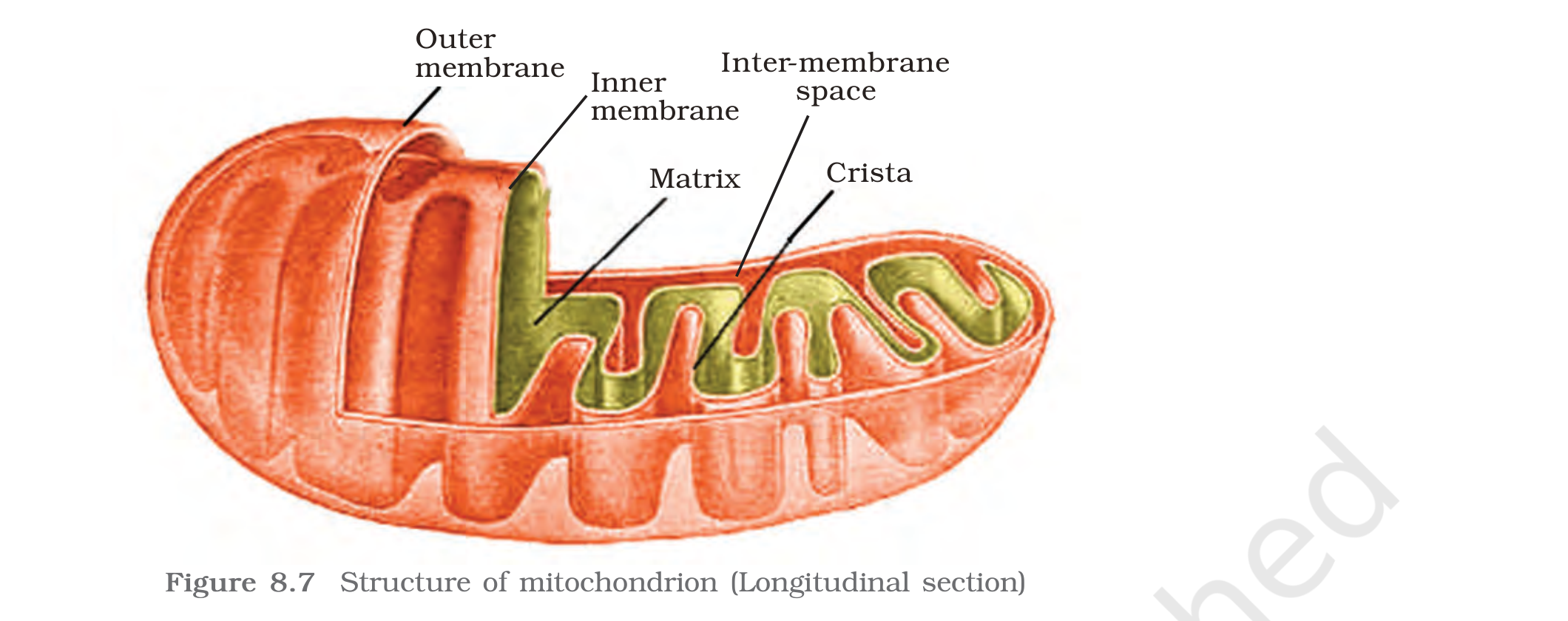
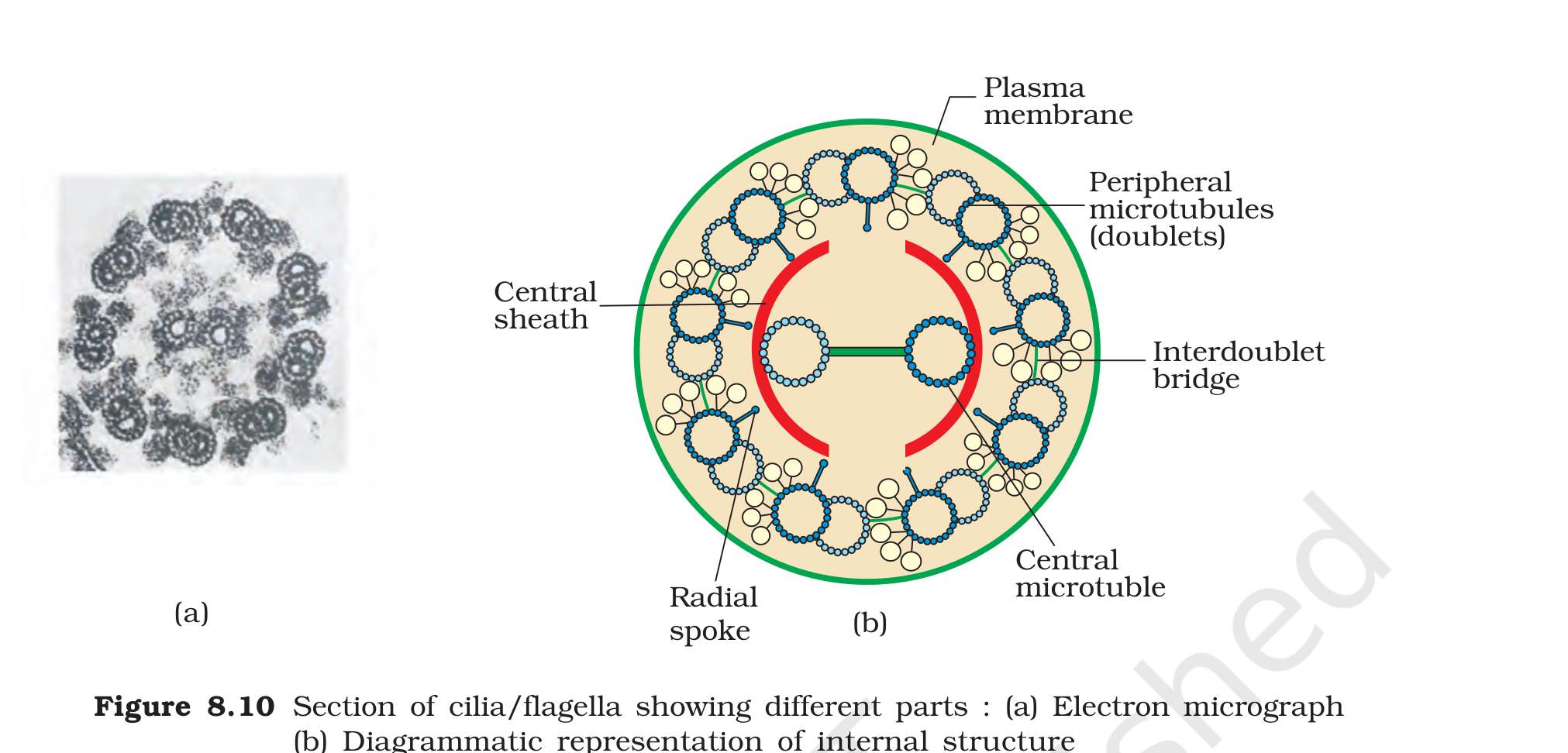
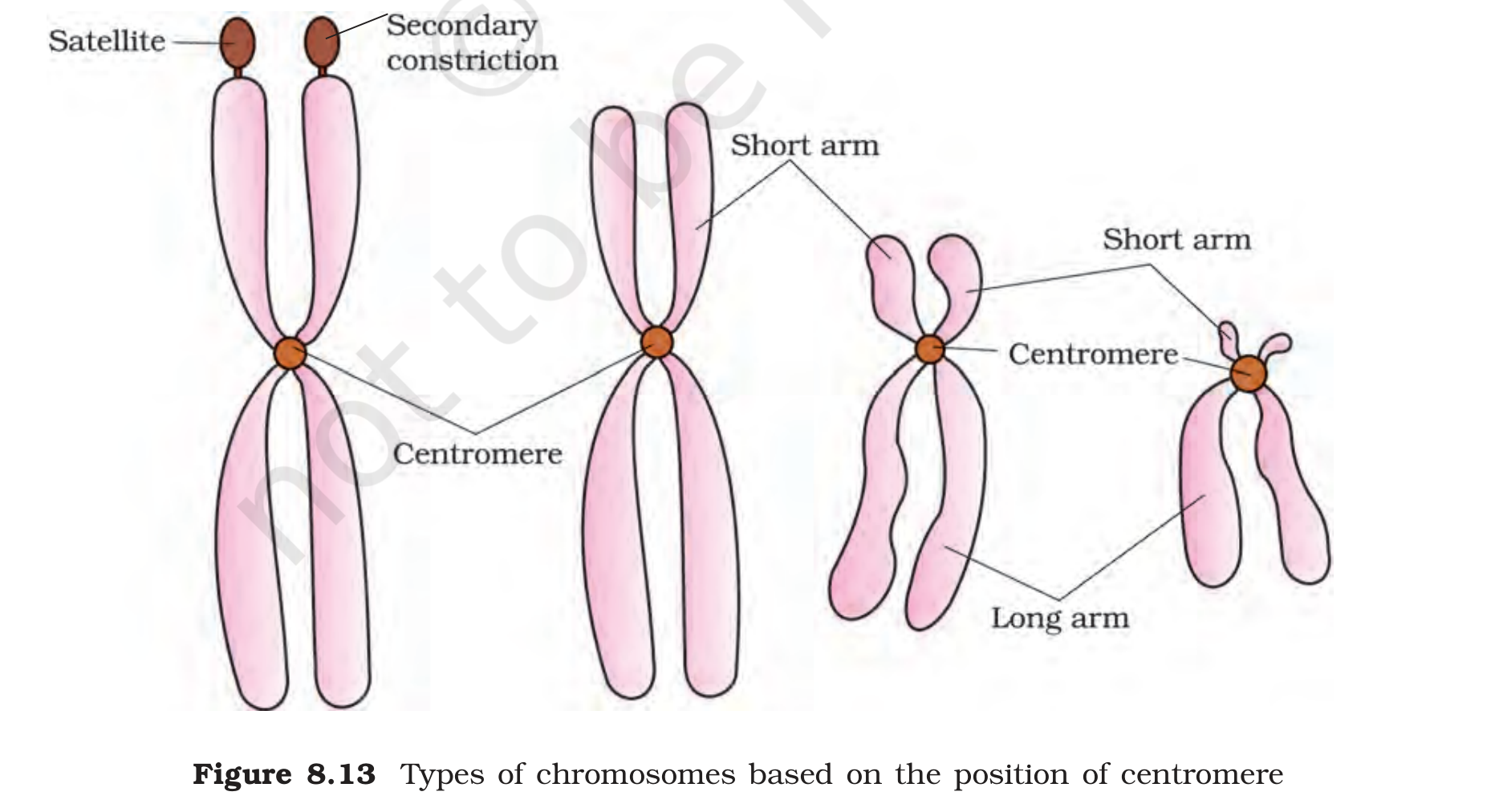
The NCERT longitudinal section of a mitochondrion, with the outer and inner membranes, cristae, matrix and intermembrane space labelled.
Exam
Chromosome questions are settled by one line each: metacentric has a middle centromere and equal arms, sub-metacentric has a slightly off-centre centromere, acrocentric has it near the end, telocentric has it at the end. For the nucleus, remember the double envelope, the perinuclear space, the pores and the nucleolus that makes ribosomal RNA.
Common mistake
Do not call the nucleolus a membrane-bound organelle, because it has no membrane. Do not say the centromere holds the two chromatids at the kinetochore instead: the centromere holds them and the kinetochores sit on its sides. And do not forget that chromosomes are visible as separate structures only in dividing cells.