

Concepts: Kingdom Fungi
Biological Classification20 min readLesson 3 of 6
3.1 The fungal body
Fungi are heterotrophs with a body plan of their own. Yeasts are single cells, but almost all other fungi are filamentous. Long thread-like structures called hyphae make up the body, and the network they form is the mycelium. A hypha that is one continuous tube with many nuclei inside is called coenocytic; others have cross walls, called septa, that divide the tube into cells. The wall is made of chitin along with other polysaccharides, and that chitin wall is the feature that keeps fungi out of the plant kingdom.
Fungi grow in warm, humid places, which is why food is kept cold in a refrigerator. They are found in air, water and soil and on living animals and plants. Some are single-celled and useful, such as the yeasts used for bread and beer. Some are sources of antibiotics, such as Penicillium. Some cause disease, such as Puccinia, which brings rust to wheat. Mushrooms and toadstools are fungi, and the white spots on a mustard leaf are a parasitic fungus.
Nutrition is heterotrophic. Most fungi are saprophytes: they release enzymes into dead material, absorb the soluble products, and leave the rest. Others are parasites and feed off living plants or animals. Many live as symbionts. With algae they form lichens, and with the roots of higher plants they form mycorrhiza, another symbiotic association.
3.1.1 How fungi reproduce
Vegetative reproduction happens by fragmentation, fission or budding. Asexual reproduction uses spores called conidia, sporangiospores or zoospores. Sexual reproduction uses oospores, ascospores or basidiospores. The spores are made in structures called fruiting bodies.
The sexual cycle has three steps in a fixed order. Plasmogamy is the fusion of the protoplasms of two gametes or two hyphae. Karyogamy is the fusion of their nuclei. Meiosis follows, and the zygote produces haploid spores. In some fungi the two haploid cells fuse at once into a diploid cell. In the ascomycetes and basidiomycetes an extra stage appears between plasmogamy and karyogamy. Each cell then holds two separate haploid nuclei, a condition called a dikaryon, and that phase of the life cycle is the dikaryophase. Later the two nuclei fuse, and meiosis in the fruiting body produces haploid spores. The form of the mycelium, the type of spore and the fruiting body decide the class of a fungus.
3.1.2 Phycomycetes
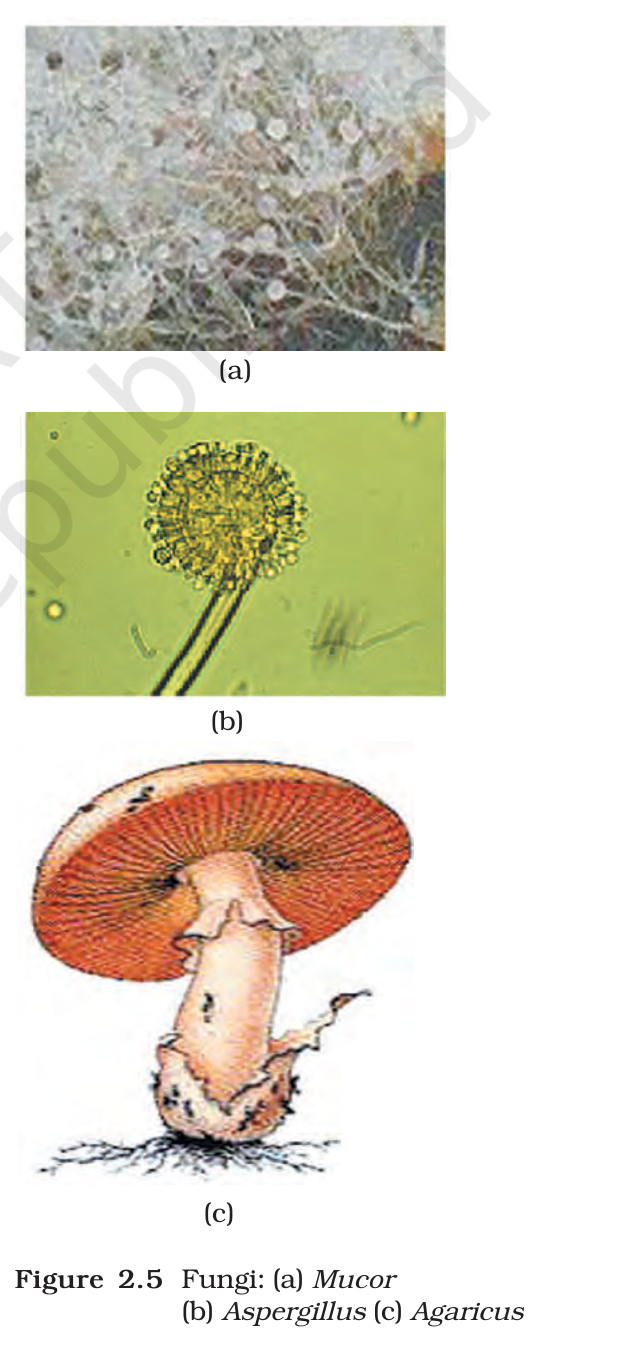
This class grows in water, on rotting wood, in damp corners, and as obliged parasites on plant hosts. Its mycelium has no septa and is coenocytic. Asexual reproduction uses zoospores, which swim, or aplanospores, which do not. Both kinds are made inside a sporangium. Sexual reproduction gives a zygospore from the fusion of two gametes, which may be alike in form or different. Mucor is a common example, Rhizopus is the bread mould, and Albugo is the parasitic fungus on mustard.
3.1.3 Ascomycetes
Ascomycetes are the sac fungi. Most are many-celled, such as Penicillium, and some are unicellular, such as the yeast Saccharomyces. They are saprophytic, parasitic or coprophilous, meaning they grow on dung. The mycelium is branched and septate. Asexual spores are conidia, made outside on special hyphae called conidiophores. Sexual spores are ascospores, made inside sac-like asci, and the asci sit in fruiting bodies called ascocarps. Aspergillus and Claviceps are examples, and Neurospora is a favourite of biochemical and genetic research. Morels and truffles are edible members.
3.1.4 Basidiomycetes
Mushrooms, bracket fungi and puffballs belong here. The class grows in soil, on fallen logs and stumps, and as parasites within living plants; rusts and smuts are its members. The mycelium is branched and septate. Asexual spores are usually absent, and vegetative reproduction by fragmentation is common. Sex organs are absent too, and plasmogamy happens when two vegetative cells of different strains fuse. The product is dikaryotic and grows into a basidium. Karyogamy and meiosis happen in the basidium, which then carries four basidiospores on the outside. The basidia sit in fruiting bodies called basidiocarps. Agaricus is the mushroom, Ustilago the smut and Puccinia the rust fungus.
3.1.5 Deuteromycetes
These are the imperfect fungi, named because only the asexual and vegetative phases are known. When the sexual stage of a deuteromycete is found, it is moved into the class it belongs to. The mycelium is septate and branched, and reproduction is only by conidia. Some members are saprophytes, some are parasites, and many decompose litter and return minerals to the soil. Alternaria, Colletotrichum and Trichoderma are the examples.
3.1.6 Practice from the NCERT exercise, question 9
Exercise 9. Compare the classes on two points. Phycomycetes: aseptate coenocytic mycelium; saprophytic, parasitic or aquatic; asexual zoospores or aplanospores; sexual zygospore. Ascomycetes: septate mycelium; saprophytic, parasitic or coprophilous; asexual conidia; sexual ascospores in asci. Basidiomycetes: septate mycelium; saprophytic or parasitic; asexual spores usually absent; sexual basidiospores on a basidium. Deuteromycetes: septate mycelium; saprophytic, parasitic or decomposing; asexual conidia; sexual stage unknown.
Exam
Questions on the fungal sexual cycle want the three steps in order. Write plasmogamy, karyogamy and meiosis, then add the dikaryophase for ascomycetes and basidiomycetes. Questions on classification of fungi want the four class names with one spore type each: zygospore, ascospore, basidiospore, conidia. A comparative answer in a table scores faster than three separate paragraphs.
Common mistake
Do not write that fungi are plants without a pigment, because the chitin wall and heterotrophic absorption are the reasons they sit in their own kingdom. Do not mix up the dikaryon with a diploid cell: a dikaryon has two separate haploid nuclei in one cell, while a diploid cell has one fused nucleus. Do not say asci make conidia, because conidia are the asexual spores of ascomycetes and ascospores are the sexual ones.