

Concepts: Kingdom Protista
Biological Classification18 min readLesson 2 of 6
2.1 A kingdom of single cells
Every single-celled eukaryote is placed in Kingdom Protista, but the boundary of the kingdom is not sharp. What one biologist treats as a photosynthetic protist, another may treat as a plant, and the chapter admits this honestly. Protists are mostly aquatic. Their cells have a proper nucleus and other membrane-bound organelles. Some carry flagella or cilia. They reproduce both asexually and sexually, and the sexual route involves fusion of cells and the formation of a zygote.
2.1.1 Chrysophytes
This group contains the diatoms and the golden algae, or desmids. They live in fresh water and in the sea, they are microscopic, and they drift with the current as plankton. Most make food by photosynthesis. The diatom wall is the famous part: two thin overlapping halves fitted together like a soap box, with silica embedded in the walls. The silica makes the wall almost indestructible, so diatom walls settle on the bottom of water bodies and build up over billions of years into diatomaceous earth. This gritty deposit is used for polishing and for filtering oils and syrups. Diatoms also do much of the food production in the oceans, which is why they are called the chief producers there.
2.1.2 Dinoflagellates
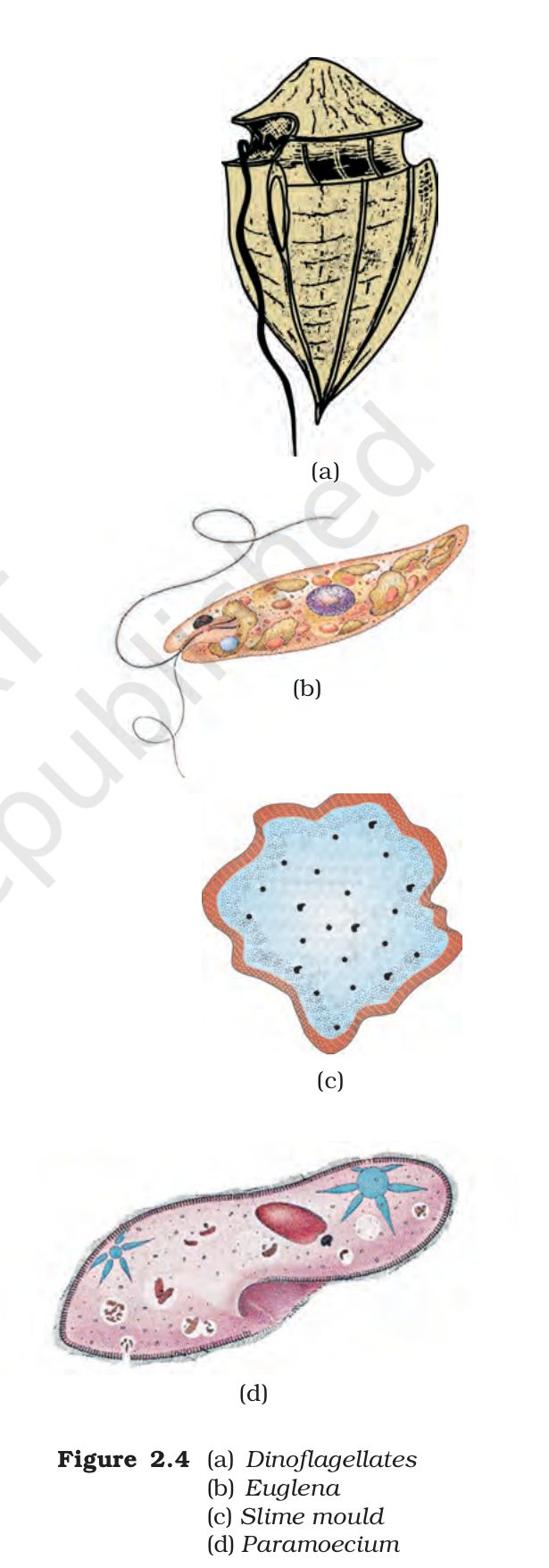
Most live in the sea and make their own food. Their colour can be yellow, green, brown, blue or red, because different pigments dominate in their cells. Stiff cellulose plates sit on the outer surface of the wall. Most have two flagella: one runs lengthwise and the other sits crosswise in a groove between the wall plates. Red dinoflagellates such as Gonyaulax can multiply so fast that the sea itself turns red. That is the red tide, and the toxins released in such numbers can kill fish and other marine animals.
2.1.3 Euglenoids
Most euglenoids live in still fresh water. They have no cell wall; a protein-rich pellicle forms their outer layer and lets the body bend. They have two flagella, one short and one long. In sunlight they photosynthesise, and when held in the dark they behave like heterotrophs and feed on smaller organisms. Their pigments match those of higher plants. Euglena is the textbook example.
2.1.4 Slime moulds
These protists feed on dead matter. The body crawls over decayed twigs and leaves, taking in organic material as it moves. When conditions are right, the creeping bodies gather into one mass called a plasmodium, which can spread over several feet. When conditions turn unfavourable, the plasmodium forms fruiting bodies with spores at their tips. The spores have true walls, they survive years of harsh conditions, and air currents carry them away.
2.1.5 Protozoans
All protozoans are heterotrophs, living as predators or as parasites, and they are believed to be close to the primitive ancestors of animals. Four groups are recognised in the chapter. Amoeboid protozoans live in fresh water, sea water or damp soil, and they move and capture prey by pushing out pseudopodia, the false feet of Amoeba. Marine forms have silica shells, and some, such as Entamoeba, are parasites. Flagellated protozoans are free-living or parasitic, and they move with flagella; the parasitic members include Trypanosoma, which causes sleeping sickness. Ciliated protozoans are aquatic and swim actively by rows of thousands of cilia; Paramoecium is the example, and rows of cilia drive food-bearing water towards a gullet that opens on the cell surface. The sporozoans carry an infectious spore-like stage; the best known member is Plasmodium, the malarial parasite.
2.1.6 Why the kingdom matters
Protista is not a tidy group, and the chapter admits at the start that the boundary is not sharp. Even so, its members do a large share of the work in aquatic food chains. Diatoms and other photosynthetic protists make food at the base of those chains, and the animals of the water depend on that food. The dark side is disease. Entamoeba is a parasite, Trypanosoma causes sleeping sickness, and Plasmodium causes malaria. The same kingdom that feeds the ocean also carries some of the most serious human infections.
2.1.7 Practice from the NCERT exercises, questions 6 and 10
Exercise 6. The four groups of protozoans are the amoeboid forms, which move and feed with pseudopodia; the flagellated forms, which move with flagella; the ciliated forms, which move with cilia and steer food into a gullet; and the sporozoans, which have an infectious spore stage.
Exercise 10. Euglenoids have a pellicle instead of a wall, two flagella of unequal length, plant-like pigments, and a mixed mode of life. They photosynthesise in light and feed like heterotrophs in the dark, which makes them a bridge between autotrophs and heterotrophs.
Exam
Protista questions usually ask for a group and one named example. Keep the pairs ready: diatoms and desmids with silica walls, Gonyaulax with red tides, Euglena with a pellicle and mixed nutrition, slime moulds with a plasmodium, Amoeba with pseudopodia, Trypanosoma with sleeping sickness, Paramoecium with cilia, Plasmodium with malaria. One line on the feature plus the example is enough for two marks.
Common mistake
Do not call the diatoms the main producers of the sea and then write that they are animals, because the chapter calls them producers. Do not put bacteria in Protista, since kingdom Monera holds all prokaryotes. Do not say that all protozoans are parasites, because most are free-living predators. And do not confuse the slime mould plasmodium with the malarial parasite Plasmodium; the first is a feeding mass of a protist, the second is the malaria parasite.