

Concepts: The five kingdom system and Kingdom Monera
Biological Classification20 min readLesson 1 of 6
1.1 From two kingdoms to five
People have tried to sort living things from the earliest civilisations, but for a long time the sorting followed use rather than biology. Aristotle made the first attempt with a scientific basis. He split plants by simple form into trees, shrubs and herbs, and he divided animals into those with red blood and those without it. In the age of Linnaeus the two kingdom system settled into place, with every organism placed in Plantae or in Animalia. That arrangement was easy to teach, and it worked for the plants and animals a student could see. It failed for the organisms that fit neither box.
The two kingdom system did not separate prokaryotes from eukaryotes. It did not separate unicellular forms from many-celled ones. It also filed photosynthetic green algae and non-photosynthetic fungi in the same kingdom, because both had a cell wall. Once cell structure, wall chemistry, nutrition and evolutionary descent became the questions, the old system had to change.
R.H. Whittaker proposed the five kingdom arrangement in 1969. His kingdoms were Monera, Protista, Fungi, Plantae and Animalia. He judged them on cell structure, the organisation of the body, how they feed, how they reproduce, and their phylogenetic relationships. The chapter's Table 2.1 sets out the five kingdoms against five characters: the kind of cell, what the wall is made of, whether a nuclear membrane is present, how the body is put together, and how the organism feeds. The wall chemistry carries the most marks: bacteria have a non-cellulosic wall, fungi have chitin, plants have cellulose, and animals have none. Protista is the mixed kingdom, holding all single-celled eukaryotes.
A three domain system has also been proposed. It splits Kingdom Monera into two domains, keeps the eukaryotic kingdoms in a third domain, and so produces six groups in place of the five. That system is studied in higher classes.
The five kingdom arrangement also shows why classification is a working model. Chlamydomonas and Chlorella were once placed with algae in the plant kingdom, while Amoeba and Paramoecium were placed in the animal kingdom. The protist kingdom now holds both sets in one group, because what connects them is their single-celled eukaryotic organisation. The criteria changed, and the grouping changed with them.
Slideshow, slide 1 of 3. Use the left and right arrow keys to change slides and the space bar to play or pause.
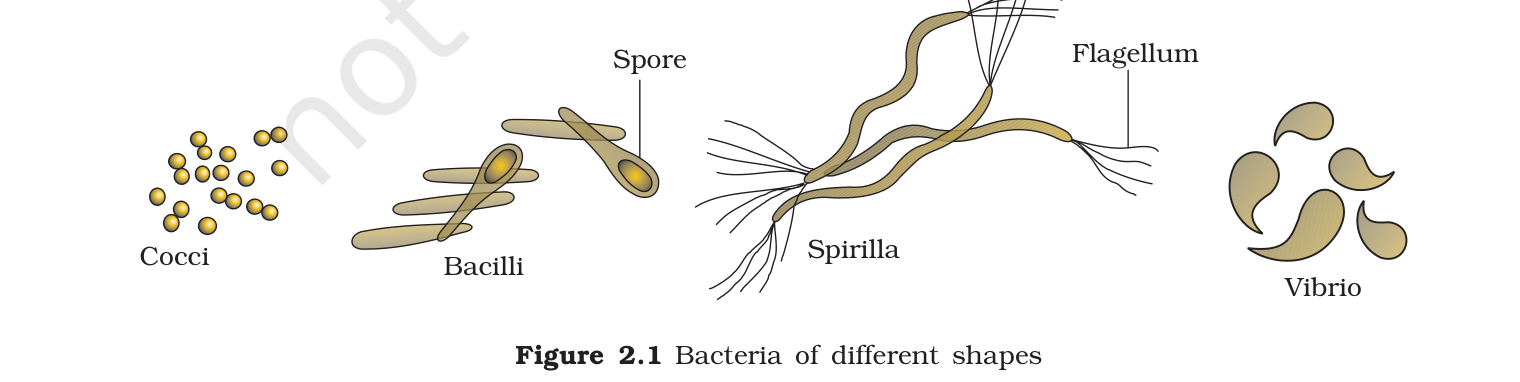
Bacteria of four shapes: round cocci, rod-shaped bacilli with a spore, spiral spirilla with flagella, and comma-shaped vibrio.
1.2 Kingdom Monera: bacteria
Bacteria are the only members of Kingdom Monera. They are everywhere: in soil, in water, in air, on skin, inside other organisms. A handful of garden soil holds hundreds of them, and they also live in hot springs, deserts, snow and deep sea beds where few other life forms survive. Many live as parasites on or inside other organisms.
Four shapes are used to sort them. The round coccus (plural cocci), the rod-shaped bacillus (bacilli), the comma-shaped vibrio and the spiral spirillum (spirilla). A single species keeps its shape, so shape is a first step in identification.
The bacterial body is simple, but its chemistry is not. Bacteria show the widest metabolic range of any group. Some make their own food from inorganic material, either by photosynthesis or by chemosynthesis. The great majority, though, are heterotrophs that draw food from other organisms or from dead matter.
1.2.1 Archaebacteria
This small group lives in the hardest places: halophiles in very salty ground, thermoacidophiles in hot springs, and methanogens in marshy, airless places. Their cell wall has a different structure from that of other bacteria, and that difference is what lets them survive extremes. Methanogens also live in the gut of cattle and buffaloes, where they produce methane, the gas collected as biogas from dung.
1.2.2 Eubacteria
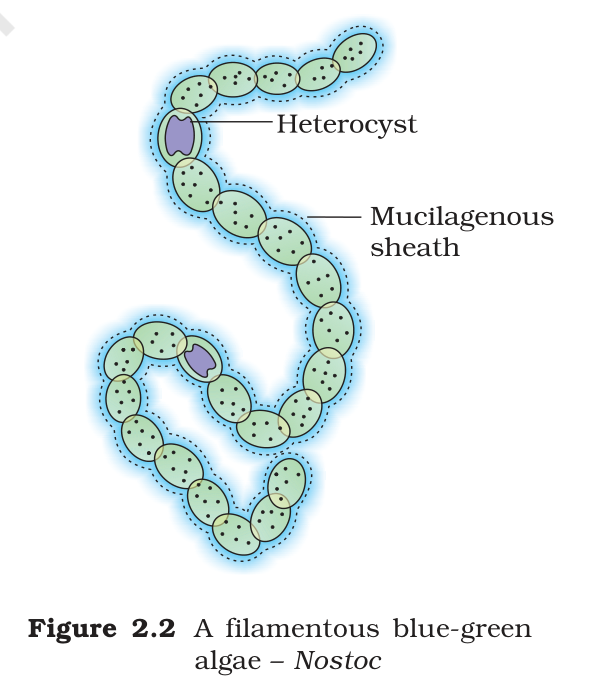
The true bacteria are eubacteria. They have a rigid cell wall and, when motile, a flagellum. The cyanobacteria, once called blue-green algae, contain chlorophyll a like green plants and photosynthesise their own food. They may be single cells, colonies or filaments, in fresh water, sea water or on land. A colony is usually wrapped in a gelatinous sheath, and in polluted water the cells can multiply into a bloom.
Some cyanobacteria fix atmospheric nitrogen in special cells called heterocysts, and Nostoc and Anabaena are the standard examples. Chemosynthetic autotrophs oxidise inorganic substances such as ammonia, nitrates and nitrites, and use the energy released to build ATP. They recycle nitrogen, phosphorus, iron and sulphur through the environment. Heterotrophic bacteria are the commonest kind. They decompose dead matter, curdle milk into curd, make antibiotics, fix nitrogen inside the roots of legumes, and some of them cause disease in people, crops, farm animals and pets. Cholera and typhoid are bacterial diseases of people, tetanus is another, and citrus canker is a bacterial disease of plants.
1.2.3 Reproduction and Mycoplasma
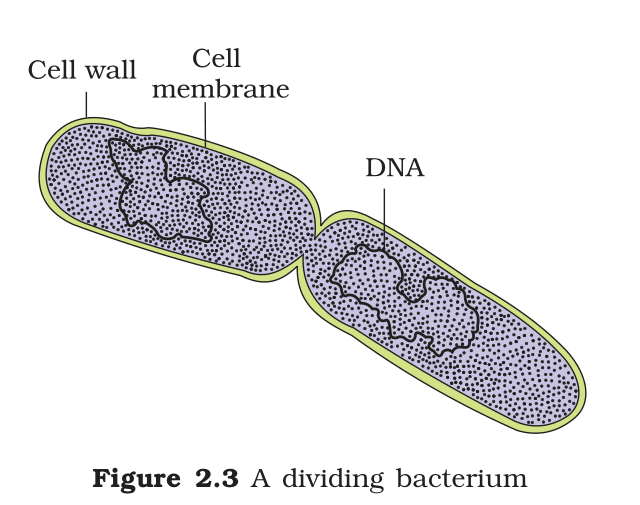
Bacteria divide mainly by fission. Under unfavourable conditions they form spores. They also exchange DNA in a primitive form of sexual reproduction, one bacterium passing a piece of DNA to another.
Mycoplasma is the odd member of the kingdom. It has no cell wall at all. It is the smallest living cell known, it can survive without oxygen, and many species are pathogens of animals and plants.
1.2.4 Practice from the NCERT exercises, questions 1 to 4
Exercise 1. Classification systems have changed in steps: Aristotle used simple form, Linnaeus used two kingdoms, and Whittaker used five. Each change came from a better criterion, not from fashion. Cell structure, wall chemistry, nutrition and descent replaced gross appearance.
Exercise 2. (a) Heterotrophic bacteria are useful in making curd and in producing antibiotics, and some fix nitrogen in legume roots. (b) Archaebacteria are economically useful as the source of biogas, because methanogens in cattle gut release methane from dung.
Exercise 3. The diatom wall is made of two thin overlapping halves that fit like a soap box. Silica is embedded in the wall, which makes it hard and durable.
Exercise 4. An algal bloom is a sudden heavy growth of algae in a water body, usually when nutrients are plentiful. Red tides are blooms of red dinoflagellates that turn the sea red; their toxins can kill fish and other marine animals.
Exam
For a question on the advantages of the five kingdom system, name the two kingdom problem first: it mixed prokaryotes with eukaryotes and unicellular with many-celled organisms. Then give the fix: Monera holds all prokaryotes, Protista holds single-celled eukaryotes, Fungi gets its own kingdom on the strength of a chitin wall, and Plantae and Animalia keep the organisms that fit them. Name the 1969 author, R.H. Whittaker, because examiners give a mark for it.
Common mistake
Do not say that all bacteria cause disease. Most are harmless or useful, and the chapter lists decomposition, curd, antibiotics and nitrogen fixation before it lists pathogens. Do not write that cyanobacteria are plants. They are bacteria with chlorophyll a, and the chapter classes are read as a separate problem from plant divisions. Do not call the archaebacterial wall the same as the eubacterial wall, because the different wall structure is exactly what lets archaebacteria survive extreme conditions.