

Concepts: Viruses, viroids, prions and lichens
Biological Classification18 min readLesson 4 of 6
4.1 Organisms outside the five kingdoms
Whittaker's five kingdoms leave out some strange things. Viruses, viroids and prions are not built of cells, and lichens are not one organism at all. The chapter calls them acellular or unusual, and each one needs its own description.
4.1.1 The nature of a virus
The name virus comes from a word for venom or poisonous fluid. In 1892 Dmitri Ivanowsky showed that tobacco mosaic disease was caused by a microbe smaller than a bacterium, since the agent passed through filters that hold bacteria back. M.W. Beijerinck showed in 1898 that sap taken from an infected tobacco plant could infect a healthy plant, and he called the new agent a virus and the fluid a contagious living fluid. W.M. Stanley crystallised the virus in 1935 and showed that the crystals were mostly protein. Outside its host, therefore, a virus behaves like an inert chemical; inside a living cell it takes over the host machinery and copies itself. It is an obligate parasite.
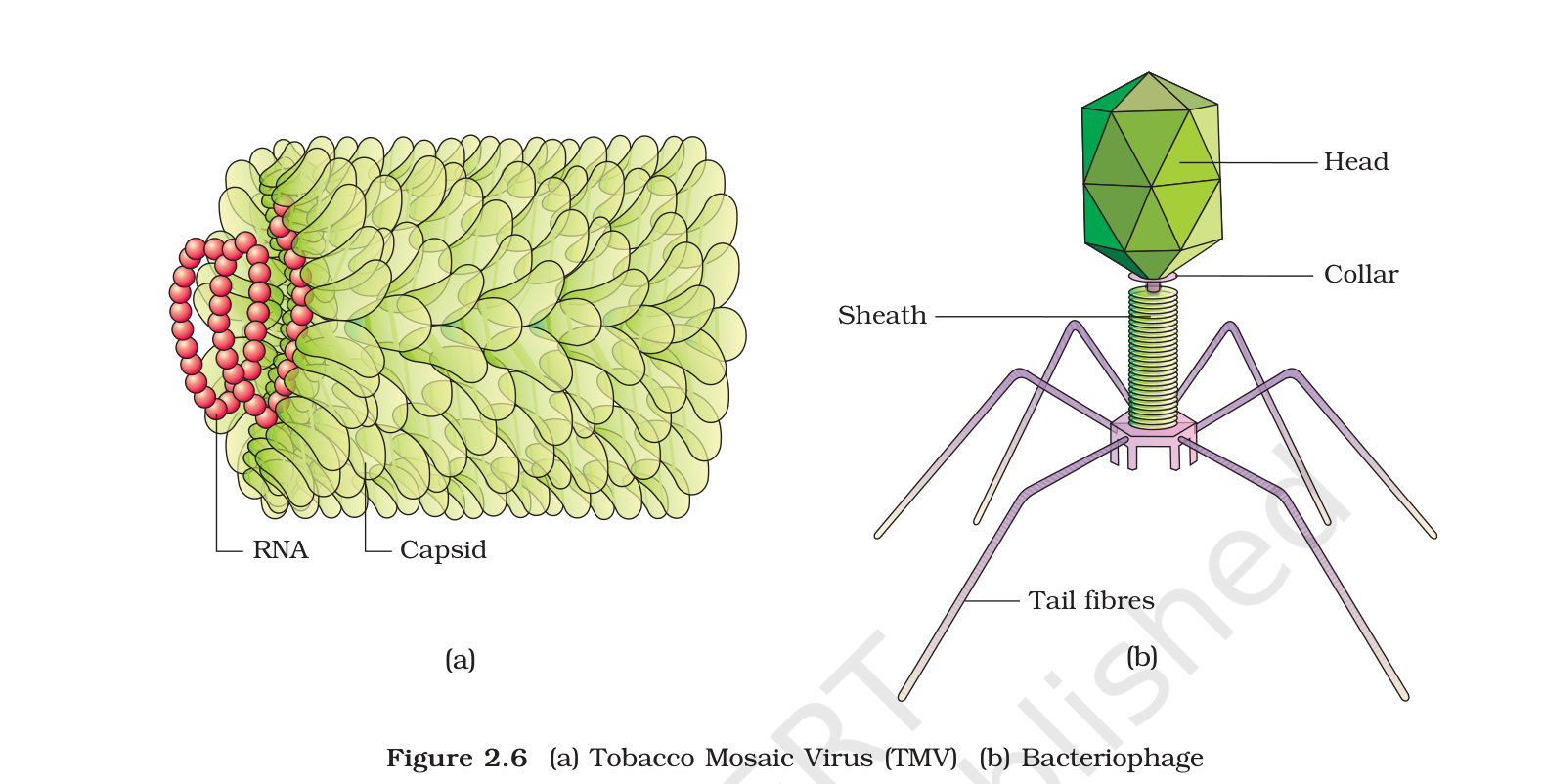
A virus particle is a nucleoprotein. It contains a protein coat and a molecule of genetic material, which is either DNA or RNA, never both. The genetic material carries the infection. Plant-infecting viruses usually carry single-stranded RNA. Viruses of animals carry double-stranded DNA, or RNA that may be single- or double-stranded. Bacteriophages, the viruses that attack bacteria, usually carry double-stranded DNA. The protein coat is the capsid, and it is built from small protein units called capsomeres. These units are packed in helical or polyhedral patterns. The nucleic acid sits inside, protected by the coat.
In people, the diseases include influenza, mumps, herpes and small pox, and the virus causing AIDS is another member. Plant infections show as mosaic patterns, curled or rolled leaves, yellowed veins and stunted growth.
4.1.2 Viroids and prions
A viroid is even smaller than a virus. T.O. Diener found in 1971 that the potato spindle tuber disease was caused by an infectious particle smaller than any known virus. The particle turned out to be free RNA. It has no protein coat, and the name viroid marks that gap. Its RNA has a low molecular weight, and it still causes disease.
A prion is an infectious agent made of protein rather than of genetic material. Prions are abnormally folded proteins of about viral size. The diseases they cause are neurological. In cattle the best known is bovine spongiform encephalopathy, called mad cow disease, and the similar human disease is variant Creutzfeldt-Jakob disease.
4.1.3 Lichens
A lichen is a partnership between an alga and a fungus, and the partnership is usually mutually useful. The algal partner is the phycobiont and it is autotrophic. The fungal partner is the mycobiont and it is heterotrophic. The alga makes food for both, while the fungus gives shelter and supplies water and mineral nutrients. The association is so tight that a lichen on a rock looks like one plant, not two. Lichens are also very good pollution indicators, because they do not grow in polluted air.
4.1.4 Practice from the NCERT exercises, questions 5, 7, 8, 11 and 12
Exercise 5. A viroid is free RNA with no protein coat, while a virus is a nucleoprotein with a protein capsid around its DNA or RNA. The viroid is smaller and its RNA is of low molecular weight.
Exercise 7. Most plants are autotrophic, but some are partly heterotrophic. The bladderwort and the Venus fly trap catch insects, and Cuscuta is a parasite that draws food from its host plant.
Exercise 8. The phycobiont is the algal partner of a lichen and is autotrophic. The mycobiont is the fungal partner and is heterotrophic. The alga feeds the fungus and the fungus gives the alga shelter, water and minerals.
Exercise 11. A virus is a nucleoprotein made of a protein capsid around one nucleic acid, DNA or RNA. Plant viruses mostly carry one strand of RNA. In animal viruses the genetic material may be double-stranded DNA, or RNA with one or two strands. Bacteriophages mostly carry double-stranded DNA. Four viral diseases are influenza, mumps, small pox and herpes.
Exercise 12. The discussion can open with the two sides. A virus is inert outside a cell, forms crystals, and has no metabolism of its own, so it looks non-living. Inside a host cell it copies its genetic material, takes over the cell machinery, and spreads infection, which is living behaviour. The fair conclusion is that a virus sits at the boundary, and the chapter itself keeps it outside the cell-based kingdoms.
Exam
Virus answers score on structure language: nucleoprotein, capsid, capsomere, DNA or RNA but never both, obligate parasite. For a question on whether viruses are living, give both halves before the conclusion. For the lichen question, the two names phycobiont and mycobiont are the marks, so spell them correctly and give the exchange of food for shelter and minerals.
Common mistake
Do not write that a virus contains both DNA and RNA, because no virus carries both. Do not call a viroid a virus without a capsid only, since its genetic material is free RNA and its RNA is of low molecular weight. Do not say a prion is a virus, because a prion has no nucleic acid at all. Do not treat a lichen as a single organism, because it is a symbiosis of two.