

Concepts: electromagnetic radiation and atomic spectra
Structure of Atom22 min readLesson 3 of 8
3.1 Waves that carry energy
Light, heat radiation and X-rays are electromagnetic radiation. An electromagnetic wave has an electric field and a magnetic field that oscillate at right angles to each other and both at right angles to the direction in which the wave travels. The wave needs no medium: it crosses vacuum at the speed of light.
A wave is described by its wavelength, its frequency and its amplitude. Wavelength is the distance between two neighbouring crests, frequency is the number of crests that pass a point each second, and the amplitude fixes the brightness. The product of wavelength and frequency is the speed of the wave. Because all electromagnetic radiation travels at the same speed in vacuum, a short wavelength must mean a high frequency.
The unit of frequency is the hertz, one cycle per second. Wavelength is measured in metres, and in spectroscopy it is more convenient to use the nanometre, the picometre or the reciprocal centimetre. Wavenumber counts how many waves fit into one unit of length and is often quoted in cm^-1.
3.2 The electromagnetic spectrum
The family of electromagnetic radiations covers an enormous range of wavelengths. Radio waves are the longest, with wavelengths from metres down to a fraction of a metre. Microwaves follow, then infrared, then the narrow band of visible light, then ultraviolet, X-rays and finally gamma rays. The visible band runs from about 400 nm at the violet end to about 750 nm at the red end.
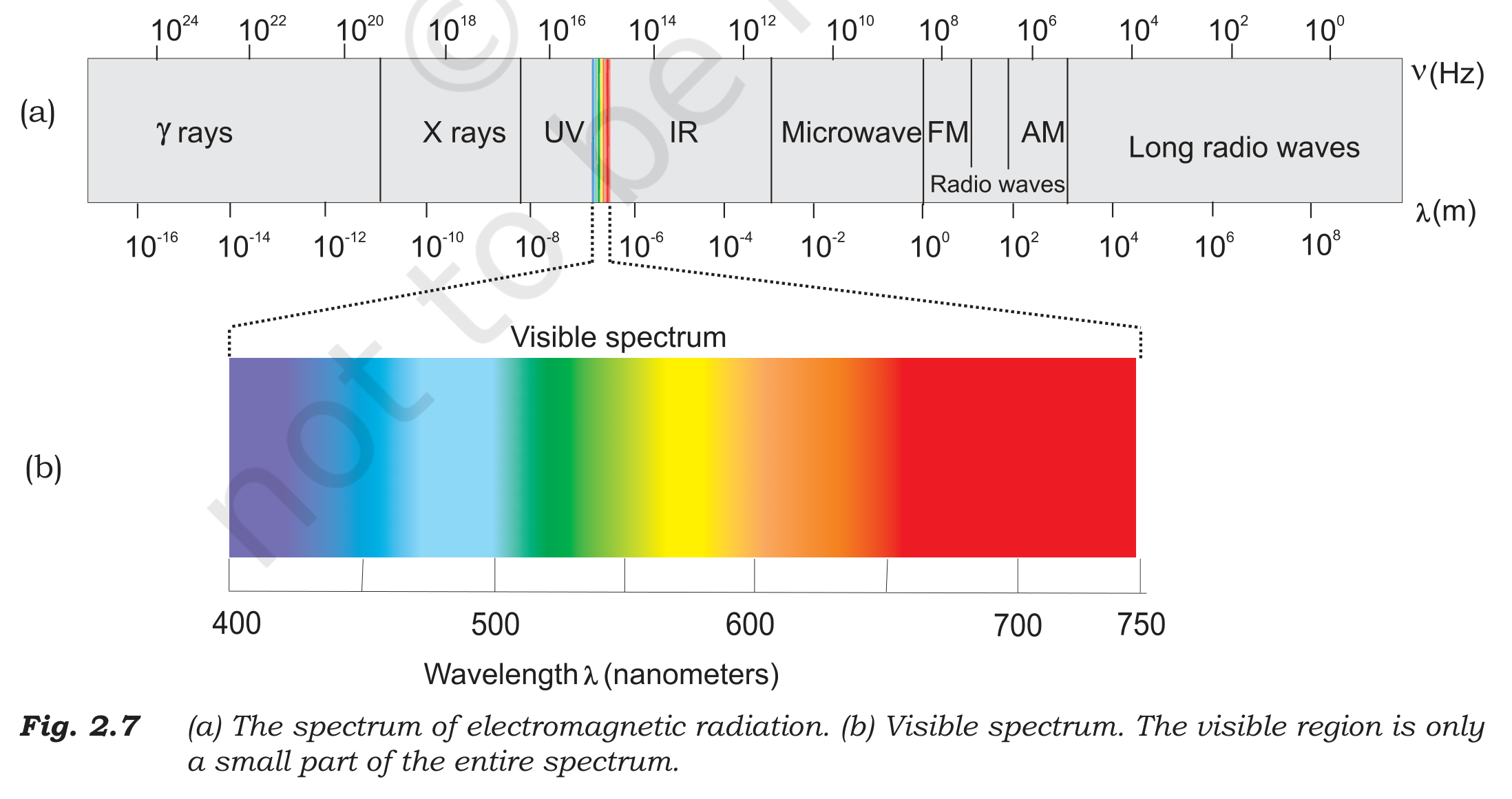
Only this small visible band can be seen by the eye. Instruments are needed to detect the rest. The different regions have different uses: radio waves for broadcasting, microwaves for radar, infrared for heating and for remote controls, ultraviolet for sterilising, X-rays for medical imaging and gamma rays for treating tumours.
3.3 Black body radiation and Planck's quantum
A hot object emits radiation over a wide range of wavelengths. An iron piece heats up through dull red, then bright red, then white, and each colour corresponds to a different temperature. The intensity rises with temperature, and the wavelength at which the emission peaks shifts towards shorter values as the object becomes hotter.
Classical physics predicted that the energy emitted should keep increasing as the wavelength decreases, which contradicts experiment. Max Planck repaired the theory in 1900 with one radical assumption: the energy of the oscillators in the body is not continuous but comes in packets. Each packet, called a quantum, carries energy proportional to the frequency.
A body can absorb or emit energy only in whole multiples of this quantum. At ordinary temperatures a quantum of visible light is much larger than the available thermal energy, so such radiation is not emitted continuously. The quantum idea explains the shape of the black body curve and the shift of its peak with temperature.
3.4 The photoelectric effect
When light of sufficiently short wavelength falls on a metal surface, electrons are ejected. This is the photoelectric effect. Three observations cannot be explained by the wave picture. The ejection is nearly instantaneous once light arrives. The maximum kinetic energy of the ejected electrons depends on the frequency, not on the brightness. Below a certain threshold frequency no electrons come out at all, however intense the light.
Einstein explained all three by treating light itself as a stream of photons, each with energy h nu. One photon is absorbed by one electron, so the maximum kinetic energy equals the photon energy minus the energy needed to free the electron from the metal, called the work function. Brighter light means more photons, so more electrons are ejected, but each electron still receives only one photon.
The threshold frequency corresponds to a photon energy exactly equal to the work function. The stopping potential is the voltage needed to stop even the fastest photoelectrons, and measuring it gives a direct value of the maximum kinetic energy.
3.5 Atomic spectra
A spectrum produced by passing light through a prism or a grating separates the wavelengths. A continuous spectrum contains all wavelengths, as a glowing solid gives. A line spectrum contains only a set of sharp wavelengths. Hydrogen excited in a discharge tube gives a line spectrum, and the same lines appear as dark absorption lines when white light passes through hydrogen gas.
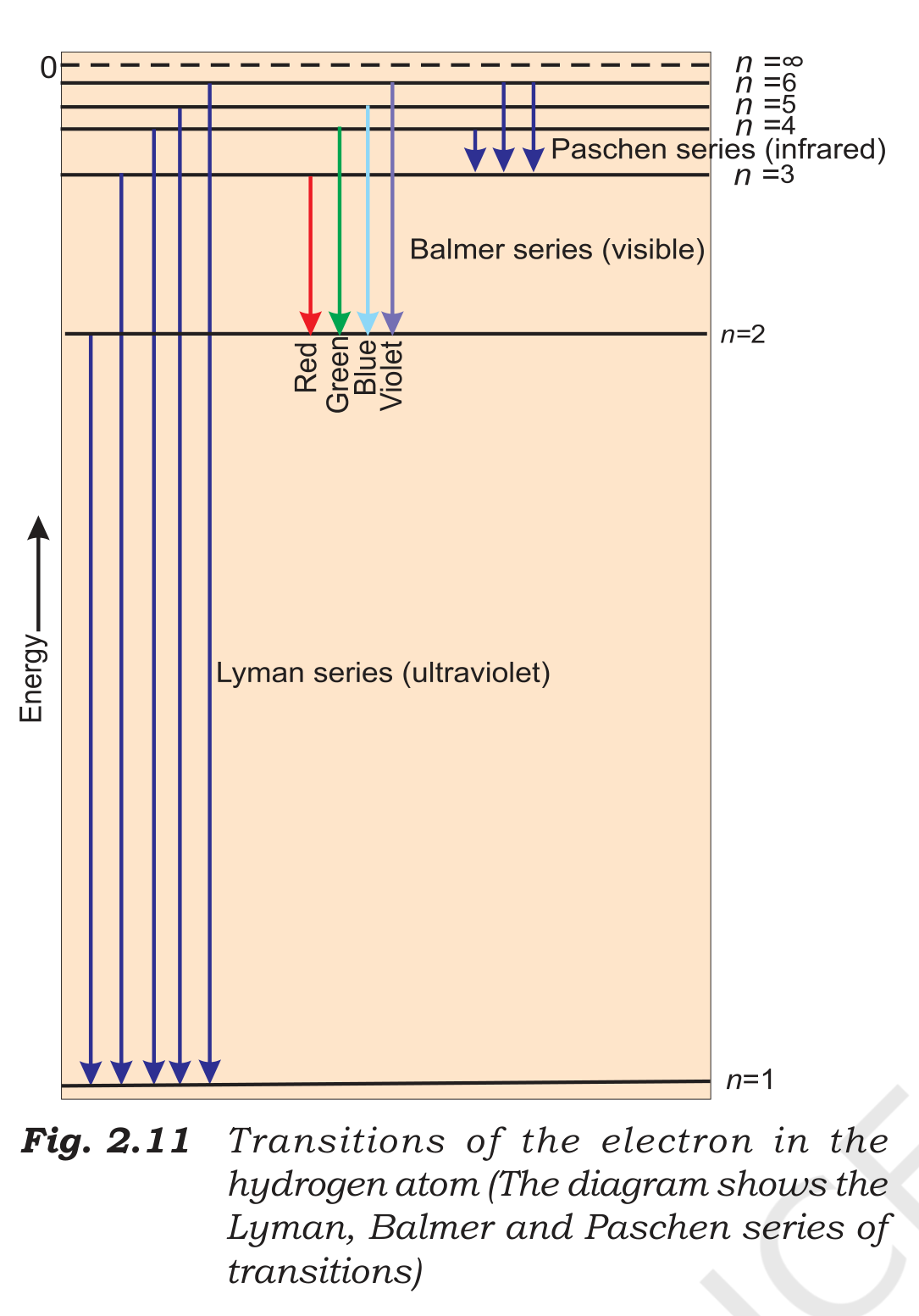
In hydrogen the lines fall into series. The Lyman series lies in the ultraviolet and ends on n = 1. The Balmer series ends on n = 2 and includes the four visible lines: red, green, blue and violet. The Paschen, Brackett and Pfund series lie in the infrared and end on n = 3, 4 and 5. The Rydberg formula reproduces all of these positions with one constant.
The fact that the same few levels appear in both emission and absorption means that the atom can hold only certain amounts of energy. A continuous family of energies would give a continuous spectrum, so the line spectrum is direct evidence for quantised energy levels inside the atom.
Common mistake
Do not confuse intensity with frequency. Making light brighter increases the number of photons and therefore the photocurrent, but it does not increase the energy of each ejected electron. Only a change in frequency or wavelength changes the maximum kinetic energy.