

Concepts: the Bohr model and its limitations
Structure of Atom22 min readLesson 4 of 8
4.1 Why a new model was needed
The Rutherford model failed on two counts. It could not explain why the atom is stable, and it could not explain the sharp lines of the hydrogen spectrum. Niels Bohr in 1913 kept the nuclear atom and added quantisation to the electron's motion. The model works well for one-electron systems and it still gives the correct energy levels of hydrogen, even though its picture of circular orbits has been replaced.
4.2 The postulates
Bohr proposed that the electron in a hydrogen atom moves around the nucleus in certain allowed circular paths, called stationary states or orbits, without radiating energy. Each such orbit has a fixed radius and a fixed energy, and the electron does not lose energy while it stays in one. The model is a first step beyond classical physics: it keeps the nuclear atom and adds one quantum condition instead of discarding either idea.
Energy changes only when the electron jumps between two stationary states. If the electron goes from a lower state of energy E1 to a higher state of energy E2, it absorbs a photon whose energy equals the difference. If it falls from a higher state to a lower one, it emits a photon of that same energy. The photon frequency follows from Planck's relation.
The third postulate says that only those orbits are allowed in which the angular momentum of the electron is an integral multiple of h divided by 2 pi.
4.3 Radius, velocity and energy of the orbits
Combine the quantisation condition with the Coulomb force providing the centripetal force for the circular motion. The electrostatic attraction between the nuclear charge and the electron supplies the force, and the two equations together fix the allowed radii and the corresponding energies.
Solving the pair gives the radius of the nth orbit for a hydrogen-like ion. The radius grows as the square of the principal quantum number and shrinks as the nuclear charge increases.
The energy of the electron is the sum of its kinetic energy and its electrostatic potential energy. The kinetic energy is positive and the potential energy is negative, and the total comes out negative, which is what keeps the electron bound. The expression is written as the energy of the electron relative to the free electron at rest.
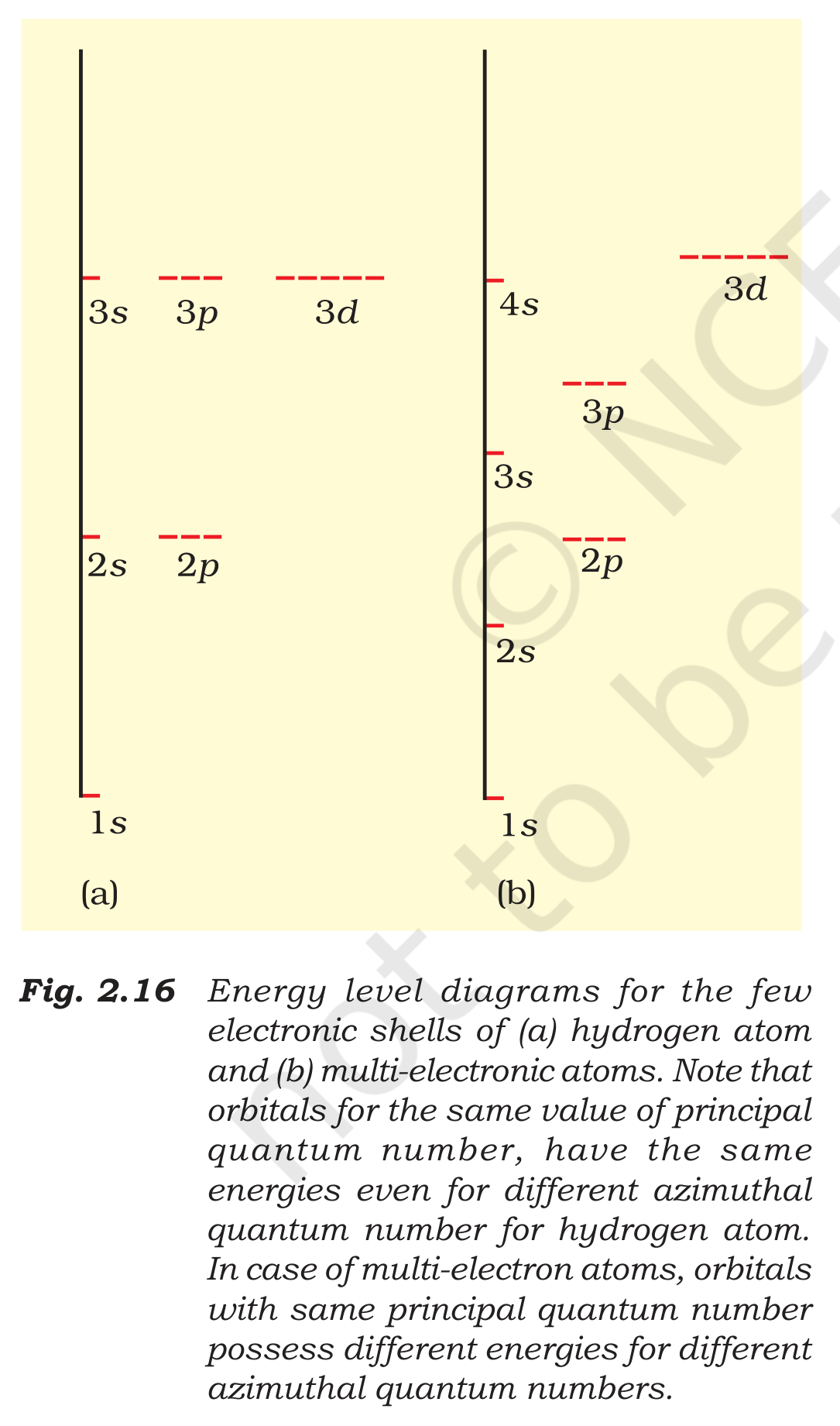
For hydrogen, the first orbit has radius 52.9 pm and energy -13.6 eV. The negative sign means the atom is bound; the ground state electron needs 13.6 eV to escape completely. The spacing between levels shrinks as n increases, and the levels converge to zero energy at large n.
4.4 Explaining the spectrum
A hydrogen atom in its ground state can absorb a photon only if the photon energy matches the gap to one of the higher levels. Once excited, the electron returns to a lower level in one or more steps, and each step emits a photon of a fixed energy. The set of all possible steps gives the set of observed lines, and the series are exactly the families that end on a common lower level.
Putting the energy expression into the frequency rule reproduces the Rydberg equation. For an absorption from n1 to n2, the wavelength is given by the difference of 1/n squared, with the Rydberg constant appearing naturally.
The shortest wavelength in a series is the jump from the highest level down to the series limit, and the longest is the jump from the nearest higher level. This is why only a few lines in a series are visible and the rest crowd together near the limit.
4.5 Successes and failures
The model gives the correct radii, the correct energies and the whole hydrogen spectrum. It also explains why each element has its own spectrum, because the level spacings depend on the nuclear charge. It predicts that one-electron ions such as He+ and Li2+ should behave like scaled copies of hydrogen, and this is confirmed for the line positions.
The failures are equally clear. The model works for one electron only and cannot handle helium, which has two. It cannot explain the fine splitting of spectral lines observed with better instruments. It says nothing about the intensity of lines, only their positions. It treats the electron as a particle moving in a circle with a definite path, which contradicts the uncertainty principle. Finally it gives no reason why angular momentum should be quantised in this way; that reason comes from wave mechanics.
Exam
The ground state of hydrogen needs 13.6 eV to ionise. For a hydrogen-like ion with nuclear charge Z, the ionisation energy from the ground state is 13.6 Z squared eV. Check the sign convention: bound state energies are negative, and the energy change that ejects an electron is positive.