

Concepts: quantum mechanics, quantum numbers and configurations
Structure of Atom24 min readLesson 5 of 8
5.1 Matter behaves like a wave
Bohr's model demanded a special rule to allow only certain orbits. Louis de Broglie offered a reason in 1924: if light can behave as a particle, matter can behave as a wave. A particle of mass m moving with speed v has an associated wavelength given by Planck's constant divided by its momentum.
For everyday objects the wavelength is unbelievably small. A cricket ball of mass 0.15 kg moving at 30 m s^-1 has a wavelength of about 1.5 x 10^-34 m, far too small to detect. For an electron accelerated through a few hundred volts the wavelength is of the order of 10^-10 m, which is the spacing between atoms in a crystal. Davisson and Germer confirmed the wave nature by diffracting electrons from a nickel crystal and getting a diffraction pattern just as X-rays would give.
The wave picture also explains Bohr's rule. If the electron behaves as a standing wave around the circular path, the circumference must contain a whole number of wavelengths, otherwise the wave interferes with itself and cancels. Writing that condition and substituting the de Broglie wavelength gives the angular momentum rule. Quantisation is no longer an extra assumption; it follows from wave behaviour.
5.2 The uncertainty principle
If an electron is a wave, it cannot also be a point at a definite position with a definite momentum. Heisenberg made this precise: the product of the uncertainty in position and the uncertainty in momentum cannot be smaller than Planck's constant divided by four pi.
The relation has nothing to do with the clumsiness of instruments. It is a property of the wave nature of matter. A sharply localised wave needs a wide spread of wavelengths, so a precisely known position means an uncertain momentum, and the reverse is also true. For a macroscopic object the right hand side is so small compared with everyday uncertainties that the effect cannot be noticed.
This is the deepest failure of the Bohr model: it assigns a definite circular path with a definite radius and speed at every instant, which the uncertainty principle forbids. The modern model gives up the path and keeps only the probability of finding the electron in a region.
5.3 The quantum mechanical model
The modern description starts with a wave function, usually written psi, obtained by solving the Schrodinger equation for the electron in the atom. The wave function itself has no physical meaning. Max Born gave the rule that makes it useful: the square of the wave function at a point is proportional to the probability density of finding the electron at that point. A large value of the square means the electron is likely to be found there, and a node means the probability is zero.
Slideshow, slide 1 of 3. Use the left and right arrow keys to change slides and the space bar to play or pause.
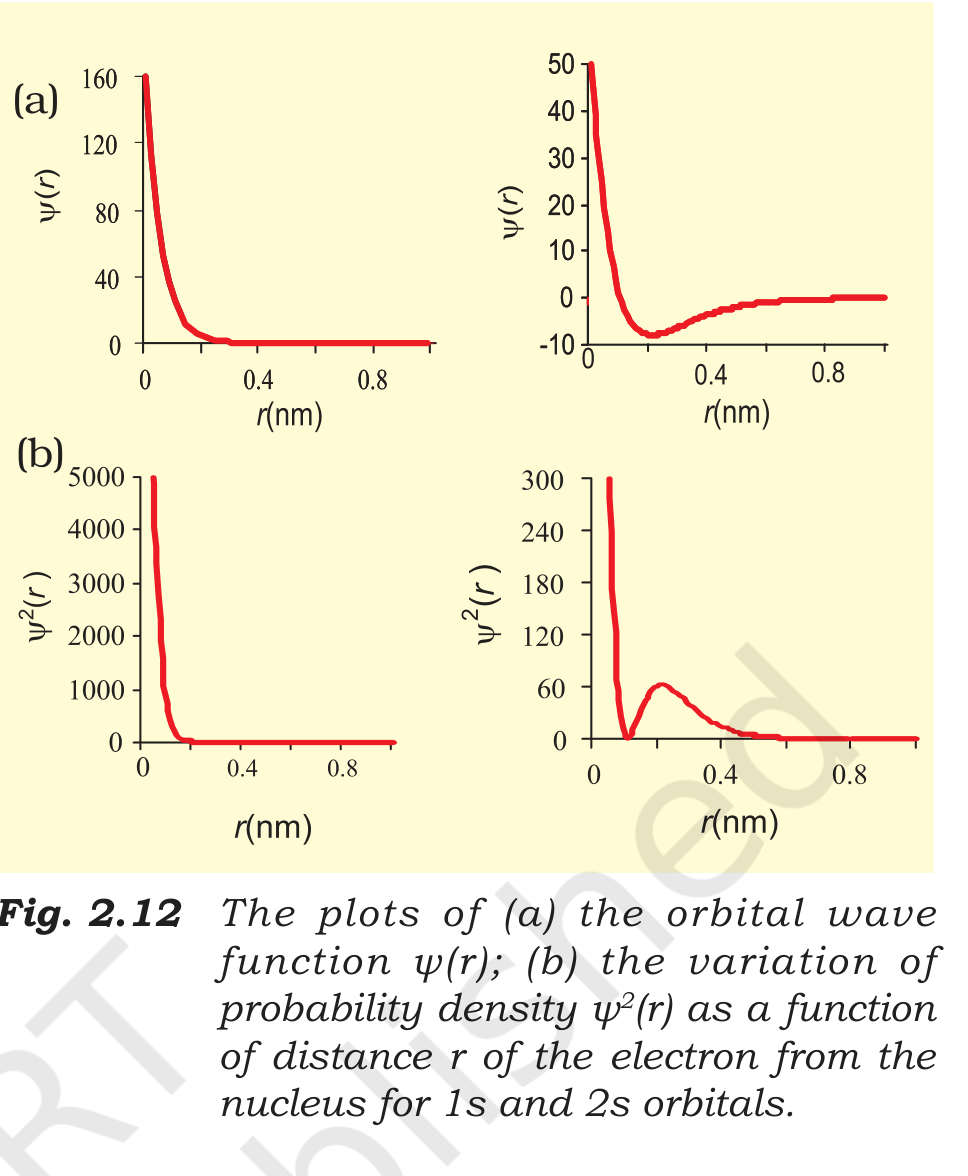
Plots of the orbital wave function and of the probability density against distance from the nucleus for the 1s and 2s orbitals.
An orbital is not a path. It is a region of space together with a wave function that gives the probability of finding the electron there. An orbital can hold at most two electrons, and the pair must differ in spin.
5.4 Quantum numbers
The wave function for the hydrogen atom led to four quantum numbers, and every electron in an atom is labelled by a set of them. The first three come from the solution and the fourth from an additional property, the spin.
The principal quantum number n decides the main energy level, called the shell. It can take any positive integer value, and larger n means a larger, higher energy shell. The number of orbitals in a shell is n squared.
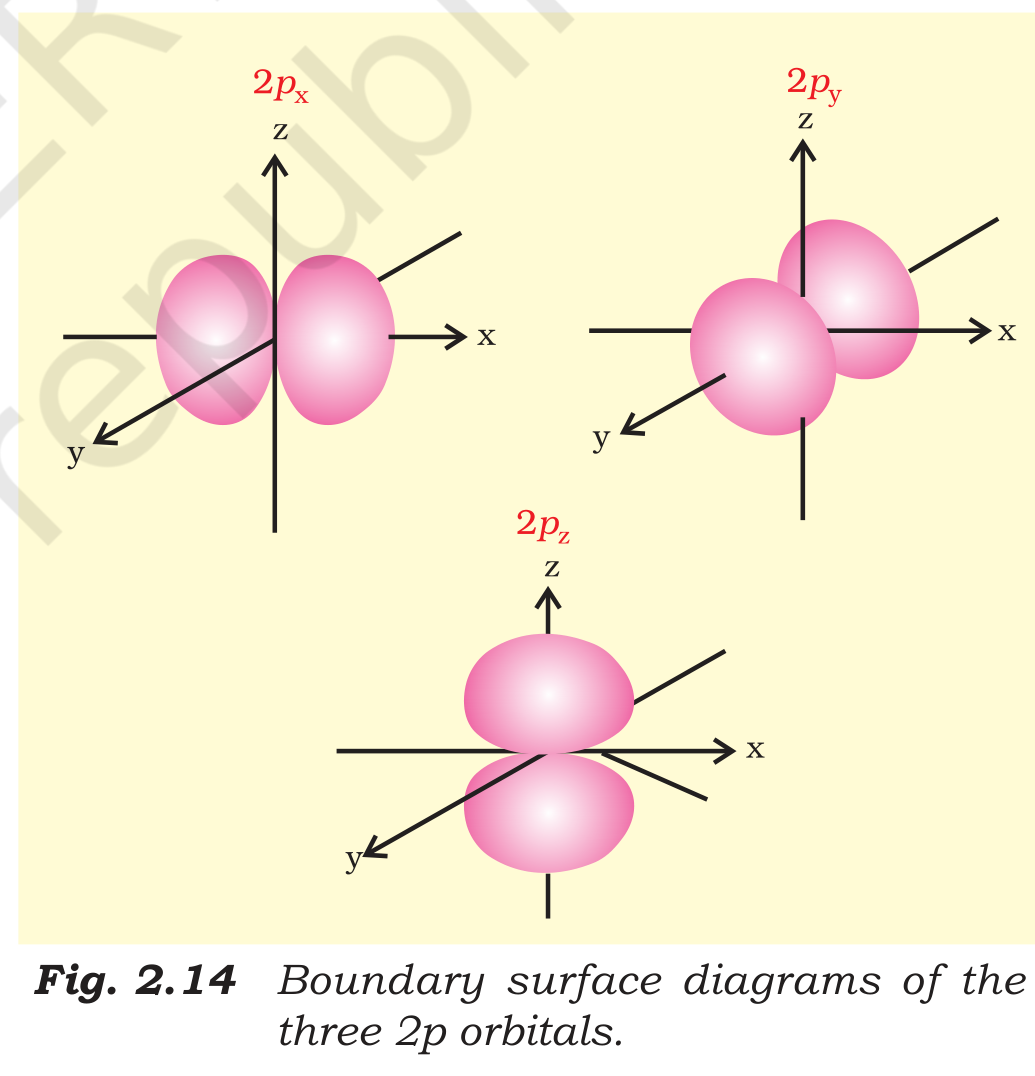
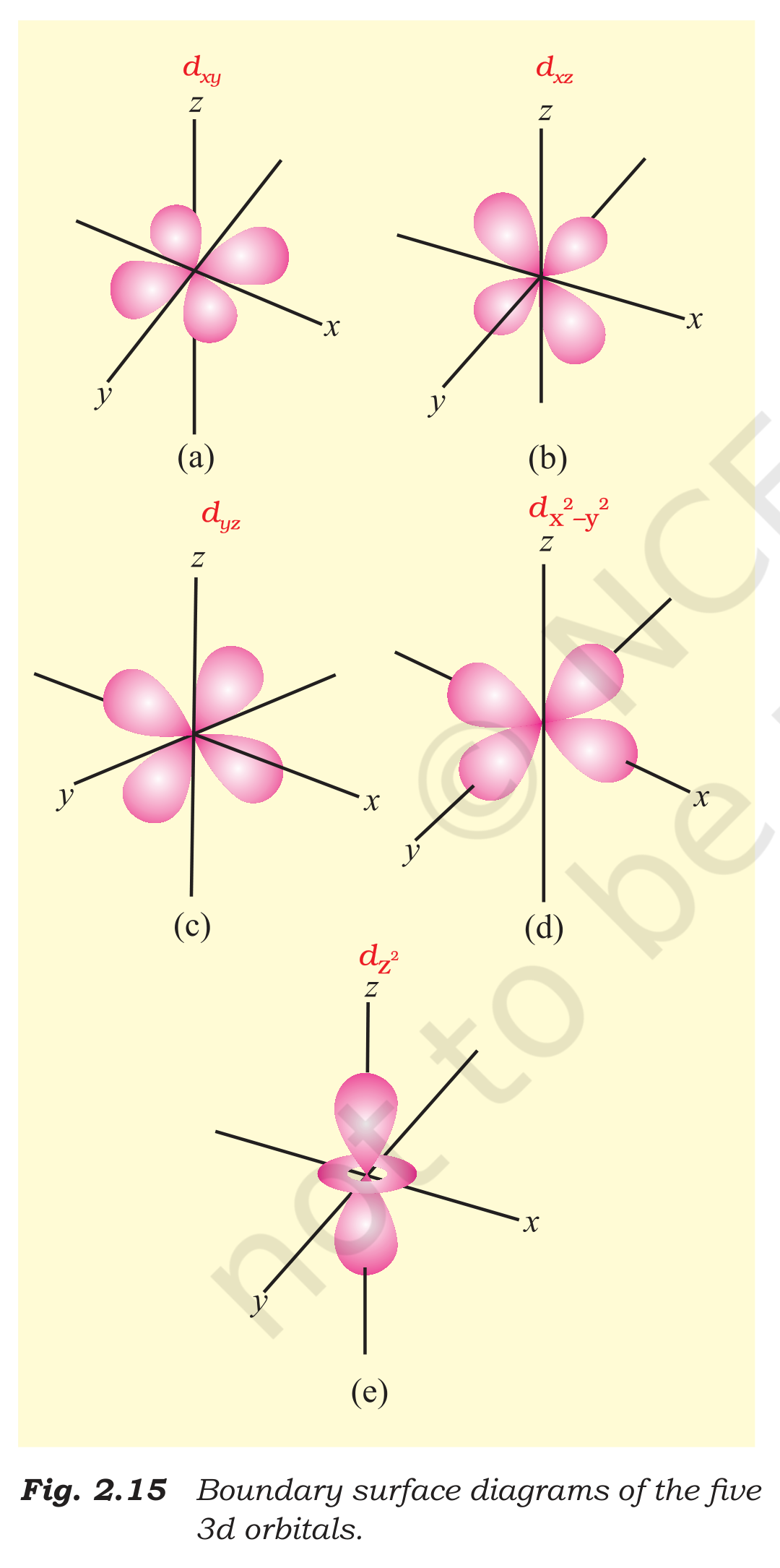
The azimuthal quantum number l decides the shape of the orbital and is called the subshell. For a given n, l runs from 0 up to n minus 1. The values 0, 1, 2 and 3 correspond to s, p, d and f subshells. An s orbital is spherical, a p orbital has two lobes, and d and f orbitals have more complicated shapes. The number of orbitals in a subshell is 2l plus 1.
The magnetic quantum number m_l fixes the orientation of the orbital in space. It can take values from minus l to plus l in steps of one, and the 2l plus 1 values correspond to the number of orbitals in that subshell. For a p subshell l is 1 and m_l can be -1, 0 or +1, so there are three p orbitals, usually written p_x, p_y and p_z.
The spin quantum number m_s describes the spin of the electron and has only two possible values, +1/2 and -1/2. It is not obtained from the orbital wave function and is a purely quantum property.
5.5 Nodes and orbital energies
A node is a surface where the probability of finding the electron is zero. Radial nodes depend on the distance from the nucleus, and angular nodes are planes or cones through the nucleus. The counts follow simple formulas, and the total node count rises with n.
In hydrogen and other one-electron systems, the energy depends only on n, so the 2s and 2p orbitals of hydrogen have the same energy. In a multi-electron atom the repulsion between electrons changes this, and orbitals with the same n but different l have different energies. The practical filling order is decided by the n plus l rule: the orbital with the lower value of n plus l fills first, and when two orbitals tie, the one with the lower n fills first.
5.6 Electronic configuration
The arrangement of electrons among the orbitals of an atom is its electronic configuration. Three rules build it. The Aufbau principle says that the lowest energy orbital available is filled first. Pauli's rule forbids an electron pair from sharing all four labels: one orbital can hold at most two electrons, and those two must differ in spin. Hund's rule says that orbitals of equal energy are each occupied by one electron before any of them is paired, and the unpaired electrons have parallel spins.
The order is not simply by increasing n. The 4s orbital fills before 3d because its n plus l value is 4 against 5 for 3d, and that is why potassium and calcium fill 4s before the transition series begins. Copper and chromium are exceptions: a completely filled d subshell or a half-filled d subshell gains extra stability from exchange energy and from the symmetry of the arrangement, so copper is 3d10 4s1 and chromium is 3d5 4s1 rather than the configurations the simple order predicts.
Common mistake
Do not write 3d before 4s in a configuration just because the d subshell has a lower number. Write in the order the orbitals fill, 4s then 3d, and group the subshells for the element if your textbook does so. The count of electrons in each subshell is what matters.