

Concepts: subatomic particles and early atomic models
Structure of Atom20 min readLesson 2 of 8
2.1 Cathode rays and the electron
At the end of the nineteenth century, physicists studied the discharge of electricity through gases at low pressure. A glass tube with two electrodes and a nearly empty space between them glows when a high voltage is applied. Rays travel from the cathode towards the anode, and the tube's glass behind the anode glows where they strike it. These cathode rays bend towards a positively charged plate and away from a negative one, so they carry a negative charge.
Measurements with electric and magnetic fields gave the ratio of charge to mass for the particle that makes up cathode rays. When only an electric field is applied, the beam bends by an amount that depends on the field strength and the particle's charge to mass ratio. When only a magnetic field is applied, the bend depends on the same ratio in the other direction. Balancing the two deflections restores the straight path, and the balance condition gives the value. The result is close to 1.76 x 10^11 C kg^-1, and the same value appeared whatever gas was used and whatever metal the electrodes were made from. Cathode rays are therefore a basic constituent of all atoms.
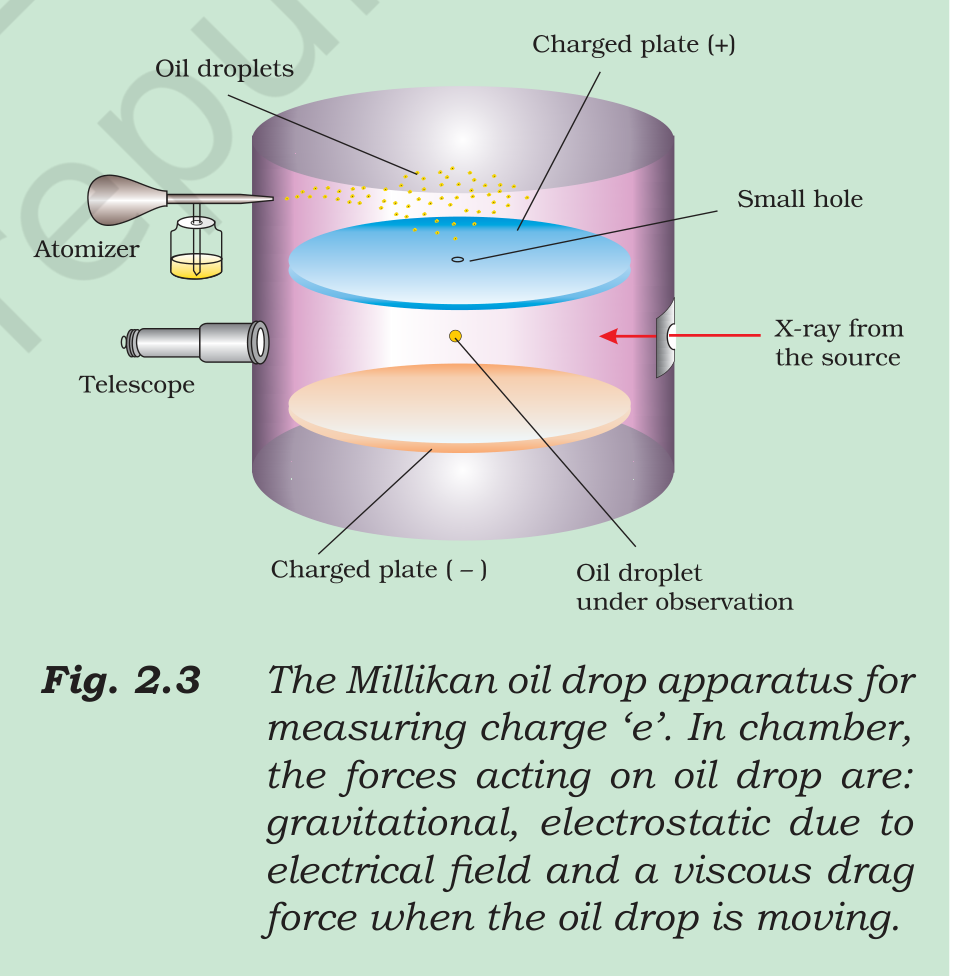
The charge on the electron was measured separately by Millikan in the oil drop experiment. Tiny oil drops are sprayed between two charged plates, and the electric field is adjusted so that an electrically charged drop hangs still: the electric force balances its weight. The charge on a drop always came out as a whole number multiple of about 1.6 x 10^-19 C, and that smallest charge is the elementary charge. Combining the charge with the charge to mass ratio gives the electron mass as 9.1 x 10^-31 kg.
2.2 Protons and neutrons
Positive rays travel in the discharge tube in the direction opposite to cathode rays. Their mass to charge ratio depends on the gas in the tube, which shows that they are positive ions of the gas. The lightest positive particle, produced with hydrogen, was named the proton. Its charge is equal and opposite to the electron's charge, and its mass is about 1836 times the electron mass. Later experiments showed that most nuclei contain a third particle, the neutron, which carries no charge and has a mass almost equal to the proton mass.
The three particles are now summarised with their charges and masses. An electron has charge -1.602 x 10^-19 C and mass 9.109 x 10^-31 kg. A proton has charge +1.602 x 10^-19 C and mass 1.672 x 10^-27 kg. A neutron has no charge and mass 1.675 x 10^-27 kg.
2.3 Thomson's model
Thomson pictured the atom as a sphere of positive charge with electrons embedded in it, roughly like seeds in a fruit. The number of electrons matches the positive charge, so the atom as a whole is neutral. The model explains neutrality and the presence of electrons in all atoms, and it gives the mistaken impression that the positive charge is spread evenly through the atom.
2.4 Rutherford's nuclear model
Rutherford and his students fired alpha particles at a thin gold foil. Most particles passed straight through, some were deflected through small angles, and a very few bounced back. A uniform positive sphere could not produce backward scattering, because a diffuse charge would only nudge the fast alpha particle. The only explanation is that nearly all the mass and the whole positive charge are packed in a tiny central region, the nucleus. Electrons occupy the rest of the atom's volume.
From the scattering data Rutherford estimated the nuclear radius to be of the order of 10^-15 m, while the atom's radius is about 10^-10 m. The nucleus is therefore enormously dense and the atom is mostly empty space. The electrons are held around the nucleus by the electrostatic attraction between opposite charges.
The model explains the large angle scattering but not the stability of the atom. A charged particle moving in a curved path radiates energy, so an orbiting electron should lose energy continuously, spiral into the nucleus and emit a continuous spectrum. Hydrogen actually gives sharp line spectra and ordinary atoms are stable, so the classical picture is incomplete.
2.5 Atomic number, mass number and nuclides
The atomic number Z is the number of protons in a nucleus and decides the element's identity. The mass number A is the total count of protons and neutrons, so the neutron number is A minus Z. A nuclide is written with its symbol, the mass number as a superscript on the left and the atomic number as a subscript on the left, as in carbon-13 with six protons and seven neutrons.
Isotopes are atoms of the same element with different mass numbers. They have the same Z and the same electron count, so their chemistry is nearly identical, but their masses differ. Carbon-12, carbon-13 and carbon-14 are isotopes. Isobars are atoms of different elements with the same mass number, such as argon-40 and calcium-40. Isotones have the same number of neutrons, and isoelectronic species have the same number of electrons.
Exam
For a nuclide symbol with A and Z given, read the neutron number as A minus Z and the electron number as Z for a neutral atom. For an ion, add the lost electrons or subtract the gained electrons from Z before counting electronic configuration.