

Concepts: motion in a plane with constant acceleration
Motion in a Plane22 min readLesson 3 of 7
3.1 Position and displacement in a plane
A particle moving in a plane needs two coordinates for each instant, and the position vector points from the origin to the particle. As the particle moves, the position vector changes in both length and direction. Displacement is the change in the position vector, drawn from the initial point to the final point, and it does not depend on the path taken.
The average velocity over a time interval is the displacement vector divided by the interval, so it has the direction of the displacement. As the interval shrinks, the direction of the displacement becomes the tangent to the path, and the limit is the instantaneous velocity. That is why the velocity vector of a moving body always points along the tangent to its path at that instant.
The average speed is again the path length divided by the time, and it is not the magnitude of the average velocity when the path curves. In a quarter circle of radius r covered in time t, the displacement has magnitude root 2 times r while the path length is half pi r, so the two averages differ by a factor of about 1.11.
3.2 Acceleration in a plane
Acceleration is the rate of change of the velocity vector, and it is not parallel to the velocity in general. A car taking a turn at constant speed is accelerating because the direction of its velocity is changing, even though the speed itself is steady. The change in velocity is found by vector subtraction, and the average acceleration points along the direction of that change.
The instantaneous acceleration is the limit of the average acceleration as the interval shrinks. For a body moving along a curved path, the acceleration at each point has a component along the tangent, which changes the speed, and a component toward the centre of curvature, which changes the direction. In projectile motion the single acceleration g is vertical, which makes the horizontal motion uniform and the vertical motion uniformly accelerated. A body moving in a circle at constant speed has the other extreme, a pure radial acceleration with no tangential part.
3.3 Constant acceleration, component by component
When the acceleration vector is constant, the vector equations of motion split into two independent sets of scalar equations, one for x and one for y. The time is the only quantity shared between them. This is the most useful fact in the chapter, because it means a two dimensional problem becomes two one dimensional problems that are solved side by side.
Write the knowns in two columns, x and y, then apply v = u + at, s = ut + half a t squared, and v squared = u squared + 2as in each column. The velocity at any instant is the vector sum of the two components, and the direction follows from the inverse tangent of the ratio of the components.
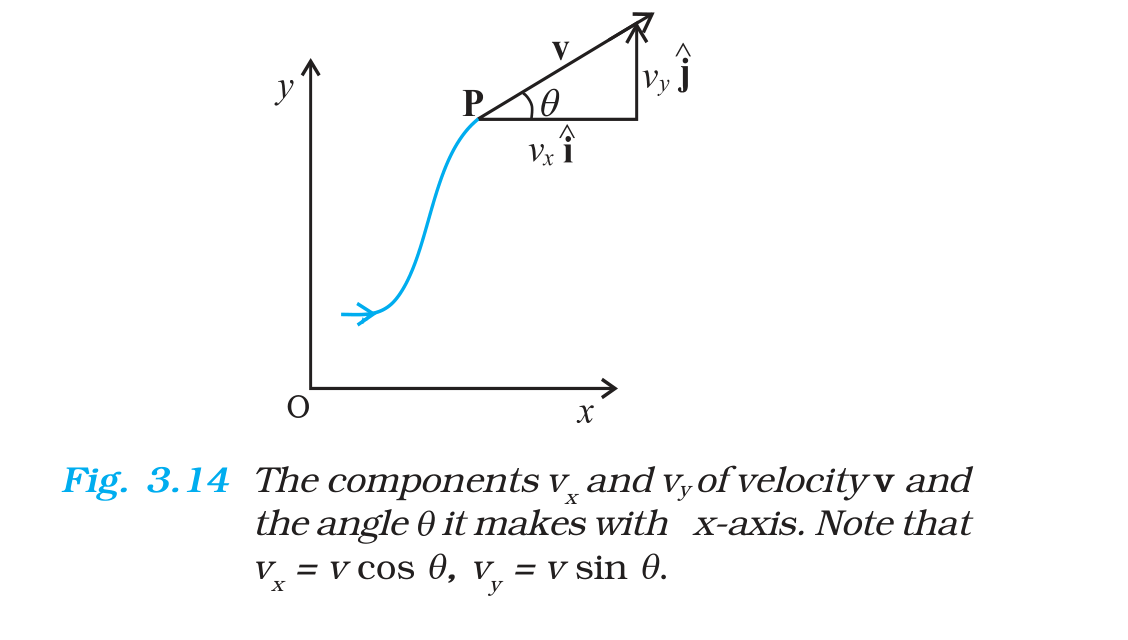
The figure shows a velocity vector resolved into its horizontal and vertical components at a point on a curved path. The horizontal component tells how fast the body advances across the plane, and the vertical component tells how fast it rises or falls.
3.4 Worked example: a body with two accelerations
A body starts from rest at the origin with an acceleration of 4 m per second squared along x and 2 m per second squared along y. After 3 s its velocity components are 12 and 6, so the speed is root of 144 plus 36, about 13.4 m per second, at an angle of inverse tangent of 0.5, about 26.6 degrees above the x-axis. Its position after 3 s is 18 m along x and 9 m along y.
Now suppose the x acceleration stops after 3 s while the y acceleration continues. The body then moves with constant velocity along x and accelerating motion along y, so the path bends. The position at 6 s follows from the two columns separately: the x displacement adds 12 times 3 more, and the y displacement adds the second interval with its own initial velocity. Keeping the columns separate is what makes such questions simple. Writing the two columns side by side on paper is the fastest way to see which quantity is already known and which one the question wants. A sketch of the path with the two axes marked is worth more than a page of algebra in these problems.
A common mistake is to add speeds directly. The speed is not the sum of the component speeds but the square root of the sum of their squares, and the direction is not the average of the angles.
Exam
Draw the two axes and label u, v and a in each column before substituting. If a quantity like the time is common, find it in one column first and then use it in the other, which usually saves an equation.