

Concepts: uniform circular motion and exercise practice
Motion in a Plane24 min readLesson 5 of 7
5.1 Uniform circular motion
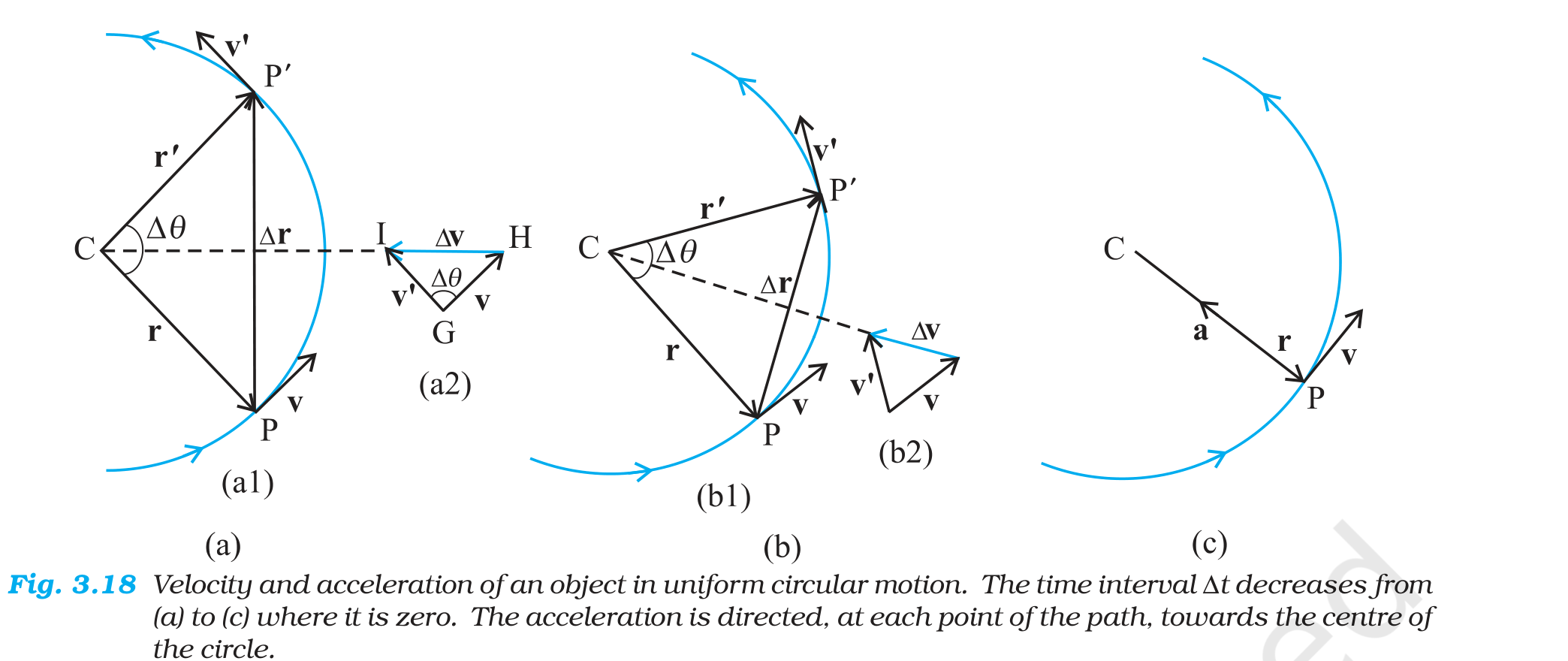
A particle in uniform circular motion travels a circle at constant speed. The speed is constant but the direction of the velocity changes at every instant, and the velocity is always along the tangent to the circle. Since the velocity changes, the motion is accelerated, and the acceleration points toward the centre of the circle at every instant. That is the centripetal acceleration, with magnitude v squared over r.
The angle swept out per unit time is the angular speed omega, measured in radian per second. The speed and the angular speed are linked by v equals omega r, because the arc length for an angle is r theta. The period is the time for one complete revolution, the reciprocal of the frequency, and it can be written as 2 pi r over v or as 2 pi over omega.
The figure shows the velocity and the acceleration at the same point of a circular path at decreasing time intervals, and the smaller intervals make it clear that the change in velocity points inward as the interval approaches zero.
5.2 The vector reason for the inward acceleration
The change in velocity over a small time interval is the vector from the old velocity to the new velocity. At every point of a circular path this change points toward the centre, because the velocity vectors at two nearby points are tangents whose difference is radial. The magnitude of the change grows with the speed and, for a fixed speed, shrinks with a larger radius. Dividing by the time interval gives a magnitude equal to v squared over r.
This result is worth cross checking with the limits. A larger radius at the same speed gives a gentler turn and a smaller acceleration. A larger speed at the same radius gives a much larger acceleration because of the square. A body on a string, a car on a curved road and a planet in orbit all share the same relation, though the force that supplies the acceleration differs.
After one complete revolution the velocity returns to its original value, so the average acceleration over a full period is zero. The instantaneous acceleration is never zero, and confusing the two averages is a standard trap in a true or false question.
5.3 Exercise practice: scalar and vector decisions
Exercises 3.1 to 3.3 sort quantities into scalars and vectors. Volume, mass, speed, density, number of moles, angular frequency and time are scalars; acceleration, velocity, displacement and angular velocity are vectors. The second list is a trap of familiar names: work, current and energy are scalars, while linear momentum, angular momentum, force, average velocity, electric field, magnetic moment and relative velocity carry direction. The third list hides its single vector among scalars: charge, energy, time and path length are scalars, and so are pressure, temperature and gravitational potential, while impulse alone carries a direction. Exercise 3.4 judges operations: adding a scalar to a vector is never meaningful, but multiplying a vector by a scalar is, and adding a component to the vector that contains it is not.
Exercise 3.5 settles statements about magnitudes. The magnitude of a vector is a scalar and each component of a vector along an axis is a scalar, while the total path length exceeds the magnitude of displacement unless the motion never reverses. Exercise 3.6 proves the triangle inequalities, with equality when the vectors are parallel or antiparallel. Exercise 3.7 uses a sum of four vectors that vanishes and checks which of its consequences hold, with the middle two true in general.
5.4 Exercise practice: motion, throws and circular motion
Exercises 3.8 and 3.9 use the circle as a path. Three skaters who reach the diametrically opposite point all have the same displacement magnitude, twice the radius, but only the one who skates along the diameter has a path length equal to it. A cyclist who rides from the centre to the rim, half around the circle and back to the centre has a net displacement of zero and an average speed of the path length divided by ten minutes.
Exercise 3.10 follows a motorist whose track turns left by 120 degrees after every 500 m, and the displacement after three turns is zero because the path closes an equilateral triangle. Exercise 3.11 compares average speed with the magnitude of average velocity for a taxi that takes a 23 km detour between two points 10 km apart. Exercise 3.12 asks for the maximum range of a ball that must stay below a 25 m ceiling, which needs the height condition rather than the 45 degree result, and exercise 3.13 reverses the question for a cricketer whose maximum range is 100 m.
Exercises 3.14 and 3.15 are circular motion numericals. A stone on an 80 cm string making 14 revolutions in 25 s has an angular speed of about 3.52 radian per second and a centripetal acceleration of about 10 m per second squared, directed toward the centre. An aircraft in a horizontal loop of radius 1 km at 900 km per hour has a centripetal acceleration near 6.25 m per second squared, about 0.64 times g. Exercise 3.16 asks whether the net acceleration in circular motion is always radial, which is false for non uniform motion, and exercises 3.17 to 3.22 work with the position vector, relative velocity, projectile range over a wall and the angle of elevation of an aircraft.
Exam
In circular motion questions, convert the revolutions per minute to radian per second before substituting. A frequency in hertz is already revolutions per second, and omega is 2 pi times that frequency.