

Concepts: projectile motion and relative velocity in a plane
Motion in a Plane24 min readLesson 4 of 7
4.1 What makes a projectile
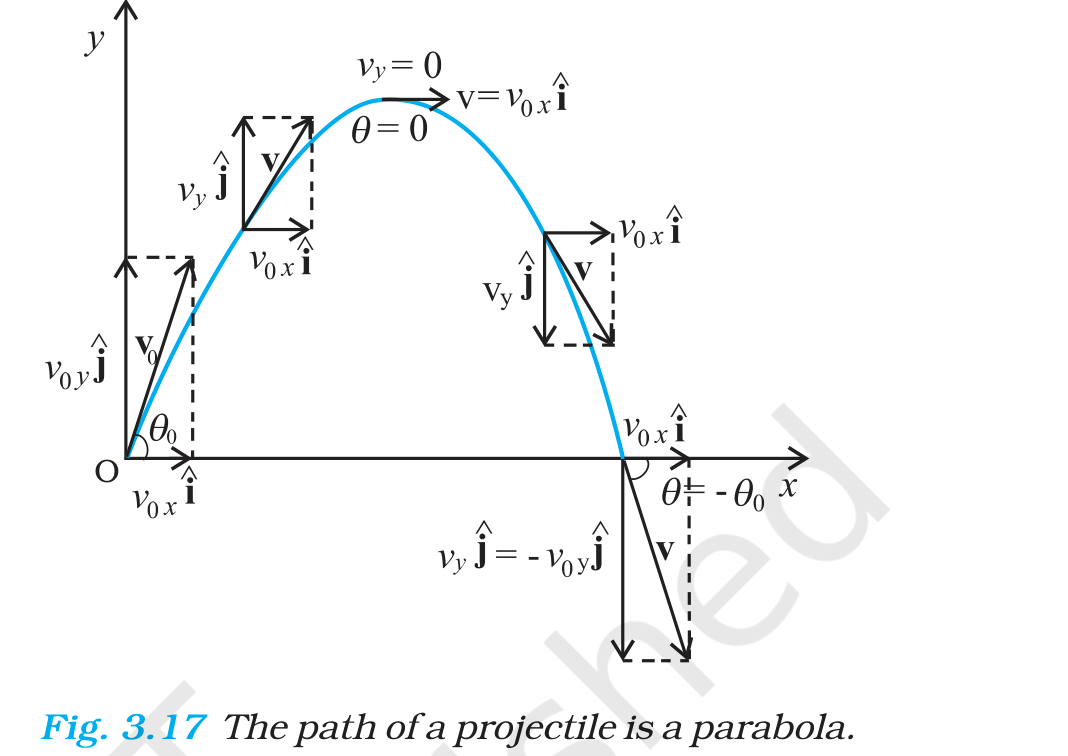
A projectile is any body thrown into the air and then left to move under gravity alone. The launch gives it an initial velocity at some angle to the horizontal, and after that the only acceleration is g vertically downward. The horizontal velocity has no acceleration to change it, so the horizontal component stays constant throughout the flight. The vertical motion is exactly the free fall of the previous chapter with the initial vertical velocity supplied by the launch.
The path is a parabola because the horizontal position grows linearly with time while the vertical position depends on the square of the time. Eliminating the time between the two equations gives y as a function of x in the form of a quadratic, which is the parabola. The figure shows the path with the velocity components marked at several points, and it makes the independence of the two motions visible.
4.2 Time of flight, height and range
Take the launch point as the origin, the initial velocity u at an angle theta to the horizontal, and upward as positive. The initial components are u cos theta along x and u sin theta along y, and the acceleration is minus g along y. The time of flight follows from setting the vertical displacement to zero: 2u sin theta over g. The maximum height follows from the vertical velocity becoming zero: u squared sin squared theta over 2g. The range follows from multiplying the horizontal speed by the time of flight: u squared sin 2 theta over g.
The range is greatest when sin 2 theta is 1, that is at 45 degrees, and the maximum value is u squared over g. Two launch angles that add to 90 degrees give the same range, one a high lob and one a flat drive, but the higher angle has the longer flight time. Doubling the speed quadruples the range, which is worth remembering in numericals.
A projectile launched horizontally from a height is a special case: the initial vertical velocity is zero, so the time of fall follows from the height alone and the horizontal distance is the horizontal speed multiplied by that time.
4.3 Worked example: a throw from the ground
A ball is thrown at 20 m per second at 30 degrees to the horizontal with g equal to 10. The components are 17.32 along x and 10 along y. The time of flight is 2 times 10 over 10, that is 2 s, the maximum height is 100 over 20, that is 5 m, and the range is 20 squared times sin 60 over 10, about 34.6 m. The velocity at the highest point is 17.32 m per second horizontal, because the vertical component is zero there while the horizontal component never changes.
A second case: a stone is thrown horizontally at 15 m per second from a cliff 20 m high. The time of fall is root of 40 over 10, about 2 s, so it lands 30 m from the base. Its speed on landing combines the unchanged 15 with a vertical 20, giving 25 m per second. In both cases the horizontal and vertical columns carry the solution, and the only shared quantity is the time.
4.4 Relative velocity in two dimensions
Relative velocity becomes a vector subtraction when the motion is in a plane. If a boat has velocity vB relative to the water and the water moves with velocity vW relative to the ground, the boat's velocity relative to the ground is the vector sum of the two. To cross a river along the shortest path, the boat must aim upstream so that the downstream component of its own velocity cancels the current. To cross in the shortest time, it should aim straight across and accept being carried downstream.
Rain and wind problems work the same way. A person walking in rain holds the umbrella tilted in the direction of the rain relative to the person, which is the rain velocity minus the person's velocity. The magnitude and the angle of the tilt come from the components of that difference. A common special case has the rain vertical and the walker horizontal, so the relative velocity points diagonally backward and the tilt angle satisfies tangent equal to walk speed over rain speed.
Relative velocity also explains why the driver of a faster car sees a slower car ahead as approaching rather than receding, and why two bodies moving at right angles to each other have a relative speed equal to the root of the sum of the squares of their speeds.
4.5 A boat crossing a river
Let a boat move at 5 m per second in still water and let the river flow at 3 m per second across a width of 400 m. If the boat heads straight across, its ground velocity has a downstream component of 3 and a crossing component of 5. The crossing time is 400 over 5, that is 80 s, and in that time the boat is carried 240 m downstream. Its ground speed is the root of 25 plus 9, about 5.83 m per second.
To land directly opposite the starting point the boat must head upstream at an angle whose sine is 3 over 5, so about 37 degrees upstream of the directly across direction. The crossing component is then the root of 25 minus 9, that is 4 m per second, so the crossing time rises to 100 s. The two answers show the trade between shortest time and shortest path.
Warning
Never add the two velocities as numbers when their directions differ. Draw the triangle of velocities, mark the right angle, and only then use Pythagoras or the tangent. A speed found by plain addition is the commonest wrong answer in river and rain questions.