

Concepts: scalars, vectors and the laws of vector addition
Motion in a Plane22 min readLesson 2 of 7
2.1 Scalars and vectors
Quantities that are fully described by a number with a unit are scalars: mass, time, temperature, speed, work, energy and electric charge. Quantities that need a direction as well are vectors: displacement, velocity, acceleration, force, momentum and electric field. A vector is drawn as an arrow whose length gives the magnitude and whose direction gives the direction, and a change of starting point does not create a new vector.
Two vectors count as equal only if their magnitudes and directions both match, whatever points they are drawn from. Vectors that have the same magnitude but opposite directions are negatives of each other. The magnitude of a vector is a scalar, and it is never negative. A unit vector has magnitude exactly one and only marks a direction, so it carries no unit of its own. Multiplying a vector by a real number scales the magnitude by the size of the number and keeps the direction when the number is positive.
2.2 The triangle and parallelogram laws
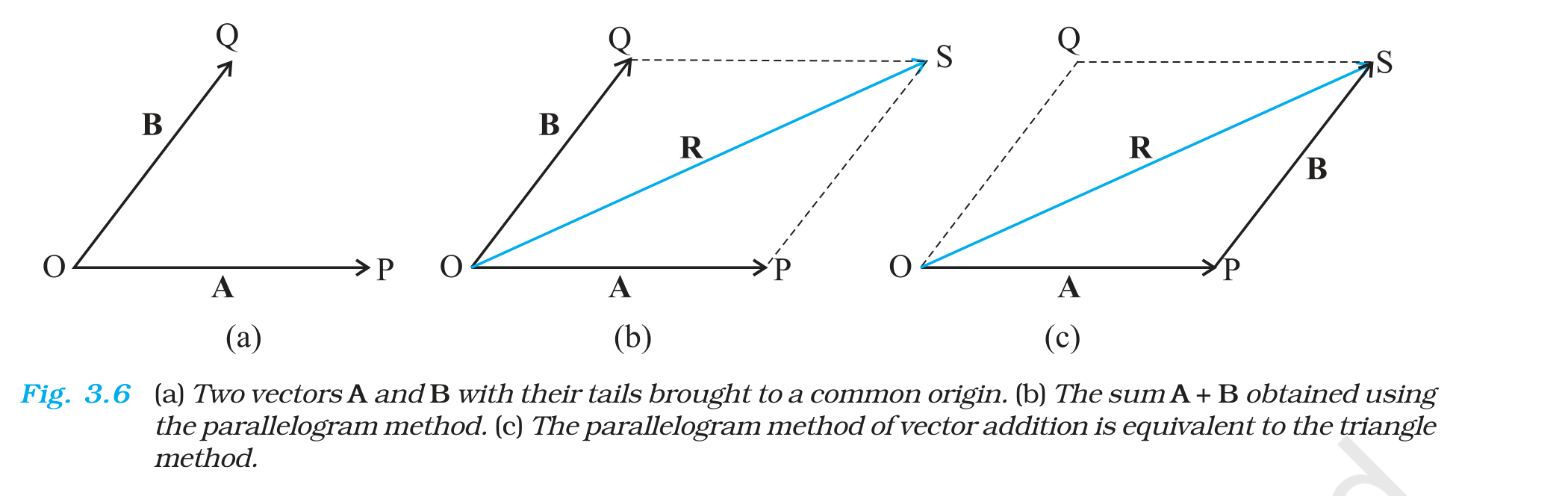
The triangle law says that when two vectors are placed tail to head, the vector from the first tail to the last head is their sum. The parallelogram law says that when two vectors are placed tail to tail, the diagonal of the parallelogram they form, drawn from the common tail, is the sum. The two constructions give the same resultant, which is the statement that vector addition is commutative. The order of addition does not matter, and a third vector can be added in any grouping, which makes addition associative.
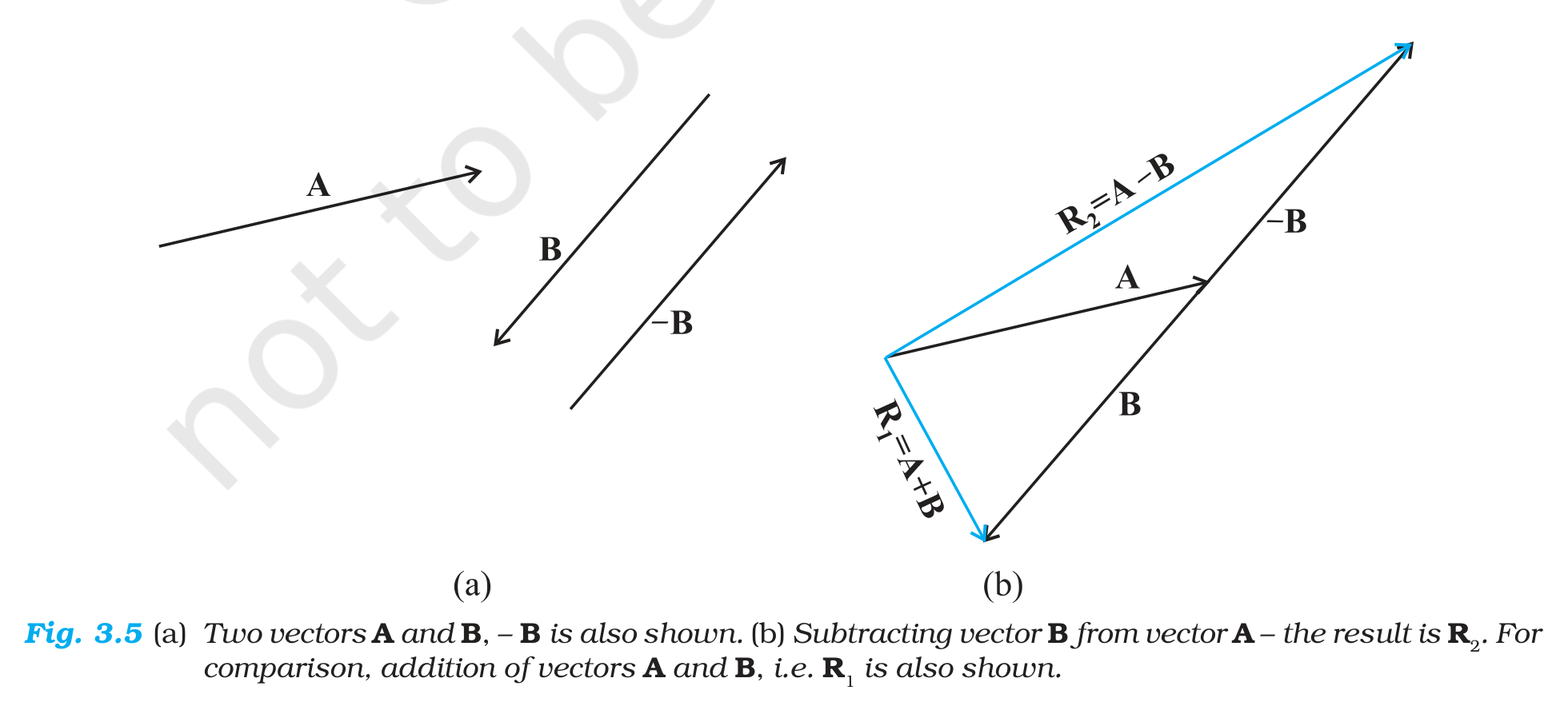
Vector subtraction uses the negative of the second vector. To find A minus B, draw A and then add minus B. The result points from the head of B to the head of A, and it is not the same as B minus A, which points the other way. A null vector has zero magnitude and no defined direction, and adding it changes nothing. The difference of a vector from itself is the null vector, and multiplying any vector by zero gives the same object.
The slides below show the triangle law, the subtraction construction and the parallelogram law from the official chapter.
Slideshow, slide 1 of 3. Use the left and right arrow keys to change slides and the space bar to play or pause.
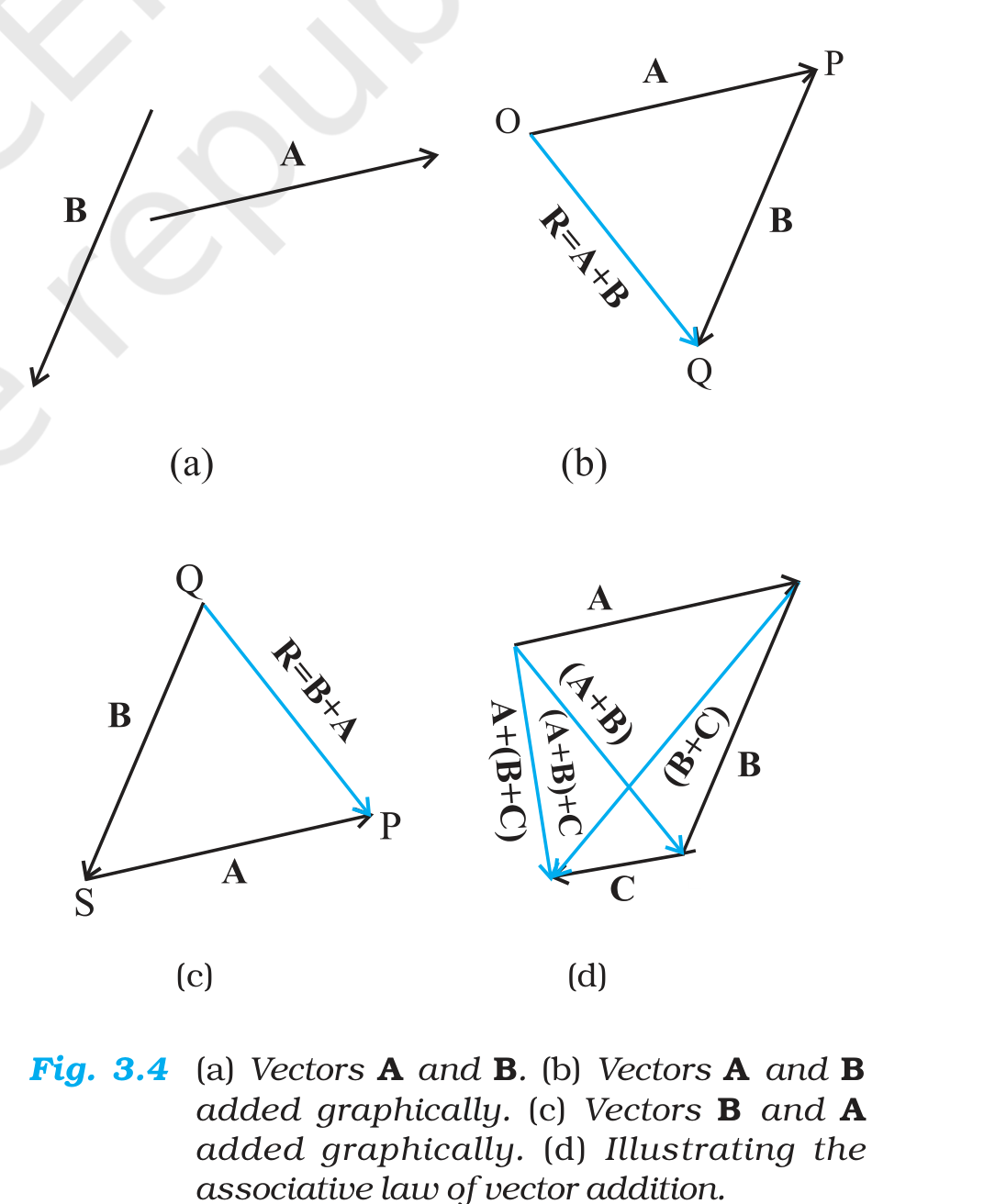
NCERT Figure 3.4: the triangle law of vector addition and the associative property, with two vectors added graphically in both orders.
2.3 Components and unit vectors
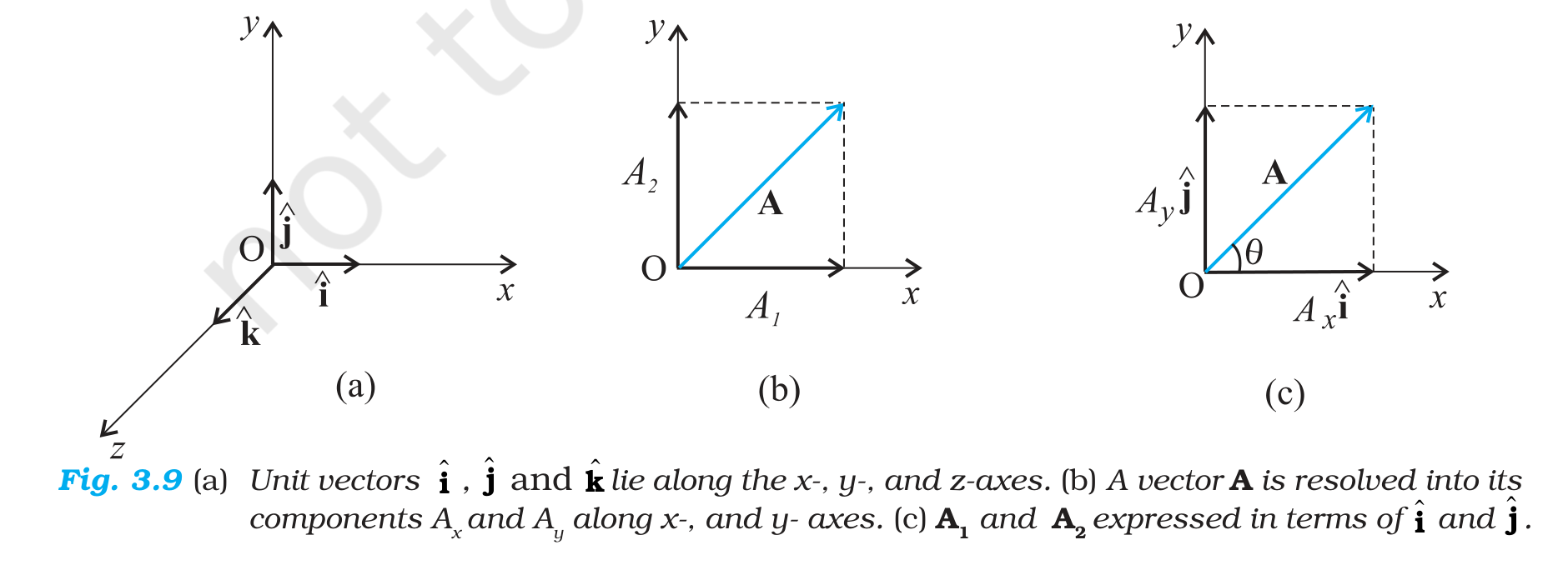
A vector in a plane can be replaced by two perpendicular components along the x and y axes, and in space by three components along the x, y and z axes. The three unit vectors i, j and k point along these axes and each has unit magnitude. A vector written as Ax i + Ay j + Az k carries the same information as the arrow, and its magnitude follows from the square root of the sum of the squares of the components.
Resolution is the inverse of addition, and it turns a vector problem into scalar problems along each axis. If a force acts at an angle to the horizontal, its forward effect is the cosine component and its vertical effect is the sine component, with the angle measured from the horizontal axis. Keep the signs from the quadrant: a component pointing in the negative axis direction is negative.
Using components, the sum of two vectors is found by adding their x components and their y components separately. That method is called the analytical method and it works for any number of vectors, which makes it the practical route when more than two vectors are involved. The figure shows the unit vectors and the resolution of a vector into components.
2.4 Worked example: sum of two vectors
Take A of magnitude 5 units along the positive x-axis and B of magnitude 5 units at 60 degrees to it in the same plane. Using the law of cosines form of the triangle law, the resultant has magnitude root of 25 plus 25 plus 50 times the cosine of 60 degrees, so root 75, about 8.66 units. The argument of the resultant from the x-axis follows from the component form: Ax = 5 and Ay = 0, Bx = 2.5 and By = 4.33, so the sum is 7.5 i + 4.33 j and the angle is the inverse tangent of 4.33 over 7.5, about 30 degrees.
The two routes agree, and the component route is easier to extend. A useful check is the triangle inequality: the magnitude of a sum can never exceed the sum of the magnitudes and can never fall below the difference of the magnitudes. Sketching the two vectors also shows at once whether the resultant should be closer to the longer vector, which catches a wrong angle in the working. Equality in the first case needs the vectors to be parallel, and in the second case antiparallel.
Common mistake
A vector cannot be added to a scalar, whatever the numbers look like. Writing 5 m plus a velocity is meaningless, and so is adding an x component to a full vector. Only like quantities, with direction included, may be added.