

Concepts: adaptive radiation and natural selection
Evolution22 min readLesson 3 of 6
3.1 Darwin's finches and the marsupials of Australia
The Galapagos Islands gave Darwin one of his clearest cases. There he found an extraordinary range of creatures, and the small black birds now called Darwin's finches drew his attention. Several kinds of finch lived on one island, and he reasoned that they had all arisen there. From a seed-eating ancestor, beak shapes diversified and the altered beaks allowed some birds to take insects and others plant food. When one ancestral form gives rise to several species that spread into the different habitats of one region, the process is called adaptive radiation; the finches are its classic case.
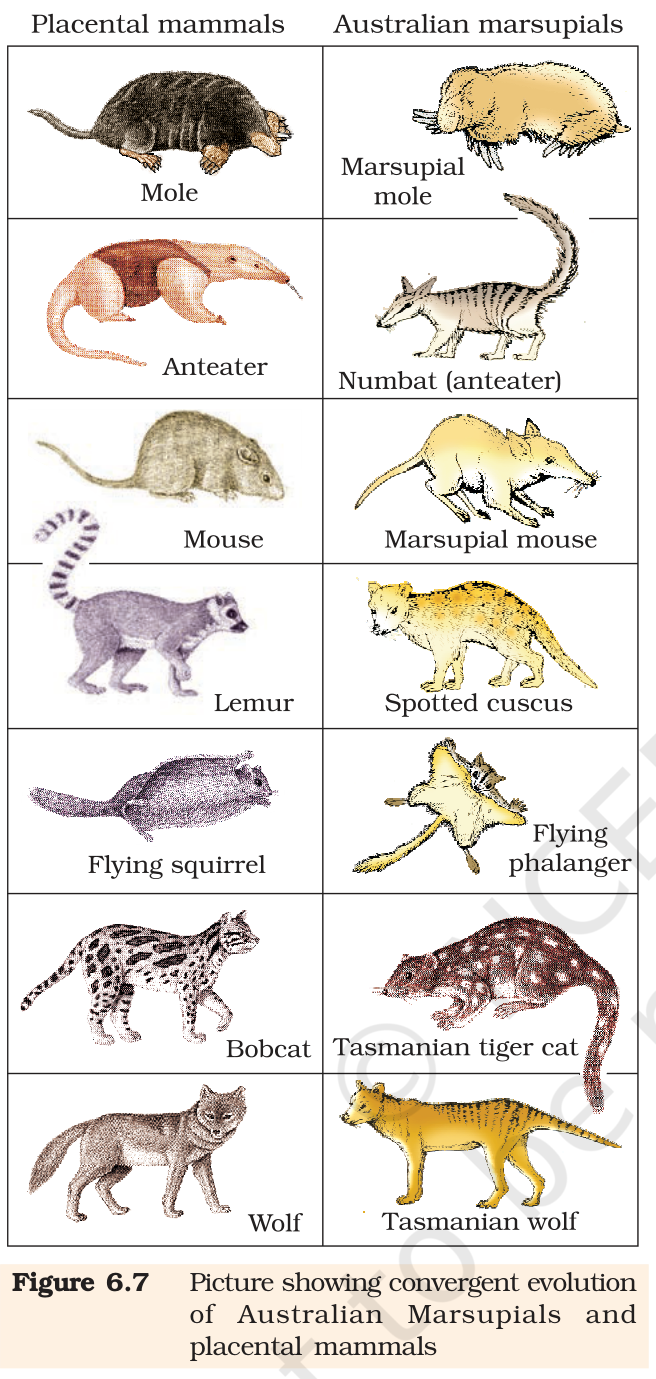
Australia supplies a second case. Its marsupials, though clearly different from one another, descend from a single stock, and their whole diversification happened on that continent. A situation where several such radiations occur within one isolated region, each occupying a different habitat, may be described as convergent evolution. Australia's placental mammals have also diversified, and the resulting forms look like the marsupials that already occupied matching niches; the placental wolf and the Tasmanian wolf-marsupial are the textbook pair.
Slideshow, slide 1 of 3. Use the left and right arrow keys to change slides and the space bar to play or pause.
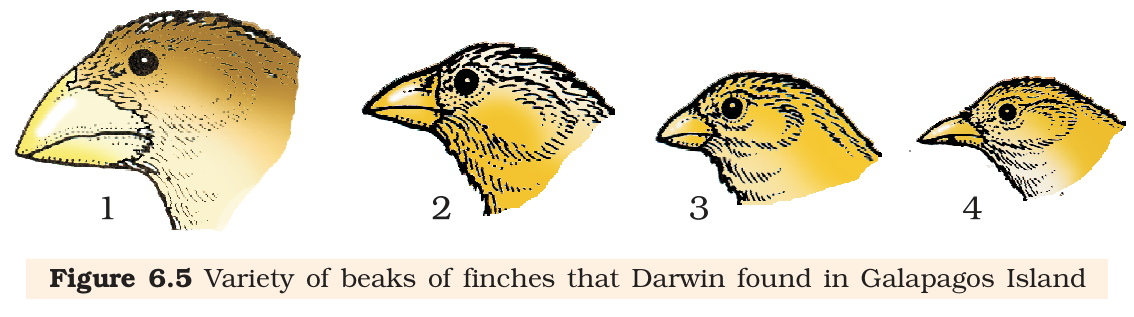
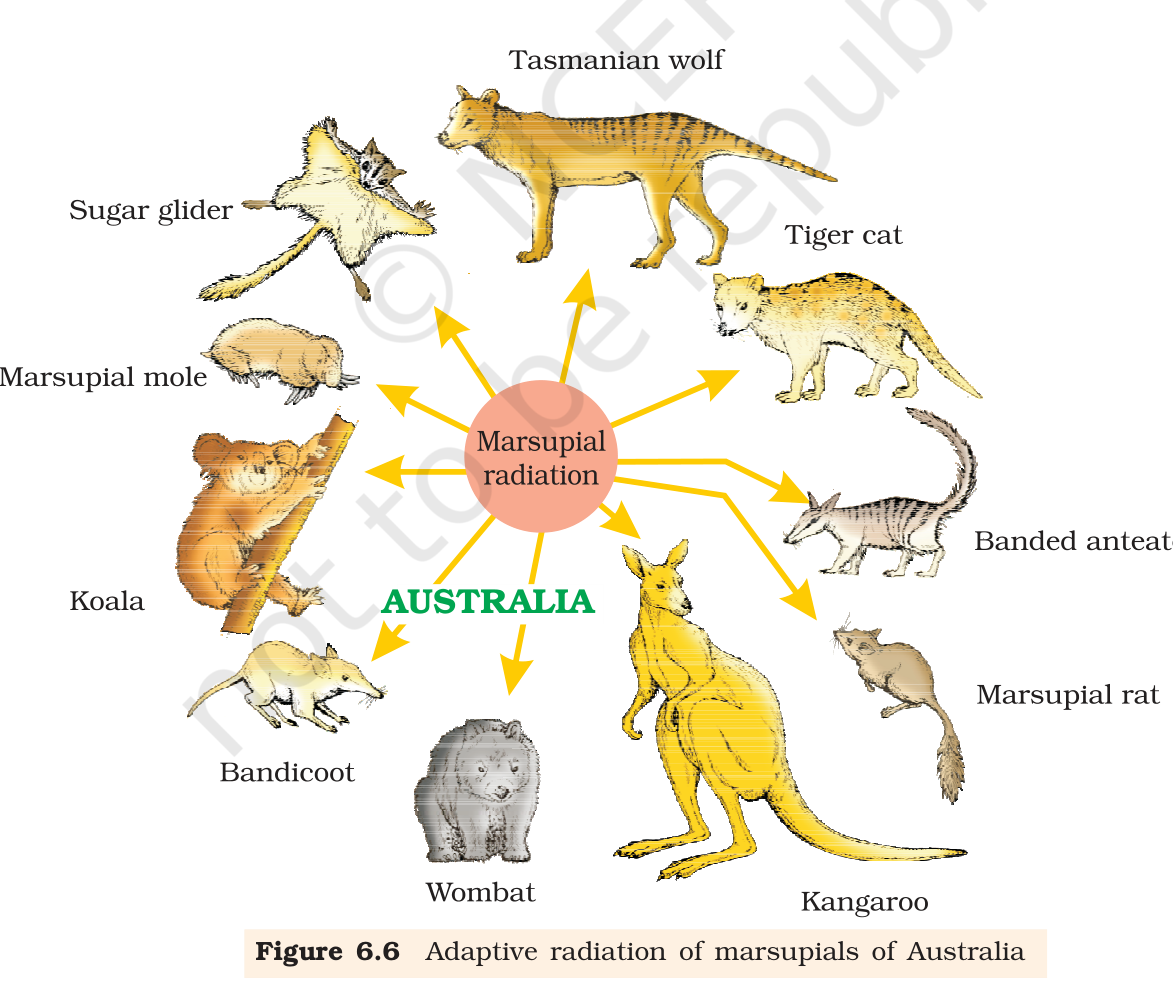
Official NCERT figure of four varieties of finch beaks that Darwin found in the Galapagos Islands, printed as Figure 6.5.
3.2 Fitness and the speed of change
Natural selection would have begun to act once cells with differing metabolic abilities existed. Selection is the core of Darwin's theory. How fast a new form appears depends on the lifespan of the organism. A microbe that divides every few hours can build a population of millions in a day. Suppose a bacterial colony growing on one medium contains variants that differ in their ability to use a nutrient. Change the medium, and only the variants that can use the new nutrient continue; over time they outgrow the rest and behave as a new species, all within days. A comparable change in a fish or a bird takes millions of years because each generation is measured in years. Under the new conditions the surviving type has higher fitness. Since fitness depends on inherited characters, there must be a genetic basis for being selected. Another way of putting it: inherited adaptive ability allows an organism to do better in a hostile environment, and fitness is the outcome of being able to adapt and then be chosen.
The two central ideas in Darwin's theory are natural selection and branching descent. Branching descent is the splitting of lineages from shared ancestors, and it explains the homologies found across groups; natural selection explains why particular variants become common.
3.3 Lamarck, Malthus and the logic of selection
Lamarck, a French naturalist who wrote before Darwin, accepted that life evolves but attributed it to use and disuse of parts. His giraffes, he claimed, had stretched their necks while reaching for leaves on tall trees, and the acquired stretch was inherited, so the necks lengthened down the generations. Modern biology rejects this, because acquired modifications of the body are not inherited in that way.
Thomas Malthus wrote about populations, and his work may have prompted Darwin's thinking. The observations on which selection rests are simple. Resources are finite. Population size stays roughly constant apart from seasonal swings. Individuals differ from one another, and no two are identical even when they look alike. Most of that difference has an inherited basis. If every individual reproduced to its maximum, numbers would grow exponentially, as a bacterial culture shows, yet real populations remain bounded; therefore individuals compete for limited resources. Some survive at the expense of others. Darwin's original step was to see that inherited differences improving the use of resources let their bearers reproduce more, and that over many generations the survivors leave more offspring, so the population's characteristics shift and new forms emerge.
3.4 Where variation comes from
Darwin left open the source of variation and the details of speciation. Mendel had described heritable factors that influence the phenotype, but Darwin did not use those results. Early in the twentieth century Hugo deVries, working with evening primrose, proposed that mutations, meaning large differences appearing suddenly, drive evolution. In his view mutation rather than Darwin's small heritable differences causes evolution. Mutations arise at random and have no direction, whereas Darwinian variation was small and directional. Darwin thought evolution gradual; deVries thought a single large mutation could create a species at once, a view he called saltation. Population genetics later made the relationship between the two clearer.
3.5 Putting the two examples together
The finch and marsupial cases show how one ancestral population can occupy several niches when opportunity exists. Each lineage accumulates features that suit its own way of life, and the isolation of an island or continent keeps the branches from merging again. That isolation is why the same pattern appears on islands more often than on large connected land masses. In the Australian case the marsupial forms were already established, and the later placental arrivals evolved similar body forms because they met similar conditions, which is convergence built on top of radiation. Reading the two together shows that radiation produces variety while convergence produces resemblance, and the two can operate in the same region.