

Concepts: origin of life and the theory of evolution
Evolution20 min readLesson 1 of 6
1.1 A very old universe and a very old earth
The story of life is short compared with the story of the universe. Current estimates put the age of the universe near 13.8 billion years. Galaxies are collections of stars together with gas and dust, and the earth is one small planet of the solar system inside the milky way. According to the Big Bang theory the universe began in a singular explosion, then expanded and cooled; hydrogen and helium appeared, and gravity collected matter into galaxies. The earth formed around 4.5 billion years ago.
At first the earth had no atmosphere of the kind we have now. Molten rock released water vapour, methane, carbon dioxide and ammonia, and these gases covered the surface. Sunlight in the ultraviolet range broke water molecules apart into hydrogen and oxygen; hydrogen, being light, escaped into space. The oxygen that remained became part of water and carbon dioxide by combining with ammonia and methane, and an ozone layer built up. Cooling allowed the vapour to condense as rain, which collected in the depressions and produced the oceans. Life is dated to roughly 500 million years after the earth formed, close to four billion years ago, and the earliest life forms lived in water.
1.2 Two discarded ideas and one experiment
The suggestion that life arrived from elsewhere is ancient. Greek thinkers imagined spores travelling between planets, and the modern name for the idea is panspermia, which some astronomers still discuss. A rival old belief held that living things grow out of rotting material such as straw or mud; this is spontaneous generation. Pasteur tested it in the laboratory. Flasks that had been pre-sterilised stayed free of life even when yeast had been killed, while in an open flask new living organisms appeared that came from pre-existing life in the air rather than from the killed yeast. That result ended the debate over spontaneous generation. The origin of the first life was left unexplained by Pasteur's work, and the question passed to chemistry.
1.3 Chemical evolution before biology
A Russian scientist, A.I. Oparin, and an English scientist, J.B.S. Haldane, independently argued that non-living organic molecules such as RNA and proteins could have given rise to the first life, and that this chemistry came before biology. They called the process chemical evolution: inorganic starting materials forming a variety of organic compounds. Conditions on the young earth suited such chemistry, with high temperatures, violent volcanic storms and an atmosphere that was reducing, containing methane and ammonia.
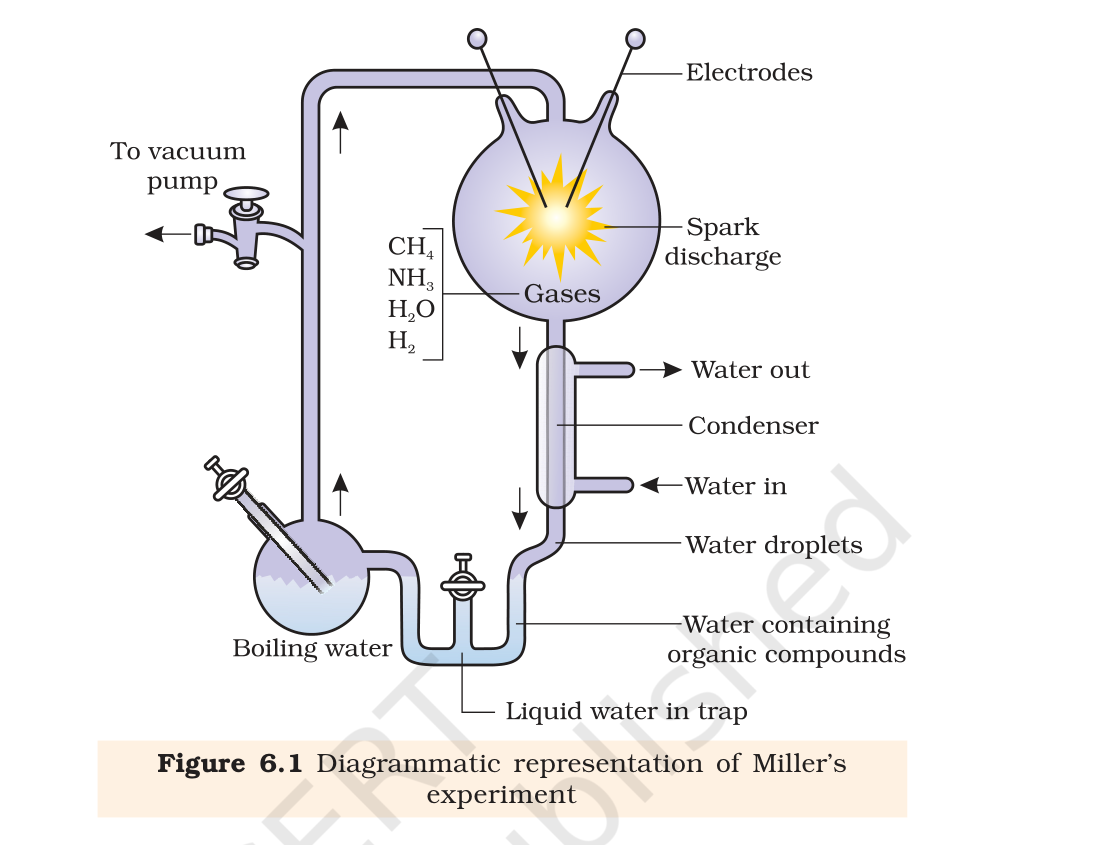
Miller tested the idea in 1953. His closed apparatus held methane, hydrogen, ammonia and water vapour at 800 degrees Celsius, and an electric discharge supplied energy. Amino acids appeared in the mixture. Comparable experiments produced sugars, nitrogen bases, pigments and fats, and meteorites were found to contain similar compounds. This body of evidence made chemical evolution acceptable as the first part of the story.
Nobody knows how the first self-replicating metabolic capsule formed. Giant molecules such as RNA, proteins and polysaccharides may have been the first non-cellular life, reproducing their molecules about three billion years ago. Cells probably appeared only around 2000 million years ago, and the earliest ones were single cells. Almost everyone accepts that the first life arose slowly from non-living molecules through evolutionary forces.
1.4 Darwin's argument
The older explanation, special creation, held three things: that every species now present was created in its present form; that the amount of diversity has never changed; and that the earth is only about four thousand years old. During the nineteenth century each of these claims was challenged. Charles Darwin spent a long voyage around the world on H.M.S. Beagle, a sailing ship, and from his observations concluded that present life forms resemble one another, and also resemble forms that lived in the distant past, to different degrees. Since many of those past forms are extinct, extinction and the appearance of new forms must both have occurred, and the change must have been gradual.
Darwin's explanation is natural selection. Variation is present in every population. Individuals whose characteristics make survival easier in local conditions of climate, food and physical factors have an advantage: they breed more successfully than those less suited. The word Darwin used for this is fitness, and he meant reproductive fitness, producing more surviving offspring. Better fitted individuals leave more progeny, and the population changes in their direction; nature has selected them. Natural selection, in this sense, is the mechanism of evolution. Alfred Wallace reached the same conclusion from his work in the Malay Archipelago. The same reasoning implies an old earth, since gradual change of this kind needs immense stretches of time.
Exam
For a question on Miller's experiment, write the four gases, the energy source, the temperature and the products. For a question on natural selection, write the three steps: variation exists, some variants survive and reproduce better, the survivors leave more progeny.