

Concepts: evidences for evolution
Evolution22 min readLesson 2 of 6
2.1 What fossils show
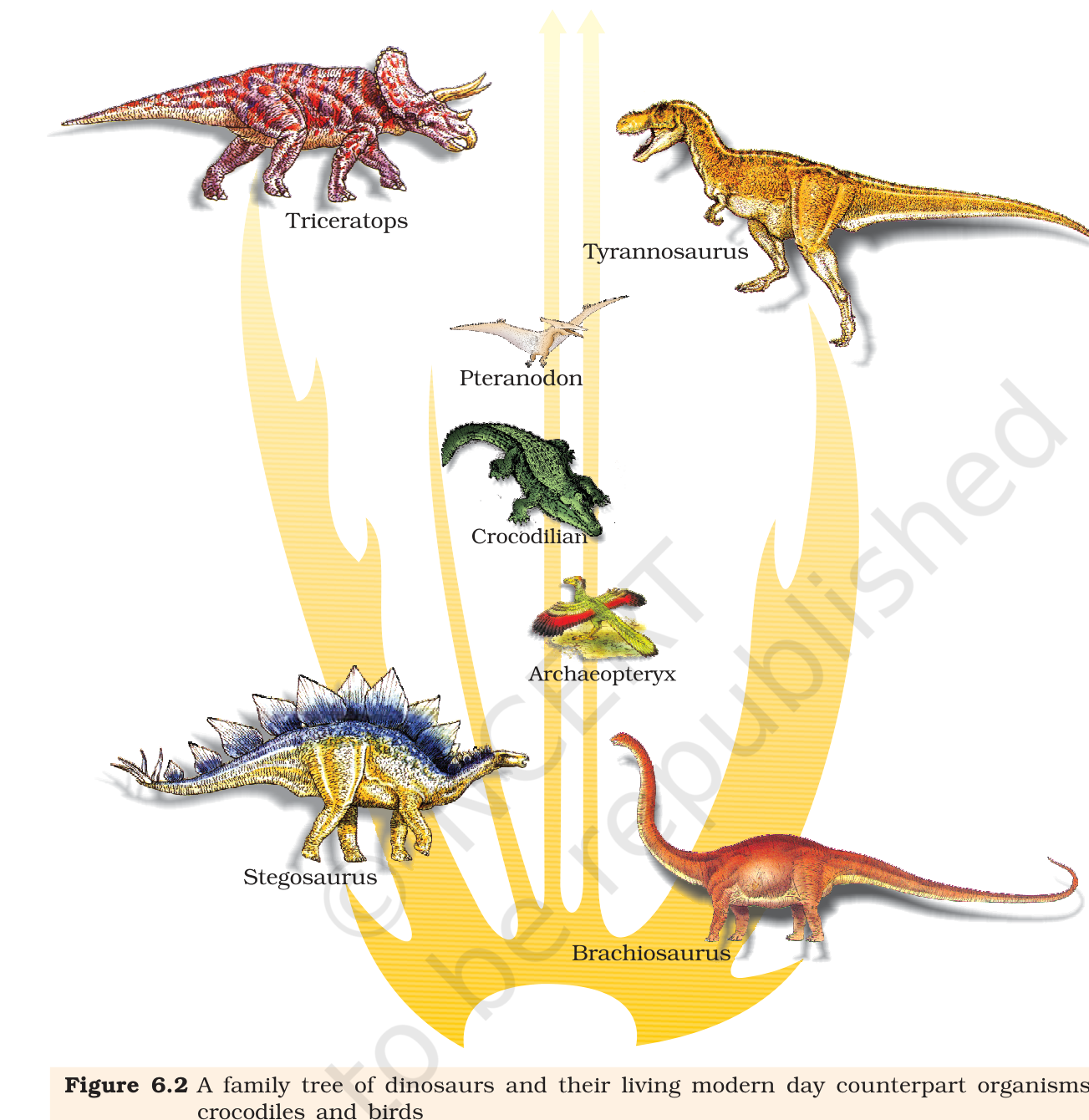
Several independent lines of evidence support evolution. The first is palaeontology, the study of fossils. A fossil is a preserved remnant, usually of hard parts, of an organism that lived long ago; such remnants are found inside rock. Rocks themselves are built up from sediments, and the layers visible in a cross section of the crust record a long sequence of deposition. Fossils in one layer are therefore of a different age from those in another, and they represent organisms that died while that sediment was forming. Some fossil forms resemble living organisms, but many belong to groups that have disappeared, the dinosaurs being the obvious case. Comparing the fossils of successive layers shows the geological period in which a form existed. The overall picture is that life has changed through time and that particular kinds of organism occur only in particular intervals of geological time, which means new kinds appeared at different moments. Radioactive dating supplies the ages of the layers and of the fossils in them.
2.2 Embryos and the correction of a claim
Embryology was used by Ernst Haeckel in support of evolution. He pointed to features shared by the embryos of all vertebrates that are missing from the adults, and the best known is a row of gill slits behind the head that leaves no trace in adults. These slits work only in fish. Haeckel concluded that an embryo passes through the adult condition of its ancestors. Later, careful work by Karl Ernst von Baer refuted that conclusion: an embryo does not go through the adult stages of other animals. The shared embryonic features are real, but Haeckel's reading of them was rejected.
2.3 Comparing body plans and molecules
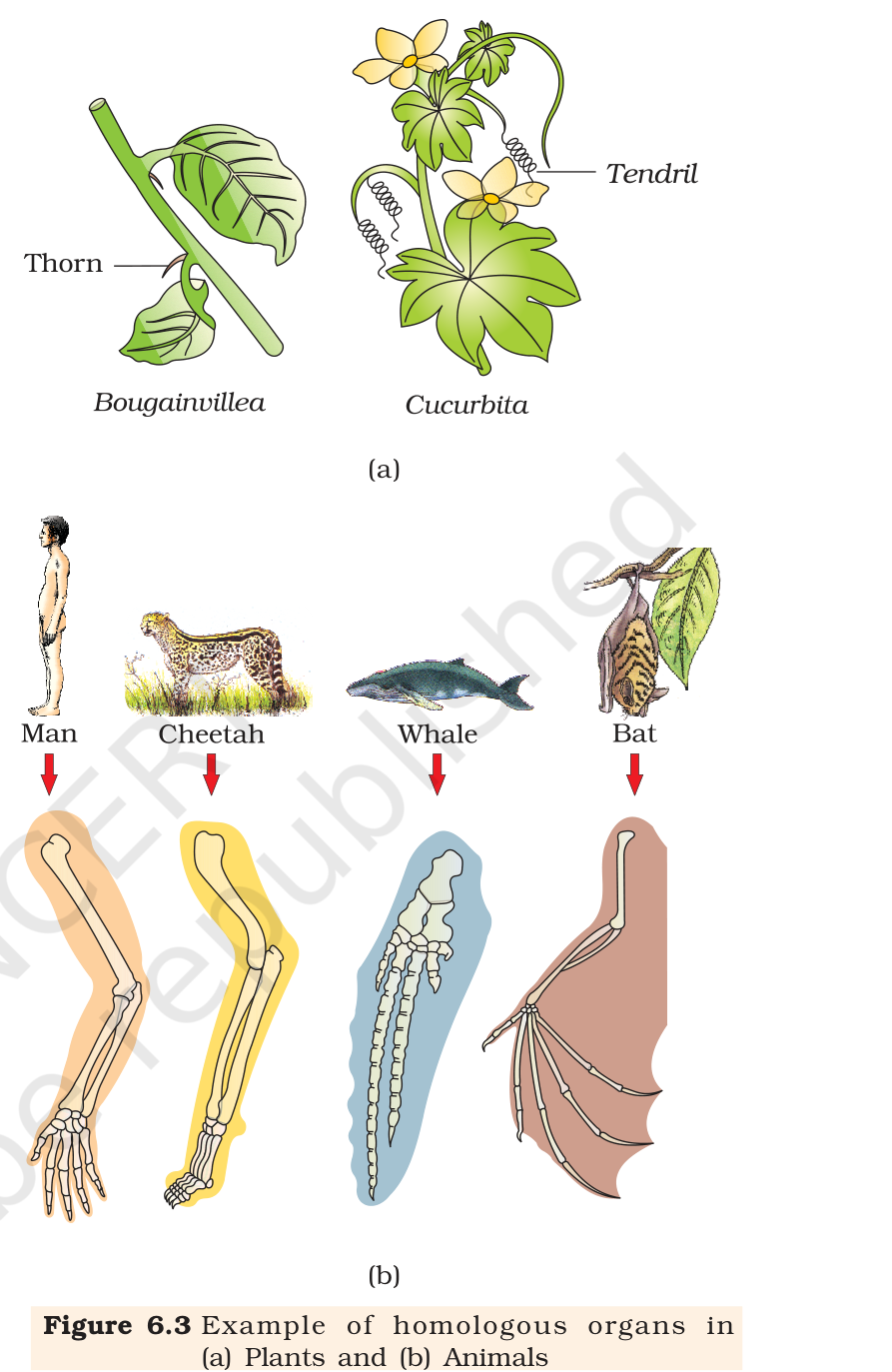
Anatomy and morphology compare present organisms with past ones, and the comparison helps decide whether ancestry was shared. Take the forelimbs of four mammals: whale, bat, cheetah and human. The same set of bones is present in each, namely humerus, radius, ulna, carpals, metacarpals and phalanges. The limbs are used for very different activities, yet the underlying structure follows the same plan and has been modified along different lines as each species became adapted to its way of life. Evolution in divergent directions produces such structures, which are termed homologous. Homology points to common descent. In plants the same principle covers the thorn of Bougainvillea and the tendril of Cucurbita, and vertebrate hearts and brains provide further cases.
Analogy is the reverse of homology. A butterfly's wing and a bird's wing both serve flight and may look similar, but their anatomy is entirely different. Structures that differ in origin yet serve one function are analogous, and they arise through convergence: unrelated lines each solve a similar problem in a similar way. Eyes of octopus and of mammals, flippers of penguins and dolphins, and the sweet potato (a modified root) with the potato (a modified stem) illustrate analogy. A shared habitat favours similar adaptations in unrelated organisms, so similarity of appearance need not mean shared ancestry.
Molecules give independent evidence. Proteins and genes that do the same job are similar across very different organisms, and these molecular resemblances point to common descent, just as structural resemblances do.
Selective breeding by humans points the same way. People have chosen plants and animals for farming, gardens, sport and security, and the breeds produced within a few hundred years differ from other breeds while still belonging to the same group. A short period of selection by humans has therefore been enough to produce large differences.
The conclusion follows directly. If selection by humans can change a lineage so much in a few hundred years, natural selection acting over millions of years can produce far greater differences.
2.4 Industrial melanism and evolution in real time
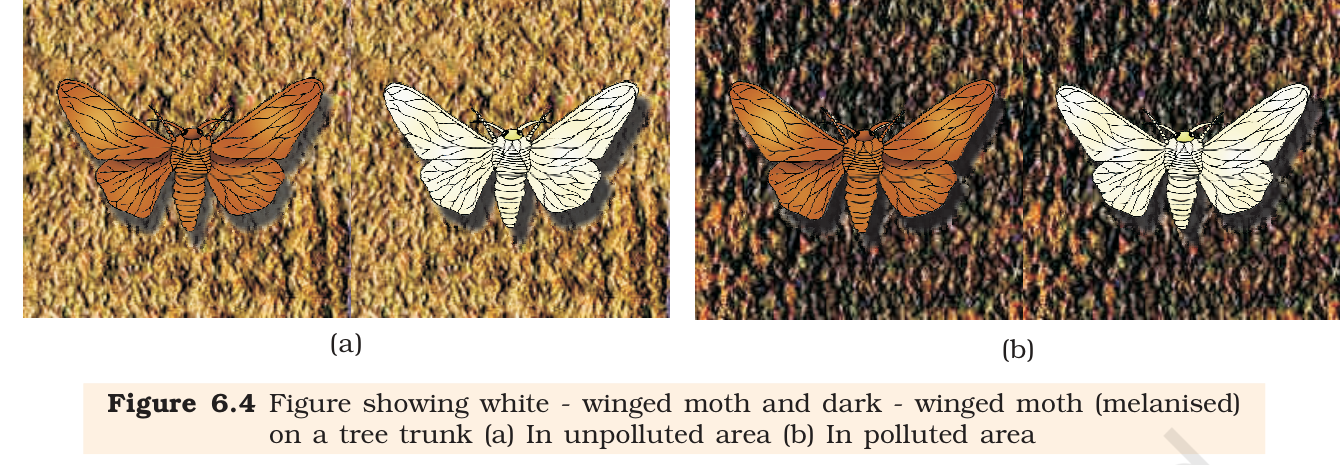
An observation from England supported evolution by natural selection while it was happening. In collections of moths made in the 1850s, before industrialisation, white winged moths were more common on tree trunks than dark winged or melanised moths. In collections from the same area after industrialisation, around 1920, dark winged moths were more common, so the proportion had reversed. The explanation is that predators spot a moth against a contrasting background. Before industrialisation, lichens covered the trees in almost white colour, so the white moth was hidden and the dark moth was picked out. After industrialisation, smoke and soot made the trunks dark, so the white moth was picked out and the dark moth survived. Lichens themselves are industrial pollution indicators, since they do not grow in polluted areas. In rural areas where industrialisation did not occur, the count of melanic moths stayed low. No variant is completely wiped out in this process.
2.5 Selection caused by people
The same reasoning explains why heavy use of herbicides and pesticides produces resistant weeds and insects so quickly, and why microbes become resistant to antibiotics. Resistant forms can appear within months or years rather than centuries. Such change, driven by human activity, is called evolution by anthropogenic action. It also shows that evolution is not goal-directed. Chance events and chance mutations supply the variation, and the environment of the moment decides which variants do better; the outcome is stochastic rather than planned.