Concepts: Hardy-Weinberg principle and the story of life
Evolution24 min readLesson 4 of 6
4.1 Allele frequencies and genetic equilibrium
A population can be described by the frequencies of the alleles at a locus. The Hardy-Weinberg principle says these frequencies stay stable and do not change from one generation to the next, so the gene pool, the total set of genes and alleles in the population, remains constant. Such constancy is genetic equilibrium. All allele frequencies together add up to one. For a diploid with two alleles, call their frequencies p and q; then p plus q is one. Homozygous AA individuals appear with frequency p squared, because the allele A on one chromosome and the allele A on the other are independent events whose probabilities multiply. The aa genotype appears with frequency q squared and the heterozygote Aa with frequency 2pq. Adding the genotype frequencies gives the square of p plus q.
Measured frequencies that differ from the predicted ones point to evolutionary change, and the size and direction of the difference show how far the population has moved. Any change in allele frequencies disturbs the equilibrium and is read as evolution. Five processes disturb this stability: gene flow between populations, random drift, fresh mutations, recombination during gamete formation, and selection by the environment. Migration of part of a population to another place changes allele frequencies in both the old and the new population, losing alleles from the first and adding them to the second, and repeated migration gives gene flow. A chance change of the same kind is genetic drift; when drift is strong the new sample can become a different species, and the original drifted group is called the founder population, the outcome being the founder effect.
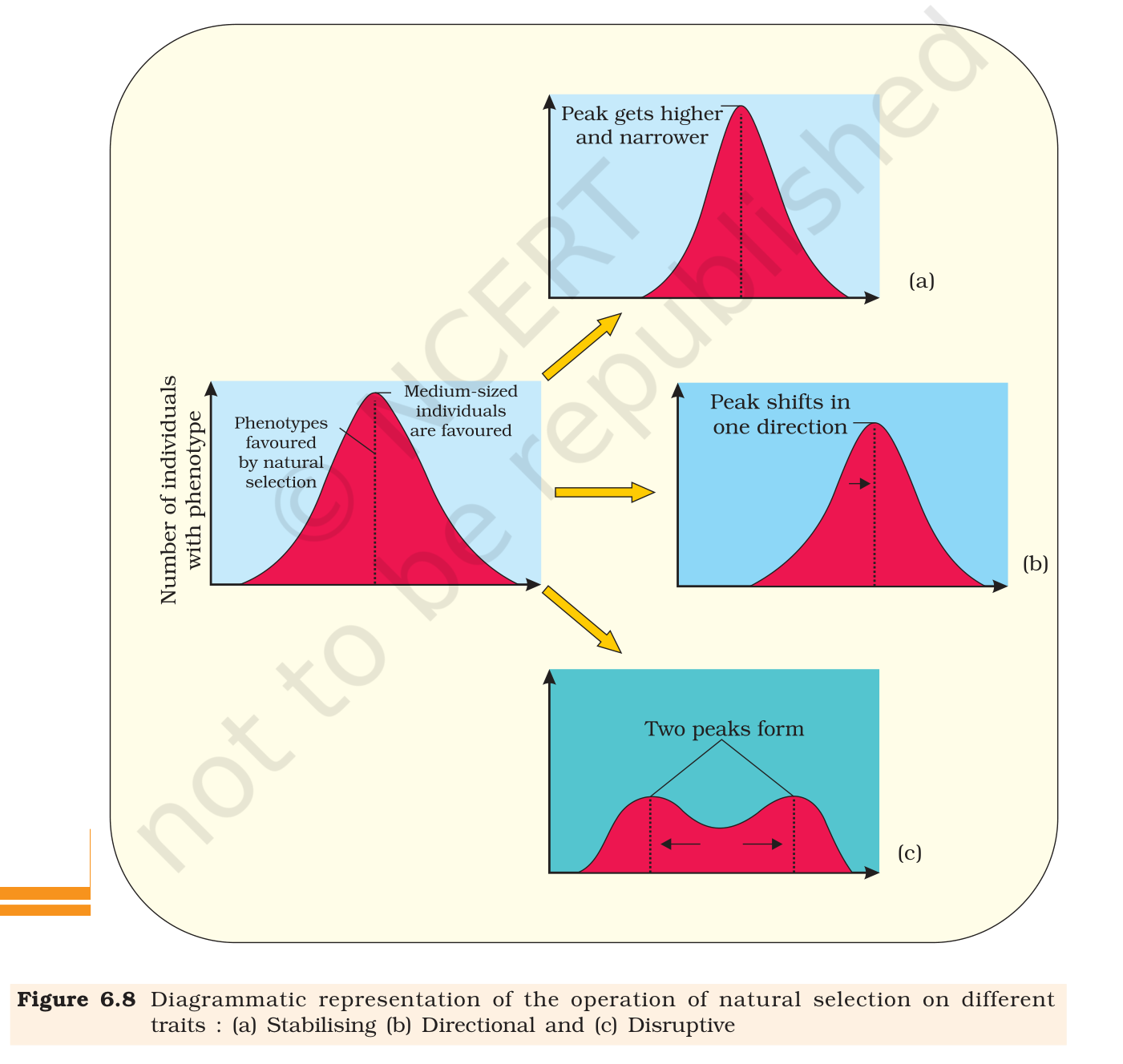
Selection can change a trait's distribution in three ways, usually shown as graphs of individual number against character value. Stabilising selection rewards the average value, so the peak becomes taller and narrower. Directional selection rewards one side of the average, so the peak moves sideways. Disruptive selection rewards both extremes, so two peaks appear and middle values become rarer.
4.2 From cells to vertebrates
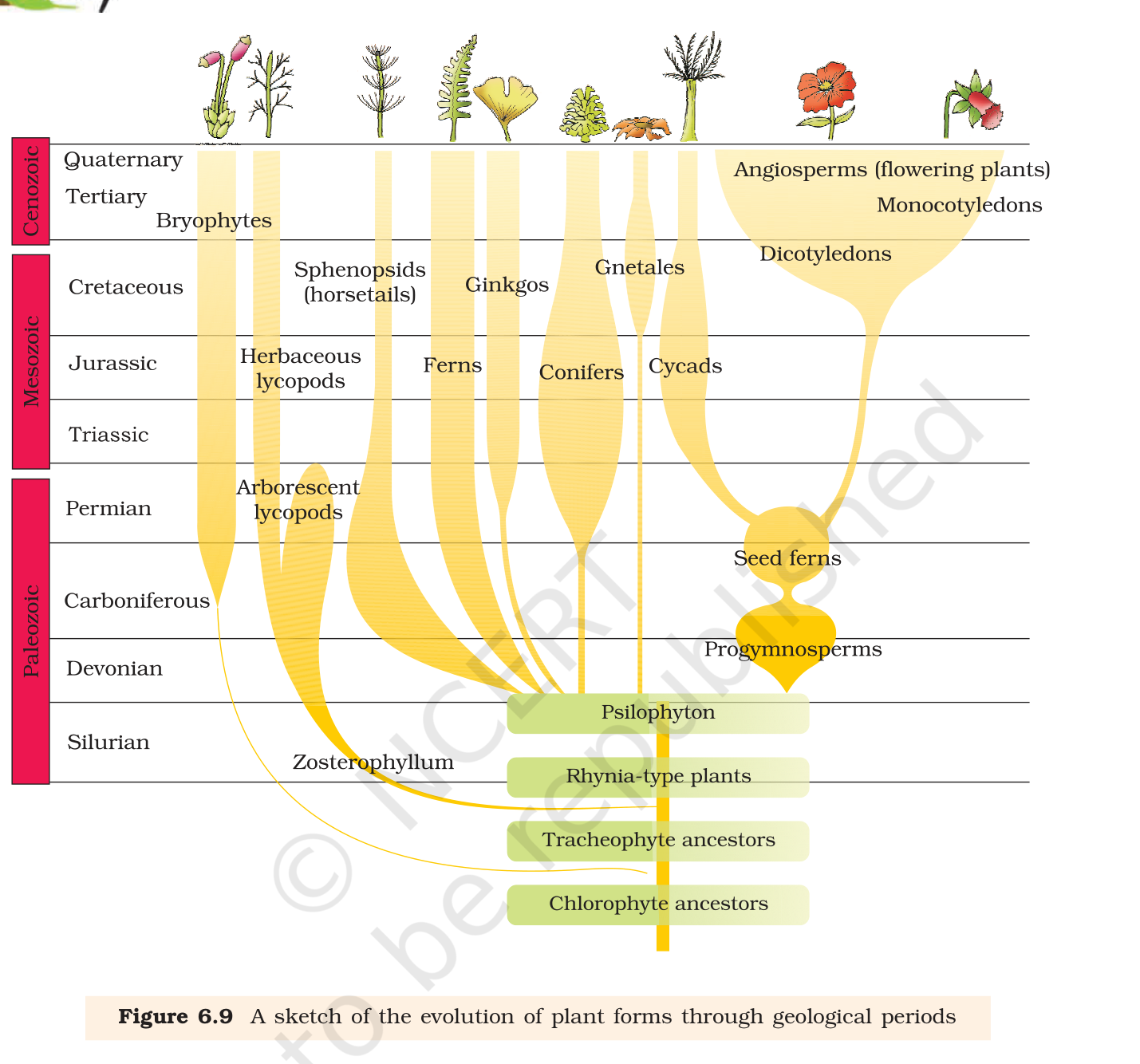
The earliest cellular life is dated at about 2000 million years ago. How aggregates of giant macromolecules acquired a membrane is unknown. Some early cells could release oxygen, probably through a reaction like the light reaction of photosynthesis, in which pigments capture solar energy and water is split. Single cells gradually gave rise to multicellular forms. Invertebrates were diverse and active by about 500 million years ago. Jawless fish appeared around 350 mya, and seaweeds with a few plants existed by about 320 mya. Plants were the first settlers of land and were already common there when animals moved in. Fishes with strong, stout fins could cross land and return to water, roughly 350 mya. A fish caught in South Africa in 1938, the Coelacanth, was thought extinct but proved to be a living lobe-finned fish, and lobe-fins gave rise to the first amphibians, which lived partly on land and partly in water and were the ancestors of today's frogs and salamanders. Amphibians in turn gave rise to reptiles, whose thick-shelled eggs resist drying in the sun; living reptiles include turtles, tortoises and crocodiles.
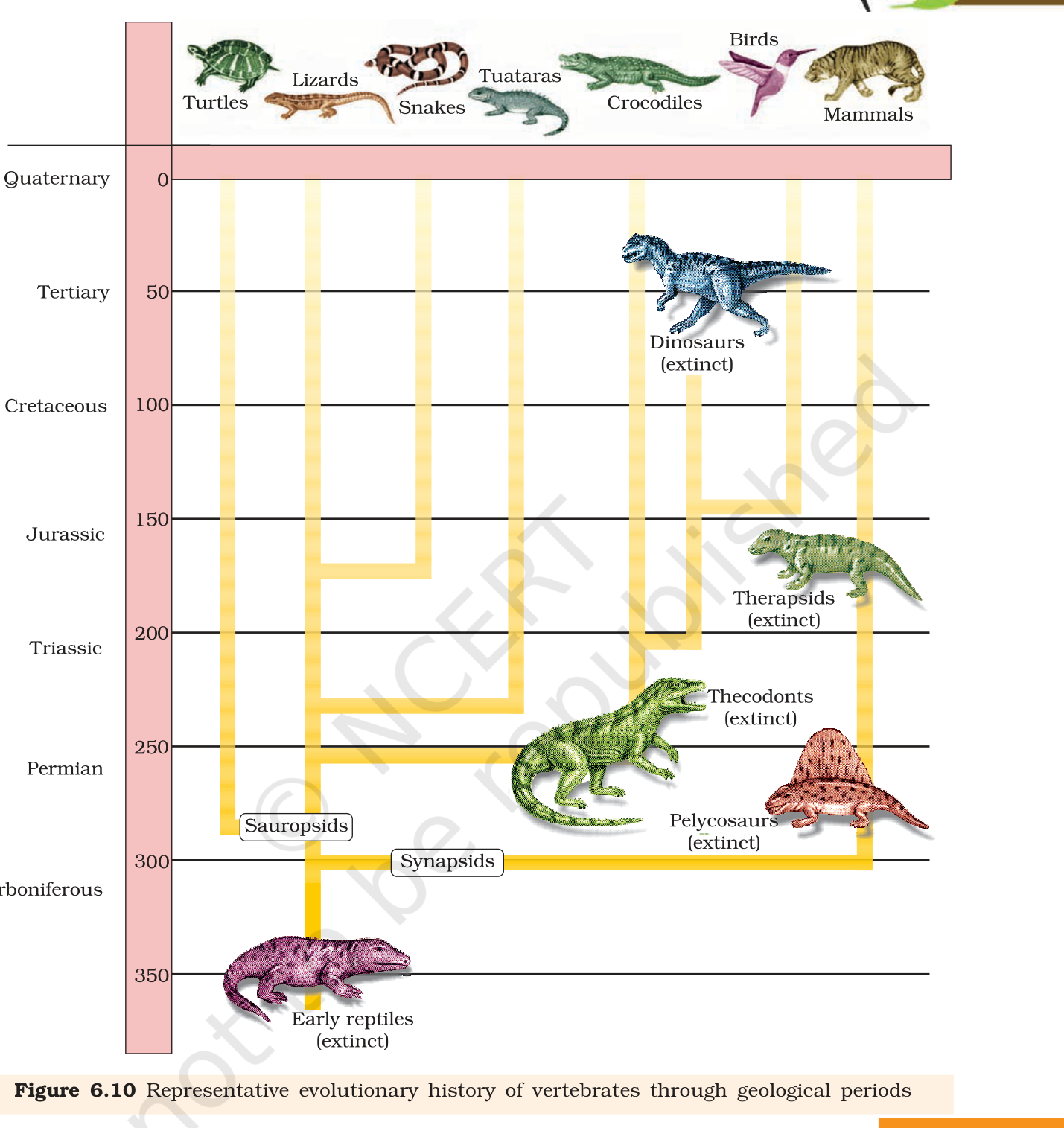
Reptiles dominated the planet for the following two hundred million years in many shapes and sizes. Tree ferns grew and their remains became coal, and some land reptiles returned to water as fish-like forms such as Ichthyosaurus about 200 mya. Dinosaurs were land reptiles, and Tyrannosaurus rex, the largest, stood about twenty feet tall and carried dagger-like teeth. Their sudden disappearance came about 65 mya, for reasons still debated; climatic change is one proposal and an origin of birds from them is another. Small reptiles of that age survive today. The first mammals resembled shrews and gave birth to live young that developed inside the mother's body. Mammals were better at detecting and avoiding danger, and when the reptiles declined the mammals expanded. South America once held mammals resembling horse, hippopotamus, bear and rabbit; when continental drift joined that continent to North America, northern forms replaced them. The same drift left Australia's pouched mammals without competitors, so they survived. Some mammals, including whales, dolphins, seals and sea cows, live entirely in water.
4.3 The human lineage
Two primates, Dryopithecus and Ramapithecus, lived about 15 million years ago. Both were hairy and moved like gorillas and chimpanzees; Ramapithecus looked more human and Dryopithecus more apelike. Man-like fossil bones from Ethiopia and Tanzania show hominid features and suggest that man-like primates walked in eastern Africa 3 to 4 million years ago, probably standing upright and not taller than four feet. Around 2 million years ago, Australopithecines inhabited East African grasslands, used stone weapons for hunting and lived largely on fruit. Among their bones were remains of a different form, Homo habilis, the earliest human-like hominid, with a cranial capacity of 650 to 800 cc and probably no meat in its diet. Fossils from Java dated to about 1.5 million years ago represent the next stage, Homo erectus, with a brain near 900 cc and probably a meat eater. The Neanderthal man, with a cranial capacity of 1400 cc, lived in the near east and central Asia between 1,00,000 and 40,000 years ago, wore hides and buried its dead. Homo sapiens appeared in Africa and spread across continents, forming distinct races. Modern Homo sapiens emerged during the ice age of 75,000 to 10,000 years ago; cave paintings from about 18,000 years ago survive at Bhimbetka in Raisen district, Madhya Pradesh, and farming began about 10,000 years ago, leading to permanent settlements.