

Concepts: charge, conductors and Coulomb's law
Electric Charges and Fields22 min readLesson 2 of 8
2.1 Two kinds of charge
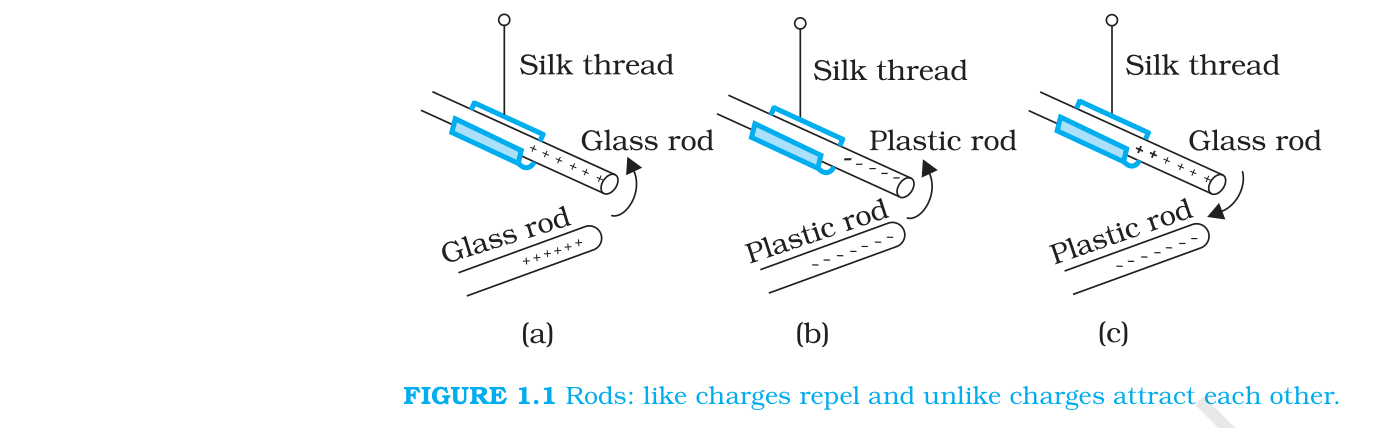
A body that has gained electrons is negatively charged, and a body that has lost electrons is positively charged. Rubbing two different materials transfers electrons between them, and both bodies end up with equal but opposite charges. Glass rubbed with silk and plastic rubbed with fur are the standard demonstrations.
Charge comes in only these two kinds. Like charges push apart and unlike charges attract. The amount of charge is a scalar, so charges add as ordinary numbers and the total charge of an isolated system stays constant. A neutral object holds equal positive and negative charge, and an object is said to be charged only when that balance is disturbed.
2.2 Some charges and how they appear
| Property | What it says | Example |
|---|---|---|
| Quantisation | Charge exists only in whole multiples of e, where e = 1.6 × 10^-19 C | A body carries 3e, not 2.5e |
| Conservation | The total charge of an isolated system does not change | Friction transfers charge, it does not create it |
| Additivity | Total charge is the ordinary sum of the parts | Two charges of 2 microcoulomb and 3 microcoulomb give 5 |
| Invariance | Charge on a body does not depend on its speed | A moving electron has the same charge as a resting one |
For a body of ordinary size the number of electrons is enormous, so a change of millions of electrons is a tiny fraction of the total. That is why the step of one electron is invisible at the macroscopic scale, and charge can be treated as continuous in everyday problems.
2.3 Conductors and insulators
A conductor has charges that can move through the material, so a charge placed anywhere on it spreads over the surface and the field inside becomes zero once the motion stops. Metals and graphite conduct, and the human body conducts because it contains water and ions. An insulator holds electrons tightly, so charge placed on one spot stays there. Glass, rubber, plastic, dry wood and most gases insulate.
Charging an insulator needs direct contact or friction, because charge cannot flow across it. A conductor can be charged by induction without contact: bring a charged rod close, the near side gains charge and the far side gains the opposite charge, then earth the far side, and the conductor is left with the charge of the near side.
2.4 Coulomb's law
Coulomb's law fixes the size of the force between a pair of point charges: multiply the charges, then divide by the square of their separation. The force runs along the line that joins the two charges. Both charges feel it, with equal size and opposite directions, so the pair forms an action and reaction pair.
The constant k equals 9 × 10^9 N m^2 C^-2 to good enough precision for board numericals. In a medium the force is weaker than in vacuum by the dielectric constant of the medium, so water, with its high dielectric constant, reduces the force between two charges by more than seventy times.
Coulomb's law has a limit. It works exactly for point charges, for uniformly charged spheres from outside, and only when the charges stay at rest or move slowly. At very small distances, and inside matter where many charges act together, the simple two-charge expression is replaced by the field equations.
2.5 Worked example: force between two small ions
Two charges of 2 × 10^-7 C and 3 × 10^-7 C sit 30 cm apart in air. Convert the distance to 0.3 m, then apply Coulomb's law with k = 9 × 10^9. The product of the charges is 6 × 10^-14 C^2 and the square of the distance is 0.09 m^2. The force comes out as 6 × 10^-3 N, attractive if the charges have opposite signs and repulsive if they have the same sign.
A second standard problem asks where a third charge can sit between a charge q and a charge 4q, separated by a distance L, so that it stays in equilibrium. The two forces on the third charge must be equal and opposite, so k q x / r1^2 = k 4q x / r2^2, which gives r1 : r2 = 1 : 2 after taking the positive square root. The charge must be placed at L / 3 from the smaller charge, whatever the size of the third charge.
Warning
Two traps cost easy marks. A charge in equilibrium between two charges must be tested with the free body idea, not by setting the potential to zero. And the ratio of forces in a medium changes, but the direction of the force does not.
2.6 Two charges on a line
A charge of 4 microcoulomb sits at the origin and a charge of 9 microcoulomb sits 30 cm to its right. Ask where a small positive test charge feels no force. The two forces act along the same line, so the balancing point lies between the charges. Let it be x from the 4 microcoulomb charge. Equality of the two forces gives 4 / x^2 = 9 / (0.3 - x)^2, and taking the positive root gives x = 0.12 m. The balance point is closer to the smaller charge, which is the general rule for this arrangement. A third charge placed there stays in equilibrium only if it is constrained to the line, since the equilibrium is unstable along the line.