

Derivations and worked examples: flux, dipole and torque
Electric Charges and Fields24 min readLesson 4 of 8
4.1 Electric flux
Think of flux as the amount of field that pierces a surface. Tilt the surface and less field passes through it. Measure the tilt by the angle between the field and the outward normal to the surface. The flux is the dot product of the field and the area vector, and its unit is N m^2 C^-1.
For a closed surface the outward normal is positive everywhere. Field leaving the surface counts as positive flux, and field entering counts as negative flux. A charge placed outside a closed surface sends in as much field as it sends out, so its net contribution to the flux is zero. Only charges inside the surface change the net flux.
4.2 The electric dipole
Two equal charges of opposite sign separated by a small distance 2a form an electric dipole. The dipole moment has size p = q × 2a and points from the negative charge toward the positive charge. The moment is a vector: its direction follows the axis of the pair, not the field.
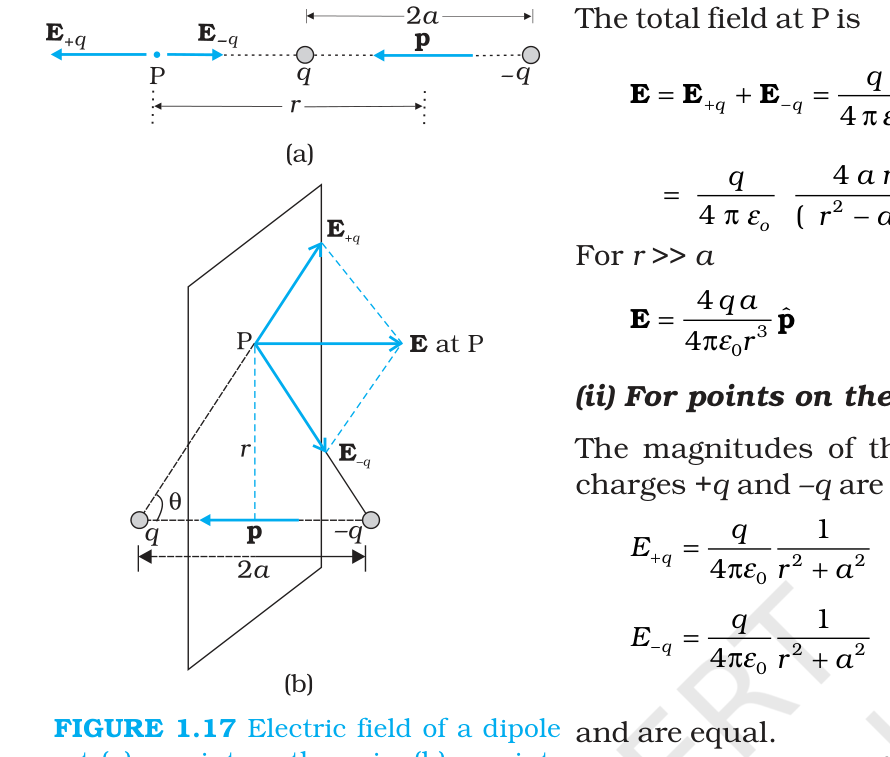
The field of a dipole is worth deriving because it appears in later chapters too. Take a point on the axis at distance r from the centre, with r much larger than a. The field of the positive charge is k q / (r - a)^2 away from it, and the field of the negative charge is k q / (r + a)^2 toward it. Subtract, use r much larger than a, and keep the first non-zero term. The two square terms nearly cancel and what remains goes as 2k p / r^3.
On the equatorial plane the two fields are equal in size and the angle between them adds a cosine factor. The result is k p / r^3, half the axial field for the same distance, and the net field points opposite to the dipole moment.
4.3 Torque and potential energy
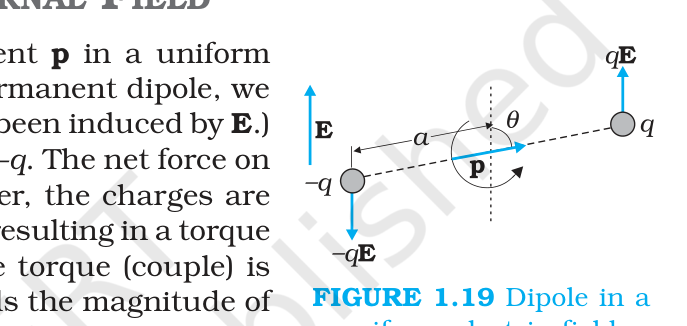
Place a dipole in a uniform field. The forces on the two charges are equal in size and opposite in direction, so the net force is zero and the centre of the dipole does not move. The pair of forces does form a couple, and the couple turns the dipole. The lever arm is a sin theta on each side, so the torque has size p E sin theta. In vector form the torque is the cross product of the dipole moment and the field.
The torque is largest when the dipole is perpendicular to the field and zero when it is parallel or antiparallel. Work done by the field in turning the dipole is stored as potential energy, and the standard expression U = -p E cos theta is lowest when the moment points along the field. A dipole aligned with the field is stable, and an antiparallel dipole is unstable.
4.4 Worked example: torque and energy
A dipole of moment 4 × 10^-9 C m is held at 30 degrees to a uniform field of 5 × 10^4 N C^-1. The torque is p E sin 30, which is 4 × 10^-9 × 5 × 10^4 × 0.5, so 1 × 10^-4 N m. The potential energy is -p E cos 30, which is about -1.73 × 10^-4 J.
A second standard problem gives two charges, one at (0,0) and one at (3 mm, 4 mm), and asks for the torque in a field of 1000 N C^-1 along the x-axis. Find the separation from the coordinates, multiply the charge by that separation to get p, then use the cross product with the field. Keep the direction in the answer: the torque vector is perpendicular to both p and E.
4.5 The continuous limit
A very small element of a charged body is still a dipole when a second charge sits nearby, because the field of that second charge varies across the element. The force on the element is then the force on its net charge plus the force on its induced dipole. This picture becomes the polarisation of a dielectric, which returns in the capacitance chapter.
Exam
Write the far field of a dipole only with the phrase r much greater than a. For distances comparable to the dipole size the derivation is not valid and the two denominator terms must be kept. A numerical answer without the direction of the torque or field loses marks.
4.6 Common mistakes in this topic
Three errors appear again and again. Writing E = k p / r^2 instead of k p / r^3 forgets that the two charges nearly cancel. Using the axial formula for an equatorial point, or the other way round, swaps the factor of two. And adding torque magnitudes without checking the direction leaves the answer half finished, because torque is a vector. Keep the formulas labelled axial and equatorial until they are automatic.