

Derivations and worked examples: Gauss's law and its applications
Electric Charges and Fields24 min readLesson 5 of 8
5.1 The statement
Gauss's law connects the flux through any closed surface to the net charge inside that surface. It is a direct consequence of Coulomb's law and the geometry of space. Choose any closed surface, called a Gaussian surface, and take the outward normal at every element. The total flux through the surface is the enclosed charge divided by epsilon0.
The law works because the flux through a closed surface from a point charge depends only on the solid angle the surface subtends, not on the shape or size of the surface. Squeeze the surface around a charge and the flux stays q / epsilon0. Move the charge outside and the positive and negative contributions of the same field lines cancel.
5.2 Justification for a point charge
Place a charge q at the centre of a sphere of radius r. The field is radial and has the same size everywhere on the sphere, and the area of the sphere is 4 pi r^2. Multiply the two and the radius cancels, leaving q / epsilon0. Any other closed surface can be built from pieces of spheres and cones, and the same cancellation happens, so the result is general.
5.3 Applications
For a long straight wire carrying a uniform linear charge density lambda, choose a coaxial cylinder of radius r and length L. The field is radial, so it pierces the curved surface and not the flat ends. The flux through the curved surface is E times 2 pi r L, and the charge inside is lambda L. Divide and the field is lambda divided by 2 pi epsilon0 r. The direction is radially outward for positive charge.
For an infinite plane sheet with surface charge density sigma, choose a pillbox that crosses the sheet. Field piercing both flat faces contributes, and the curved side contributes nothing because the field is parallel to it. The flux is 2 E A and the charge inside is sigma A, which gives E = sigma / (2 epsilon0) in magnitude. The field is uniform in size on both sides and points away from a positive sheet.
For a thin spherical shell of radius R and total charge Q, choose a concentric sphere of radius r. Outside the shell the flux is E times 4 pi r^2, and the charge inside is Q, so the field is k Q / r^2, exactly the field of a point charge at the centre. Inside the shell the flux is zero because the enclosed charge is zero, so the field is zero there. A charged conductor has zero field inside its material for the same reason, and any excess charge sits on the outer surface.
Slideshow, slide 1 of 3. Use the left and right arrow keys to change slides and the space bar to play or pause.
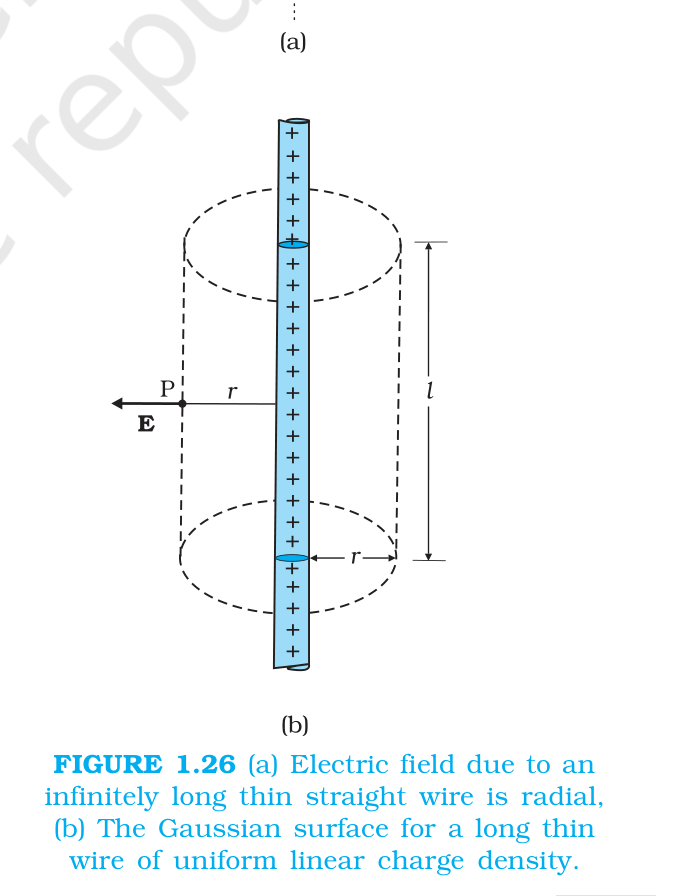
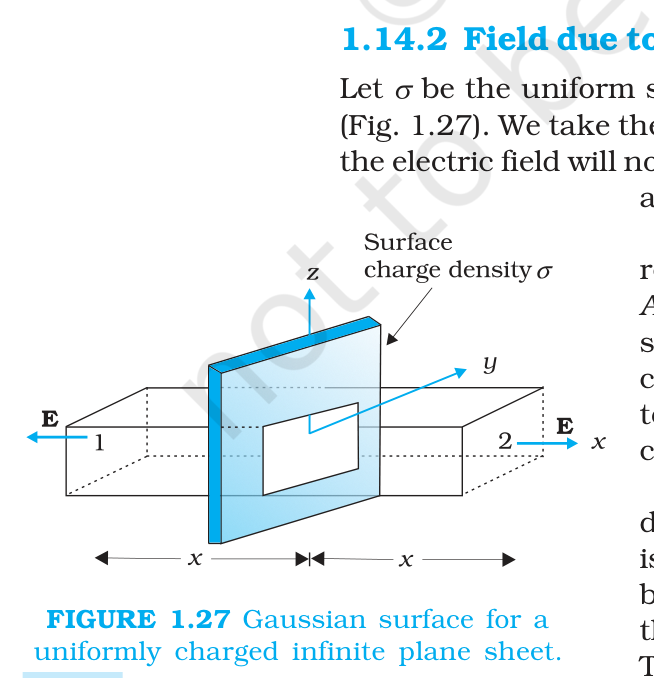
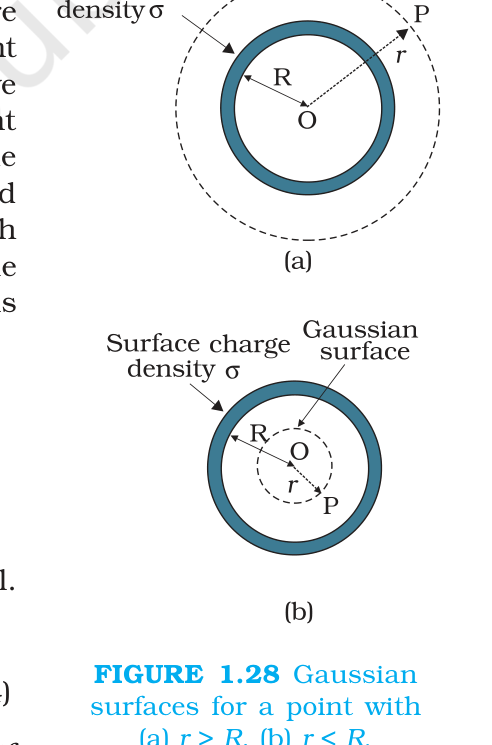
Electric field of a long straight charged wire pointing radially out, with a coaxial cylindrical Gaussian surface drawn around a section of the wire.
5.4 Worked example: flux through a cube
Put a 2 microcoulomb charge at the centre of a cube of edge 9 cm. Only the enclosed charge matters for the total flux, so divide q by epsilon0: 2 × 10^-6 / 8.854 × 10^-12, about 2.26 × 10^5 N m^2 C^-1.
5.5 Worked example: charge from the flux through a cube
A cube of side L sits in a region where the field is E = (A x + B) times the unit vector along x. The field has only an x component, so the four faces parallel to x carry no flux. The face at x = 0 has area L^2 and normal opposite to the field, so its flux is -B L^2. The face at x = L has flux (A L + B) L^2. Add the two contributions and the net flux is A L^3, so the enclosed charge is epsilon0 A L^3. Recognising that only two faces contribute is the whole trick.
5.6 Why the shape can be chosen freely
Pick a Gaussian surface that matches the symmetry of the charge distribution. A cylinder suits a line charge, a pillbox suits a sheet, and a sphere suits a point charge or a shell. If the same distribution is wrapped in an awkward surface, the flux is unchanged but the field cannot be pulled out of the integral, and the calculation stops there. The choice of surface is part of the physics, not decoration.
Exam
Three marks in this topic usually ask for the derivation of the field of a wire or a sheet. Draw the Gaussian surface, mark the angle between the field and the area vector on each part, write the flux for each part, then equate to enclosed charge over epsilon0. Skipping the angle leaves the examiner unable to see why one side contributes.
5.7 Choosing the right Gaussian surface
The surface must match the symmetry of the charge distribution. A cylinder works for a line charge because the field is radial and uniform in size on the curved surface. A pillbox works for a sheet because the field is normal to the flat faces. A sphere works for a point charge or a shell. If the surface does not match the symmetry, the field still satisfies Gauss's law, but it cannot be pulled out of the flux integral, and the method gives nothing useful. State the symmetry reason in the answer.