

Concepts: superposition, electric field and field lines
Electric Charges and Fields22 min readLesson 3 of 8
3.1 Superposition
When several charges act on one charge, each pair interacts as if the others were absent. The total force is the vector sum of the individual forces. This is the principle of superposition, and it survives the presence of matter around the charges. The same rule lets us build the field of any charge distribution from the fields of its parts.
Work through a superposition problem by fixing axes, writing each force as a magnitude with a direction, and then adding components. Do not add magnitudes unless the forces point along the same line.
3.2 The electric field
Every charge changes the space around it. Put a small positive test charge at a point and measure the force on it; the electric field at that point is the force divided by the size of the test charge. The field is a vector, it has units of newton per coulomb, and it exists whether or not a test charge is actually there.
The test charge must be small enough that its own field does not disturb the charge distribution being studied. That is the only condition on the definition.
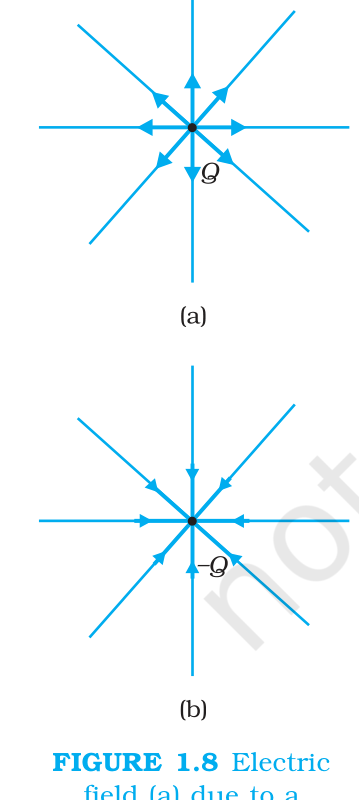
The field of a point charge falls as the square of the distance. In a medium the field is weaker by the factor K, but the 1/r^2 form is unchanged. The direction along a line through the charge is simple: away from a positive charge, toward a negative charge. Off that line the field is still radial, which means it points along the line joining the charge to the point of interest.
The field of a group of charges is the vector sum of their individual fields. For a dipole, the two fields are nearly equal in size and nearly opposite in direction at far points, so they partly cancel, and the net field falls as the cube of the distance instead of its square.
3.3 Field lines
A field line is a curve whose tangent at any point gives the direction of the field there. The spacing of the lines shows the strength: crowded lines mean a strong field, spread-out lines mean a weak field. A few rules follow from the definition and from Coulomb's law.
- Lines leave a positive charge and enter a negative charge. At infinity they start or end.
- Lines never cross. Two directions at one point would mean the field has two values, which cannot happen.
- Lines never form closed loops in electrostatics, because a closed loop would describe a field that does work around a cycle while the electrostatic force is conservative.
- The number of lines drawn through a region is a bookkeeping choice. The actual field is fixed, and only the density relative to a drawing has meaning.
For a uniform field, as between two large parallel plates, the lines are parallel, equally spaced and equally dense everywhere. For a dipole the lines bulge from the positive charge and curve into the negative one, with a neutral point region where the two fields cancel near the centre between the charges.
3.4 Worked example: field at the centre of a square
Four charges sit at the corners of a square of side 10 cm, with 2 microcoulomb at A, -5 microcoulomb at B, 2 microcoulomb at C and -5 microcoulomb at D. A charge of 1 microcoulomb is placed at the centre. The fields from A and C point in opposite directions and have equal size, so they cancel. The fields from B and D also cancel. The net field at the centre is zero, and the force on the charge there is zero as well. This kind of symmetry argument saves a long vector calculation, but state the symmetry clearly in the answer.
Exam
When a question says field, give a vector answer with direction. When it says magnitude, work with the positive root and state the direction separately. The examiner looks for the direction in one-mark and three-mark answers.
3.5 Worked example: field of two charges on an axis
Charges of 2 microcoulomb and -2 microcoulomb sit 20 cm apart on the x-axis. Find the field at a point 10 cm to the right of the positive charge, outside the pair. Let the positive charge be at the origin and the negative at 0.2 m. The point is at 0.3 m. The field of the positive charge is k q / r^2 = 2 × 10^5 N C^-1 to the right, and the field of the negative charge is also k q / r^2 with r = 0.1 m, which gives 1.8 × 10^6 N C^-1 to the left. Subtract because the fields point opposite ways, and the net field is 1.6 × 10^6 N C^-1 to the left. Sketch the arrows before substituting; a sign slip here costs the whole answer.