

Concepts: equipotential surfaces and potential energy
Electrostatic Potential and Capacitance22 min readLesson 3 of 7
3.1 Equipotential surfaces
On an equipotential surface the potential holds one value at every point. A charge that slides along the surface neither gains nor loses energy, so no part of the field can point along it, and the field must meet the surface at a right angle. If the field had a component along the surface, a charge could gain energy by sliding around the surface, which contradicts the constant potential.
For a single point charge the equipotential surfaces are concentric spheres centred on the charge. For a uniform field they are planes perpendicular to the field. For a dipole they are more complicated closed surfaces that wrap around each charge, and there is a plane through the centre where the potential is zero.
Equipotential surfaces never intersect, because a point cannot have two potentials. The spacing of the surfaces shows the field strength: closely spaced surfaces mean a rapid change of potential and a strong field, and widely spaced surfaces mean a weak field. The field lines cross equipotential surfaces at right angles everywhere.
3.2 A useful symmetry argument
The surface of a charged conductor is an equipotential surface in equilibrium. If it were not, charge would still move along the surface, and the conductor would not be in equilibrium. This is why the field just outside a conductor is perpendicular to its surface: the surface is an equipotential, so the field has no tangential component.
Draw equipotential surfaces for a pair of charges carefully. For a positive and a negative charge of equal size, the plane midway between them is the zero potential surface, and the other surfaces curve around the two charges. For two equal positive charges, the potential is positive everywhere, with a saddle shape around the midpoint between the charges.
3.3 Potential energy of a system of charges
The potential energy of a pair of charges is the work needed to bring them from infinity to their separation. It equals k q1 q2 / r, with the sign of the product of the charges deciding whether the energy is positive or negative. A positive pair stores positive energy and repels, and an opposite pair stores negative energy and attracts.
For three or more charges, add the pair energies one by one. Do not double count: with three charges there are three pairs, with four charges there are six pairs, and each pair contributes once. The total energy is the sum of these pair terms, a scalar sum with signs.
The potential energy of a system of charges is also the work done in assembling the system from infinite separation. That statement is exact and is worth writing in a derivation answer, because it connects the pair formula to the definition of potential.
3.4 Potential energy of a dipole
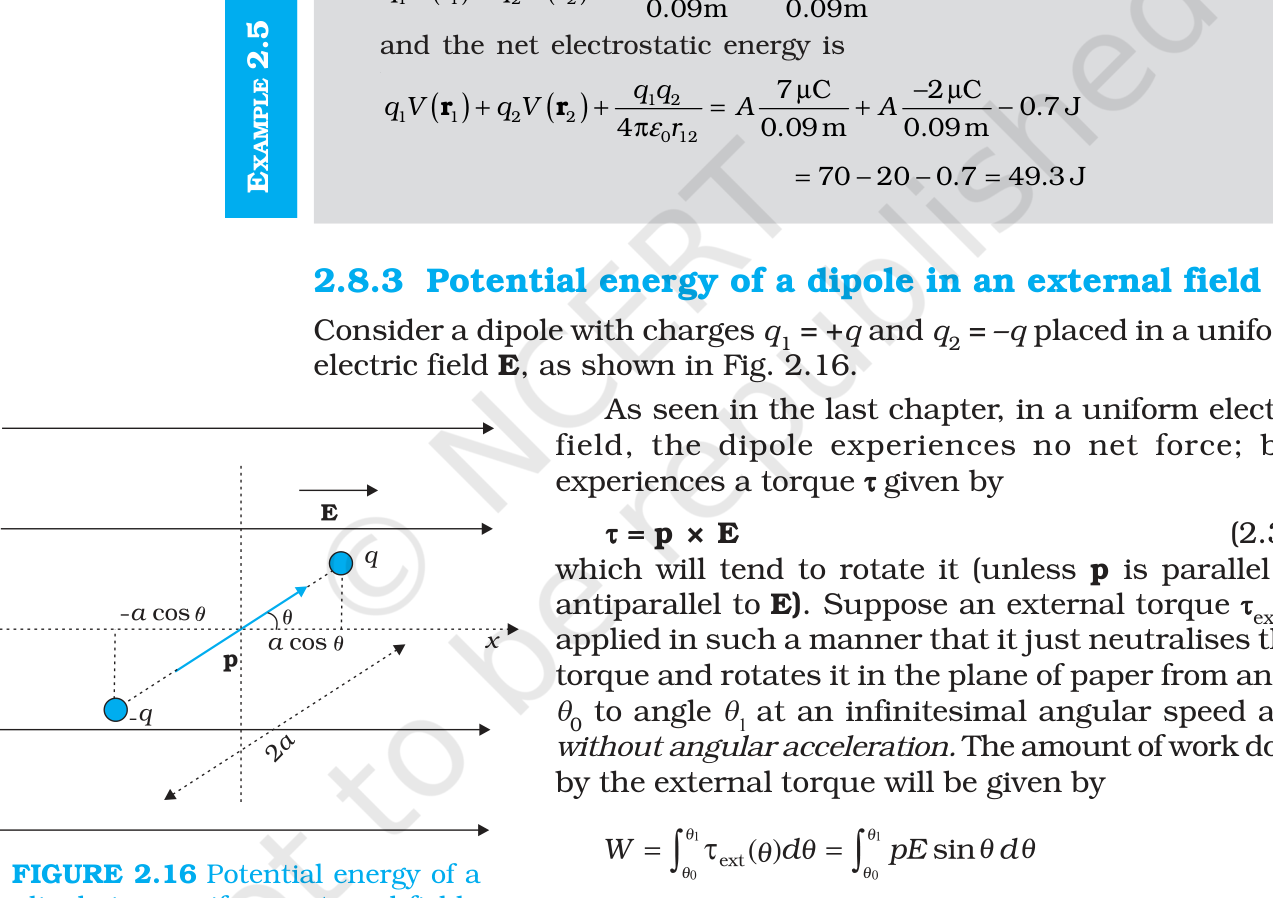
For a dipole sitting in an external uniform field, the potential energy is U = -p E cos theta. The energy is minimum when the dipole moment points along the field and maximum when it points opposite to the field. At perpendicular positions the energy is zero, which is why a dipole can sit at right angles to the field with no torque and no tendency to gain or lose energy.
The work done by an external agent in rotating a dipole from theta1 to theta2 is the change in its potential energy, p E cos theta1 minus p E cos theta2. The work done by the field is the negative of that. When the dipole rotates from parallel to antiparallel, both the work done by the agent and the change in energy are 2 p E, a favourite board question.
Exam
In a potential energy question, draw the arrangement and write the distances before writing the formula. The common error is using the distance from a charge to the origin instead of the charge to charge distances.
3.5 Worked example: potential energy of three charges
Three charges of 2 microcoulomb each sit at the corners of an equilateral triangle of side 10 cm. There are three pairs, and each pair separation is 0.1 m. Each pair term is k q^2 / r = 9 × 10^9 × 4 × 10^-12 / 0.1 = 0.36 J. The total potential energy is 3 × 0.36 = 1.08 J. The positive value tells you that the charges repel, and energy would be released if they moved apart to infinity. A negative total would mean the arrangement is bound.
3.6 Equipotentials and work in one line
Because the potential is constant on an equipotential surface, the work done in moving any charge along that surface is zero. That single sentence answers most one-mark questions on this topic. The surfaces are perpendicular to the field lines, and the spacing of the surfaces measures the field: two surfaces a fixed potential difference apart are close together where the field is strong and far apart where it is weak. The relation field equals minus the potential gradient turns that spacing into a number.