

Derivations: conductors, dielectrics and capacitors
Electrostatic Potential and Capacitance24 min readLesson 4 of 7
4.1 Conductors in electrostatics
Inside a conductor in equilibrium the field is zero. If a field existed, free electrons would move under it, so equilibrium would not yet have been reached. This single statement explains several results. The whole conductor is at one potential, because E is the negative gradient of V and a zero gradient means a constant potential. The surface of the conductor is therefore an equipotential surface.
Any excess charge on a conductor sits on its outer surface. Take a Gaussian surface just inside the surface; the field is zero on it, so the enclosed charge is zero, and the interior carries no net charge. A cavity inside a conductor is field free when there are no charges in the cavity, which is the principle of electrostatic shielding.
The field just outside a conductor is perpendicular to its surface and has size sigma / epsilon0, where sigma is the local surface charge density. The field is strongest where the surface curves most sharply, which is why charge concentrates on points and why lightning rods have sharp tips.
4.2 Dielectrics and polarisation
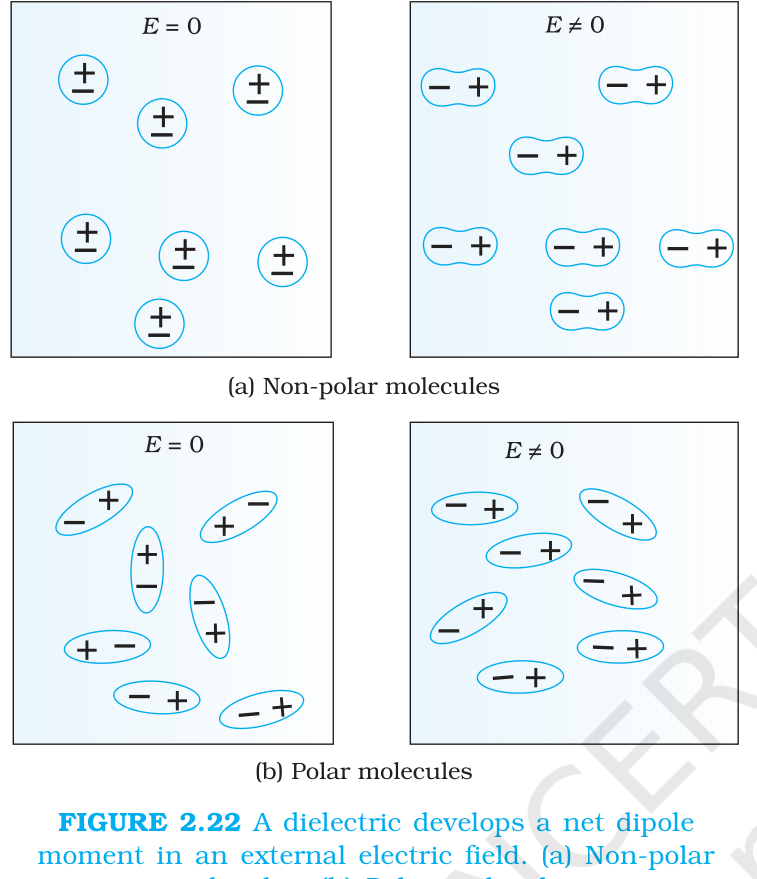
A dielectric is an insulator. In an external field its molecules polarise: polar molecules turn, and non-polar molecules have their charge centres displaced. The result is a net dipole moment per unit volume, called the polarisation, and induced surface charges on the faces of the dielectric.
The induced surface charges create a field inside the dielectric that opposes the external field. The net field inside is smaller than the applied field by the factor K, the dielectric constant. That is why a dielectric reduces the field between capacitor plates and increases the capacitance. For a vacuum K is 1, for air it is very close to 1, and for water it is about 80.
A dielectric also reduces the force between two charges in it by the same factor K, and reduces the potential at a point by K. These three statements are the same physics seen in three places.
4.3 Capacitance of a parallel plate capacitor
Take two flat conducting plates, each of area A, held a distance d apart. Put +Q on one and -Q on the other. The field in the gap is uniform, has magnitude sigma / epsilon0 which is Q / (epsilon0 A), and runs from the positive plate to the negative one. The potential difference between the plates is E d, so V = Q d / (epsilon0 A). Capacitance is charge divided by potential difference, so C = epsilon0 A / d.
The result shows that capacitance grows with plate area and falls with separation. The capacitance does not depend on the charge or the potential difference: double the charge and the potential difference doubles too, leaving C unchanged. That is worth saying in an answer, because it is often tested as a conceptual question.
With a dielectric filling the gap, the field between the plates falls to E / K for the same charge, so the potential difference falls by K and the capacitance becomes K epsilon0 A / d. A dielectric slab of constant K therefore multiplies the capacitance by K. For a partly filled capacitor, treat the arrangement as two capacitors in series or parallel depending on how the dielectric is placed.
4.4 Combinations of capacitors
In a series combination each capacitor carries the same charge, because the plates that face each other are isolated from the rest of the circuit. The potential differences add, so the reciprocals of the capacitances add and the equivalent capacitance is smaller than the smallest capacitor in the chain.
In a parallel combination each capacitor has the same potential difference, because both terminals of every capacitor are joined to the same two nodes. The charges add, so the capacitances add directly and the equivalent capacitance is larger than the largest single capacitor.
Warning
Do not mix the capacitor rules with resistor rules. Capacitors in parallel add, capacitors in series use reciprocals. Resistors are the other way round. Write the rule you are using in the answer so the examiner can see it.
4.5 Common mistakes with dielectrics
Most errors in this topic come from changing the wrong quantity. With the battery connected, V stays fixed and the charge changes. With the battery removed, Q stays fixed and V changes. The capacitance changes either way, because it is a property of the geometry and the medium. A second slip is to apply the field expression sigma / epsilon0 inside the dielectric: the net field there is sigma / (K epsilon0) when the free surface charge density is sigma. Write the fixed quantity first, then update the others.
4.6 One numerical on the conducting sphere
A conducting sphere of radius 10 cm carries a charge of 2 microcoulomb. Its potential at the surface is k Q / R = 9 × 10^9 × 2 × 10^-6 / 0.1 = 1.8 × 10^5 V. The potential at the centre is the same because the field inside is zero. Just outside the surface the field is k Q / R^2 = 1.8 × 10^6 N C^-1, and it points radially outward for positive charge. If the sphere is placed inside a hollow conductor, the field in the cavity remains zero, which is electrostatic shielding.