

Exercise practice: Electrostatic Potential and Capacitance
Electrostatic Potential and Capacitance24 min readLesson 5 of 7
5.1 Potential and work done
A charge of 2 microcoulomb is moved from a point at 200 V to a point at 500 V. The work done by the external agent is q times the potential difference, so 2 × 10^-6 × 300 = 6 × 10^-4 J. The field does the negative of this work. The sign check is simple: moving a positive charge toward higher potential needs work from outside.
A second standard type gives the potential at a distance from a point charge. For a charge of 5 × 10^-9 C at 30 cm in air, the potential is 9 × 10^9 × 5 × 10^-9 / 0.3 = 150 V. If the medium has dielectric constant 2, the potential halves to 75 V. The field would fall by the same factor.
5.2 Potential energy of a charge arrangement
Four charges of 1 microcoulomb each sit at the corners of a square of side 10 cm. There are six pairs: four sides and two diagonals. Each side pair contributes k q^2 / a, and each diagonal pair contributes k q^2 / (a root 2). Adding the six terms gives the total energy. Write the pairs first and then substitute, because the pattern is the answer.
For the three-charge version, if the total potential energy must be zero, write the three pair terms, set the sum to zero and solve for the unknown charge. This is the standard board question where a charge Q at the origin balances the potential energy of two fixed charges.
5.3 Capacitance and combination problems
A parallel plate capacitor has plate area 0.01 m^2 and separation 1 mm in air. Use C = epsilon0 A / d, which is 8.854 × 10^-12 × 0.01 / 0.001, about 8.854 × 10^-11 F, or 88.5 pF. If the separation is doubled the capacitance halves, and if the area is doubled it doubles.
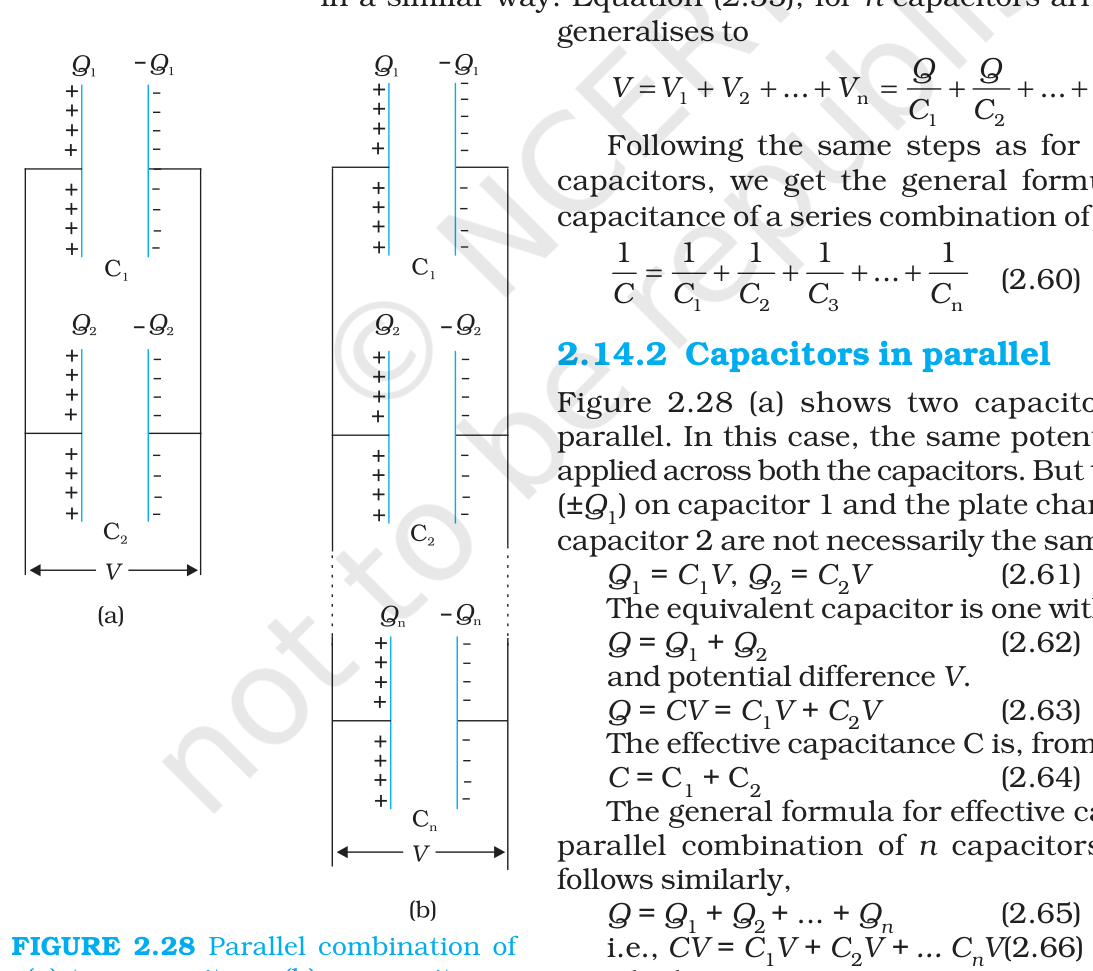
Four capacitors of 10 microfarad each form a network. If two pairs are in series and the pairs are joined in parallel, each pair gives 5 microfarad and the parallel combination gives 10 microfarad. Draw the network, reduce one pair at a time, and keep the unit microfarad through the working before converting at the end.
5.4 Energy stored before and after a change
An air capacitor of 20 pF is charged by a battery and then isolated. A dielectric of constant K is inserted. The charge stays fixed, the capacitance becomes K times larger, and the stored energy becomes U / K, because U = Q^2 / 2C. If the battery stayed connected instead, the potential difference would stay fixed and the energy would become K U, because U = (1/2) C V^2. The two cases give opposite answers, and the deciding sentence is whether the battery is connected or removed.
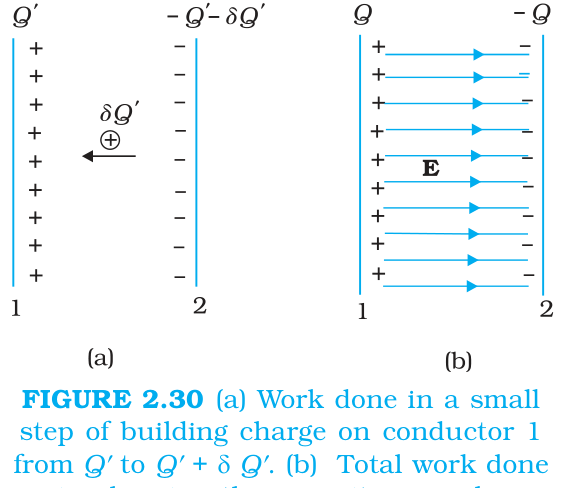
A capacitor charged to 4 microcoulomb with capacitance 20 pF stores energy Q^2 / 2C, which is 0.4 J. Pulling the plates apart at constant charge raises the energy; the work done appears as the increase in stored energy.
5.5 Potential of a charged shell
For a uniformly charged thin spherical shell of radius R and charge Q, the potential outside is k Q / r, exactly as if all the charge sat at the centre. At the surface the potential is k Q / R. Inside the shell the field is zero, so the potential has the same value k Q / R at every interior point, including the centre. A hollow conductor can therefore sit at a high potential with no field inside it, which is the idea behind a Faraday cage.
Slideshow, slide 1 of 3. Use the left and right arrow keys to change slides and the space bar to play or pause.
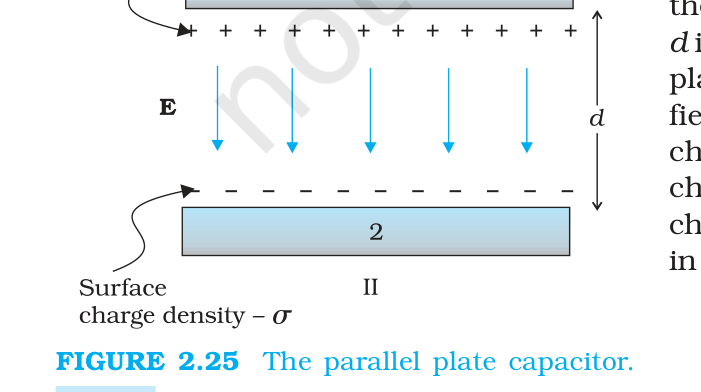
A parallel plate capacitor with plates of area A separated by a distance d, showing the uniform field in the gap and the surface charge densities on the plates.
Exam
Show the fixed quantity in every dielectric question. Battery connected means V fixed and Q changes. Battery removed means Q fixed and V changes. Write that line before the calculation and the rest of the answer follows.
5.6 Exercise with a battery still connected
A 6 microfarad capacitor is connected across a 12 V battery, and a dielectric of constant 3 is then inserted. The potential difference stays 12 V because the battery is attached. The capacitance becomes 18 microfarad, the charge grows from 72 microcoulomb to 216 microcoulomb, and the stored energy grows from 4.32 × 10^-4 J to 1.3 × 10^-3 J. The battery supplies the extra energy. Reversing the order, removing the battery first and then inserting the slab, would keep the charge fixed and reduce the energy instead.
5.7 A series and parallel network
Two capacitors of 4 microfarad and 6 microfarad are joined in series, and the pair is joined in parallel with a 10 microfarad capacitor. The series pair gives 1/C = 1/4 + 1/6 = 5/12, so C = 2.4 microfarad. Add the parallel capacitor to get 12.4 microfarad. If the network is connected across 10 V, the total charge is 124 microcoulomb. Reduce the network one pair at a time and state the rule you used at each step.