

Concepts: Bohr's model of the hydrogen atom
Atoms20 min readLesson 3 of 6
3.1 Why the classical atom cannot survive
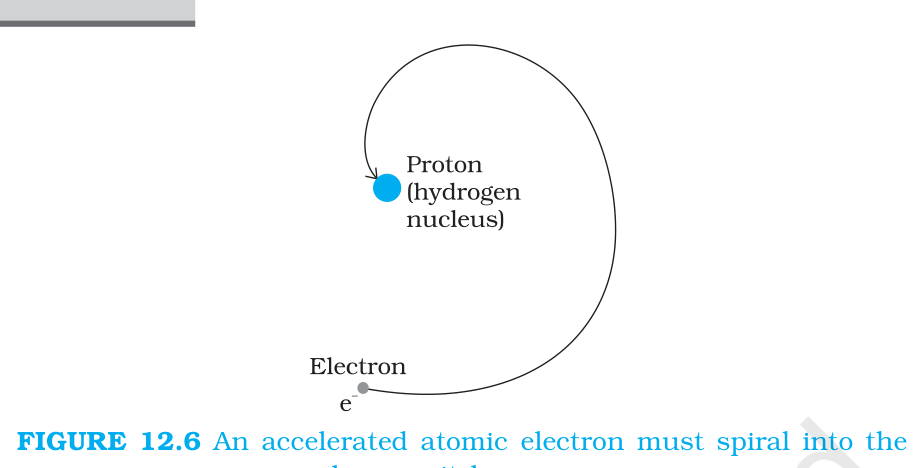
Rutherford's model pictures an electron orbiting a nucleus like a planet orbiting the sun, but the analogy breaks in one important way: the force here is electrical, not gravitational. An electron in a circular orbit is accelerating towards the centre, and classical electromagnetic theory says an accelerating charge radiates electromagnetic waves. The electron would lose energy, spiral inwards and fall into the nucleus, so the atom would not last. The frequency of the radiation would also keep changing as the orbit shrank, so the atom would emit a continuous spectrum. Both predictions are wrong, which is why Bohr had to change the rules.
3.2 The three postulates
Bohr kept the nuclear model but added three postulates in 1913.
The first postulate says that an electron can revolve in certain stable orbits without radiating energy. Each atom has definite stable states, each with a definite total energy, and these are called stationary states.
The second postulate fixes which orbits are allowed. The angular momentum of the electron is an integral multiple of h/2π: L = m v r = n h/2π, where n is 1, 2, 3 and so on, and h is Planck's constant.
The third postulate brings in the photon. An electron can make a transition from one stationary state to a lower-energy state, and in doing so emits a photon whose energy equals the difference between the two states: hν = E i - E f, with E i greater than E f.
3.3 Radius, speed and energy
In a hydrogen atom the electrostatic attraction provides the centripetal force, so (1/4πε0) e squared/r squared = m v squared/r. That gives the relation between speed and radius, v squared r = e squared/(4πε0 m), and the kinetic energy is K = e squared/(8πε0 r), the potential energy U = -e squared/(4πε0 r), and the total energy E = -e squared/(8πε0 r). The negative sign means the electron is bound; if E were positive the electron would not stay in a closed orbit.
Applying the angular momentum condition to this relation gives the radius of the nth orbit, r n = n squared a0, where the Bohr radius a0 = 4πε0 h squared/(4π squared m e squared) is about 0.53 Å. The speed falls as 1/n: v n = e squared/(2 ε0 n h), which is about 2.18 × 10 to the 6/n m/s. The total energy comes out as E n = -(m e to the fourth)/(8 ε0 squared n squared h squared), which is -13.6/n squared eV. For n = 1 this gives -13.6 eV, the ground state energy, and the energy required to remove the electron from the ground state is 13.6 eV, the ionisation energy of hydrogen. The prediction agrees with the measured ionisation energy.
3.4 Energy levels and excitation
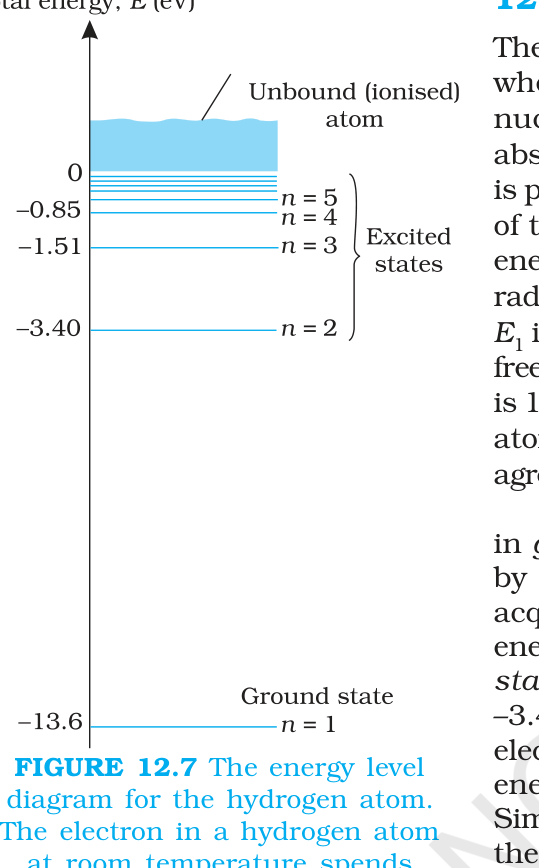
Figure 12.7 shows the levels drawn from the formula. The ground state n = 1 has E1 = -13.6 eV. The first excited state n = 2 has E2 = -3.40 eV, so the energy needed to raise the atom from the ground state to the first excited state is 10.2 eV. The next level is E3 = -1.51 eV, and reaching it from the ground state needs 12.09 eV. As n grows, the levels crowd together and the energy needed to reach the next one gets smaller, until at infinite n the energy is zero and the electron is free. Above zero the energies are continuous, not discrete.
At room temperature most hydrogen atoms are in the ground state. Collisions with electrons, or absorption of a photon, can raise the atom to an excited state. From an excited state the atom can drop back to a lower state and emit a photon. The lines seen in the spectrum are the photons from these transitions, and because the energies are discrete the frequencies are discrete too.
3.5 Reading the radius formula
The relation r n = n squared a0 carries more information than its two symbols suggest. It says the first orbit has radius 0.53 Å, the second 2.12 Å and the third 4.77 Å, so successive orbits are not evenly spaced: they spread out quickly. The speed falls as 1/n at the same time, which keeps the angular momentum rising in exact steps of h/2π. Put together, the two relations explain why the energy rises (becomes less negative) as 1/n squared and why the levels crowd near zero.
Exam
For a numerical on the nth orbit, write the three relations before substituting: r n = n squared a0, v n = 2.18 × 10 to the 6/n, E n = -13.6/n squared eV. Remember that K = -E and U = 2E, which answers most kinetic and potential energy questions without any new work. If the question gives the energy of a level in eV, convert to joules only when it also gives the Rydberg constant in SI units.