Concepts: Rutherford's nuclear model of the atom
Atoms20 min readLesson 2 of 6
2.1 From Thomson to Rutherford
By the end of the nineteenth century the evidence for atoms was strong. Thomson's work on electrical discharge through gases in 1897 showed that every element contains identical negative particles, the electrons. Since an atom is neutral overall, it must also hold positive charge in some arrangement. Thomson's own model, proposed in 1898, spread that positive charge uniformly through the volume of the atom with the electrons sitting inside it the way seeds sit in a watermelon; the name plum pudding model stuck.
The model could not survive the next round of experiments. Rutherford, who had studied under Thomson, was working with alpha particles emitted by radioactive elements. In 1906 he proposed scattering alpha particles from atoms as a way of probing what is inside, and the experiment was carried out around 1911 by Geiger and Marsden.
2.2 The Geiger-Marsden experiment
A source of alpha particles, bismuth-214, sent a beam through lead bricks that collimated it into a narrow pencil. The beam then struck a thin gold foil about 2.1 × 10 to the -7 m thick. A rotatable detector with a zinc sulphide screen and a microscope could be moved around the foil. When an alpha particle hit the screen it produced a brief flash, a scintillation, which could be counted through the microscope, so the number of particles scattered at each angle could be measured (Figures 12.1 and 12.2).
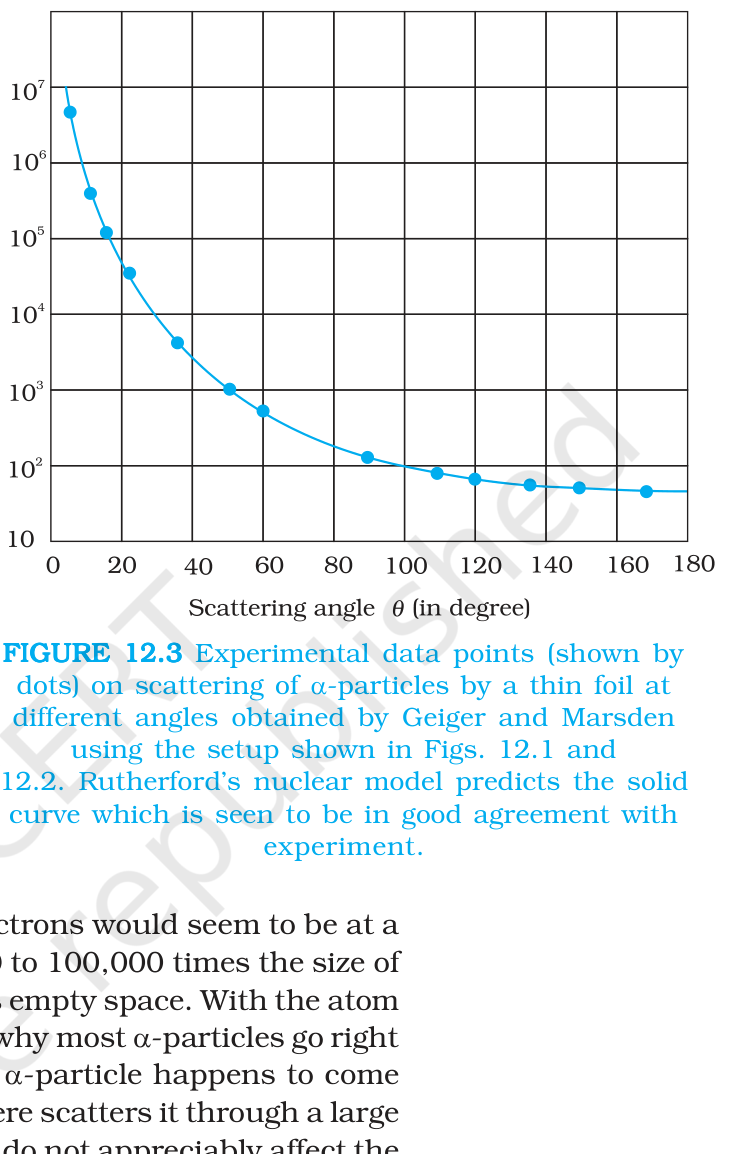
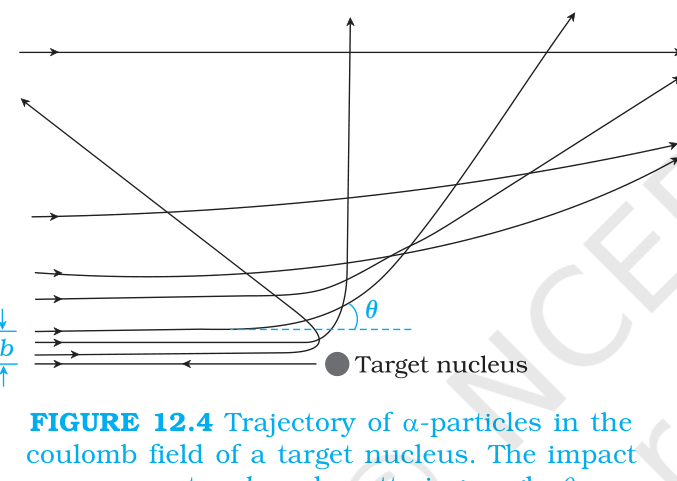
Most alpha particles passed through the foil with little or no deflection. About 0.14 per cent were scattered by more than one degree, and roughly one in eight thousand turned back by more than ninety degrees. The last figure is the surprising one. To bounce an alpha particle back, the atom must exert a very large repulsive force on it, and a diffuse cloud of positive charge cannot do that. Rutherford reasoned that most of the mass and all the positive charge must sit in a tiny volume at the centre, so that an alpha particle aimed close to it can come very near without entering the charge cloud, feel a huge force and be thrown through a large angle. The data fitted that prediction, and the credit for discovering the nucleus goes to Rutherford (Figure 12.4).
2.3 Impact parameter and closest approach
The path an alpha particle follows depends on one geometric quantity, the impact parameter b, which is the perpendicular distance between the initial line of motion of the particle and the centre of the nucleus. A particle with a small impact parameter comes close to the nucleus and is scattered strongly. For a head-on approach, b is minimum and the particle reverses its direction, so the scattering angle is about 180 degrees. For a very large impact parameter the particle passes almost undeviated, with a small angle. In a real beam the impact parameters are spread over a range, which is why particles appear at many angles with different probabilities (Figure 12.4).
The distance of closest approach is found by conserving energy. In a head-on collision the particle stops momentarily at the closest point, so all its kinetic energy has become electrical potential energy. Writing d for the centre-to-centre distance at that moment and K for the kinetic energy, K = (1/4πε0)(2e)(Ze)/d, so d = (1/4πε0)(2Ze squared)/K. For a natural alpha particle K is at most 7.7 MeV, and for gold Z = 79 the relation gives d of about 3.0 × 10 to the -14 m. Since this closest approach is much larger than the sum of the nuclear radii, the alpha particle never actually touches the gold nucleus; it turns around before reaching it. So the experiment fixes a ceiling on the nuclear size rather than measuring its radius.
2.4 The nuclear model and its two failures
In Rutherford's model all the positive charge and nearly all the mass sit in a nucleus of radius about 10 to the -15 to 10 to the -14 m, with electrons moving around it at distances of about 10 to the -10 m, roughly ten thousand to a hundred thousand nuclear radii away. Most of the atom is empty space, which explains why most alpha particles pass straight through.
The model has two serious defects. First, the electrons would move in circular orbits, and an accelerating charge is predicted by classical electromagnetic theory to radiate energy. The electron would lose energy continuously, spiral inward and fall into the nucleus, so the atom would be unstable. Second, as the electron spiralled, its frequency of revolution would change continuously and the emitted radiation would form a continuous spectrum. Real atoms are stable and emit line spectra, so classical theory alone cannot explain atomic structure. The resolution had to wait for Bohr.
Slideshow, slide 1 of 3. Use the left and right arrow keys to change slides and the space bar to play or pause.
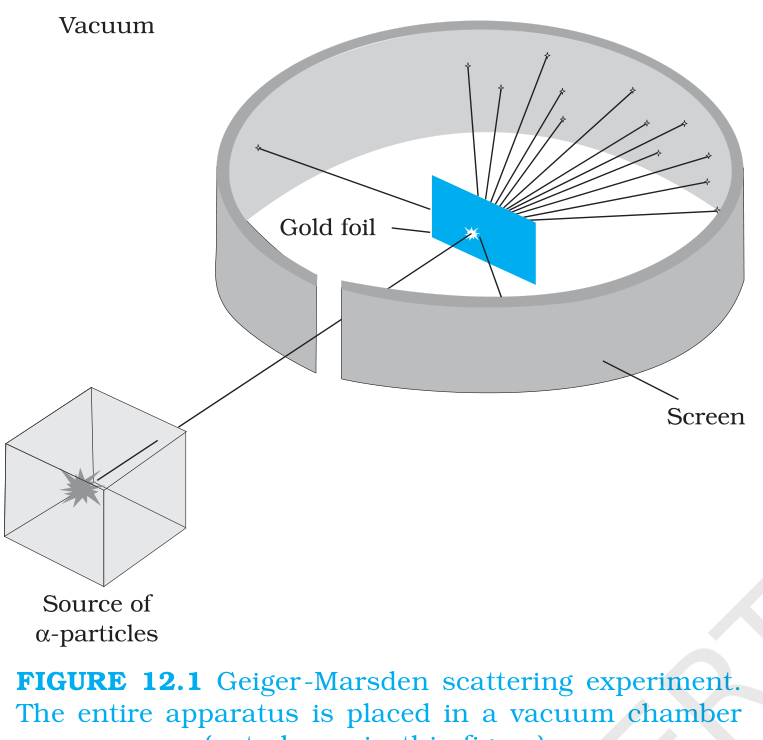
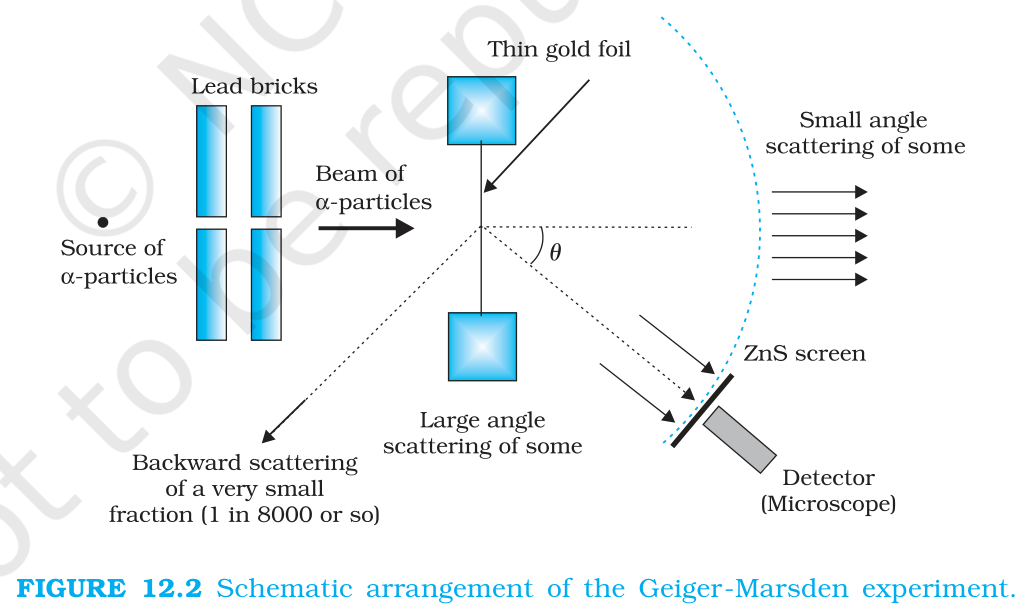
The Geiger-Marsden apparatus, with alpha particles from a bismuth source collimated through lead bricks onto a thin gold foil inside a vacuum chamber.