

Concepts: interference and Young's double slit: Wave Optics
Wave Optics26 min readLesson 3 of 6
3.1 Superposition and coherence
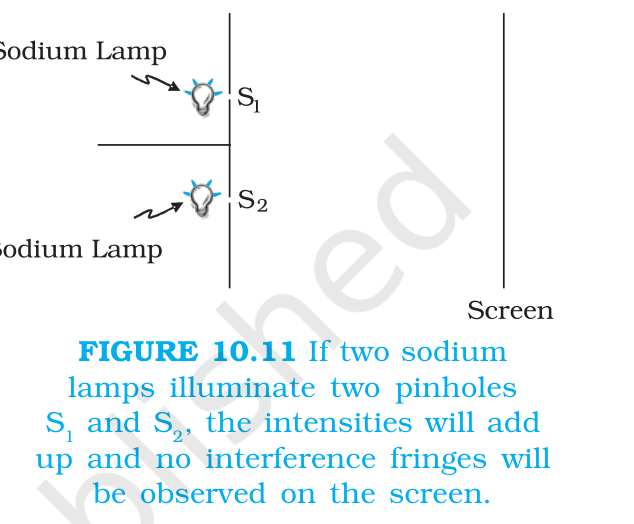
When two waves meet at a point, their displacements add. If the waves are in phase the resultant amplitude is large, and if they are out of phase the resultant amplitude is small. This is the principle of superposition, and it produces the steady pattern of bright and dark fringes only when the two sources keep a constant phase difference. Two independent lamps cannot produce a lasting interference pattern because their emissions start and stop randomly, so the phase difference changes every instant and the pattern averages out. A single source is therefore split into two paths, which keeps the phase difference fixed. ### Young's double slit experiment
In the double slit experiment, light from one narrow slit falls on two closely spaced slits. The two slits act as coherent sources, and the light from them overlaps on a screen placed some distance away. Bright and dark fringes appear at points where the path difference is a whole number or an odd number of half wavelengths. The fringe width is the distance between two consecutive bright fringes, which is the same as the distance between two consecutive dark fringes. It equals the wavelength times the screen distance divided by the slit separation. So a longer wavelength, a larger screen distance or a closer pair of slits gives wider fringes. ### Intensity and phase
The intensity at a point on the screen depends on the phase difference between the two waves. With equal intensities the result varies as the square of a cosine of half the phase angle. Bright fringes occur where the cosine is plus or minus one, and complete darkness occurs where it is zero. The fringe pattern is not affected by the overall brightness of the source, but the contrast between bright and dark fringes depends on the ratio of the two intensities. Equal intensities give complete darkness at the minima. ### Exercise coverage
Exercise questions on interference ask for the fringe width, the position of the nth bright fringe, the effect of changing the medium, and the change in the pattern when one slit is covered. The formula and the proportionalities answer almost all of them.
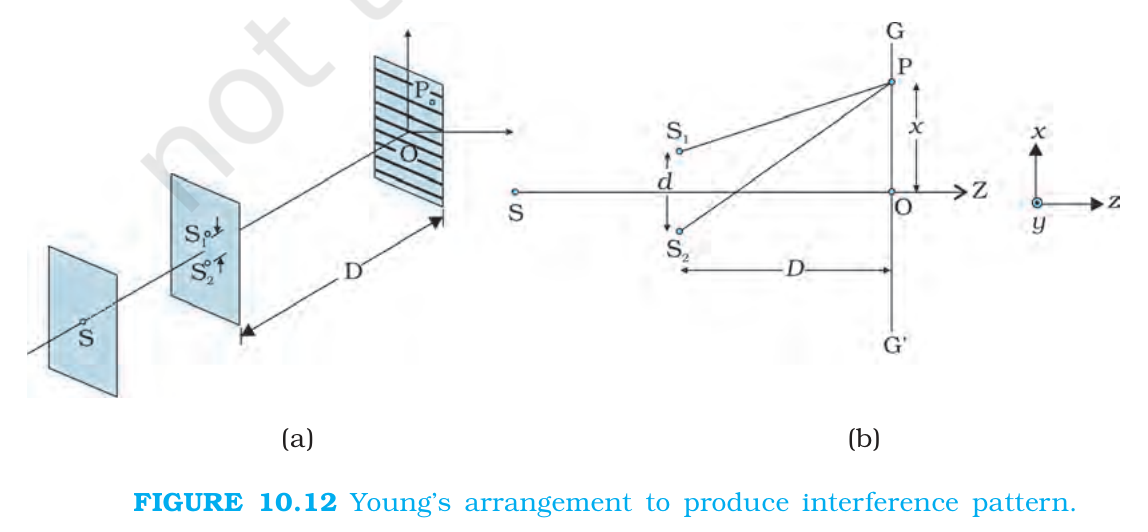
Slideshow, slide 1 of 3. Use the left and right arrow keys to change slides and the space bar to play or pause.
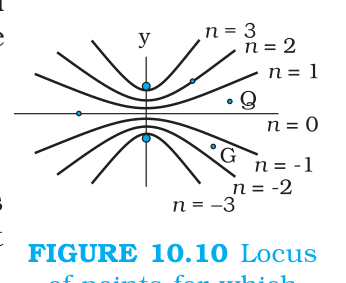
Locus of points where the resultant intensity is the same, shown as a hyperbola around two sources
Exam
When the whole apparatus is placed in a liquid, the wavelength divides by the refractive index of the liquid, so the fringe width divides by the same factor.