

Diffraction, resolving power and polarisation: Wave Optics
Wave Optics24 min readLesson 4 of 6
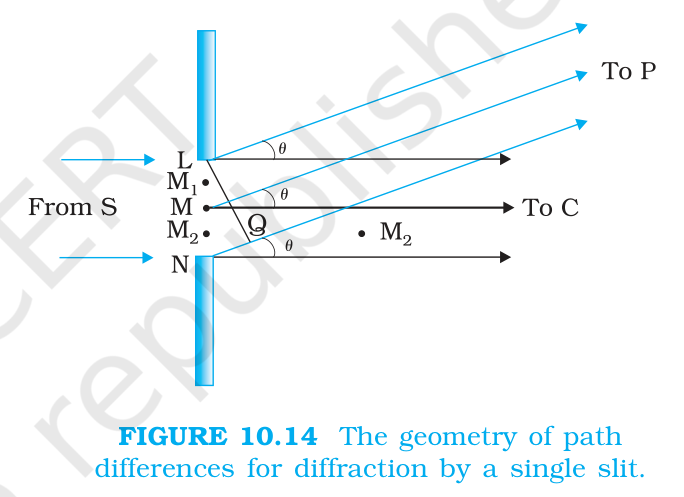
4.1 Diffraction at a single slit
When light passes through a slit whose width is comparable to the wavelength, the light spreads out and forms a pattern of bright and dark bands on a screen. This spreading is diffraction. The narrower the slit, the wider the pattern, which is the opposite of what ray optics predicts. For a single slit of width a, the minima occur where a sine theta equals a whole number of wavelengths. The central maximum is twice as wide as the secondary maxima and much brighter. The secondary maxima lie between the minima, and their intensity falls off quickly on both sides. The difference between interference and diffraction is worth writing out. Interference fringes are produced by two separate coherent sources, and all fringes are of equal width and roughly equal intensity. Diffraction fringes come from the wavelets of a single wavefront, and the central maximum is much wider and brighter than the rest. ### Resolving power and diffraction
Diffraction sets a limit on how close two objects can be and still be seen separately. A circular aperture produces a central disc surrounded by rings, and two such patterns overlap if the objects are too close. The resolution improves with a larger aperture and a shorter wavelength. ### Polarisation
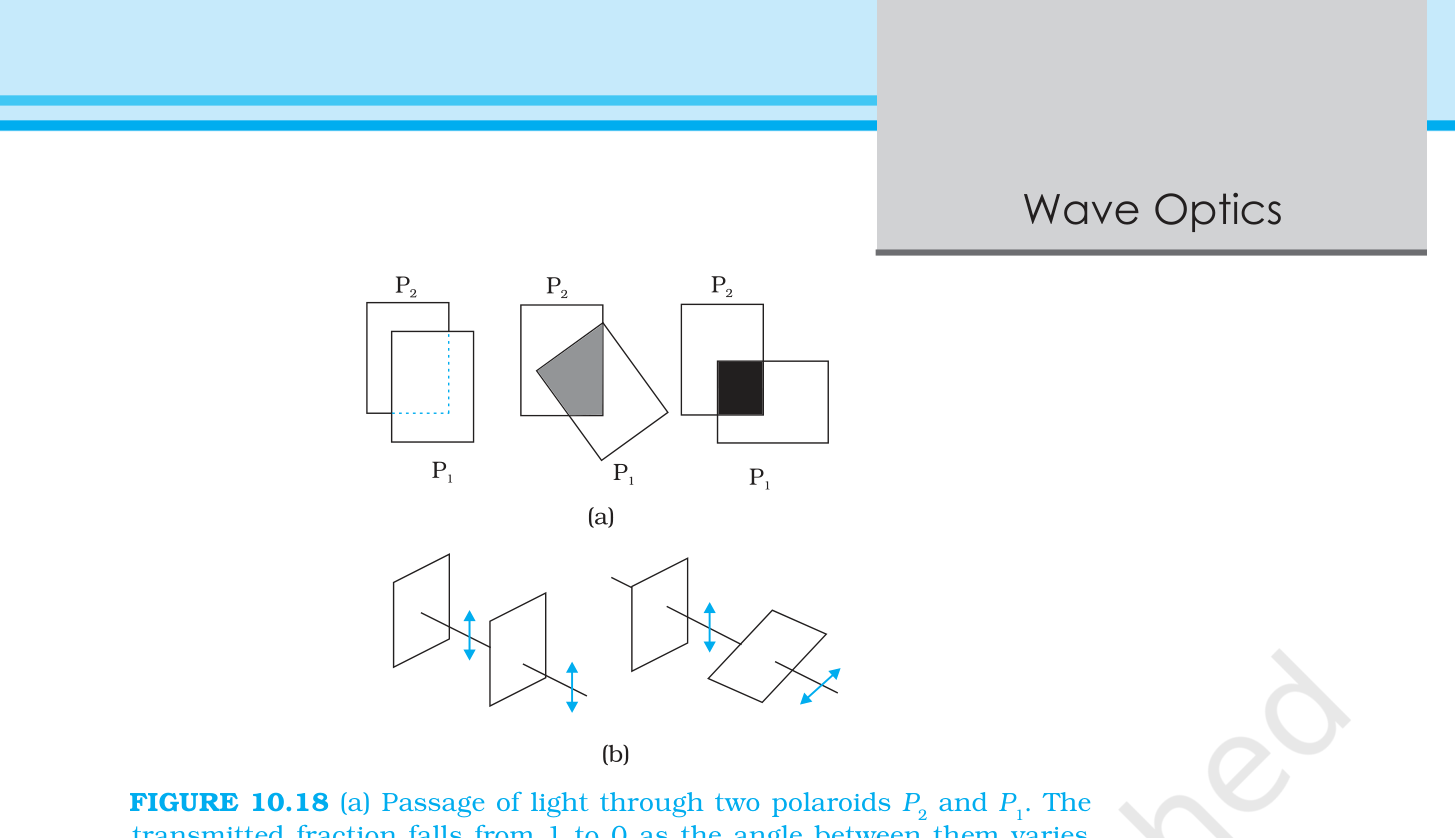
Light is a transverse wave, so its electric field oscillates perpendicular to the direction of travel. In ordinary light the oscillations occur in every direction perpendicular to the beam. A polariser allows only the component along its axis to pass, so the transmitted light oscillates in one plane. A second polariser, called the analyser, controls how much of this polarised light passes. When its axis is parallel to the first, all the light passes; when it is perpendicular, no light passes. At an intermediate angle the transmitted intensity follows the cosine squared law, which is Malus's law. Polarisation by reflection happens at a particular angle called the Brewster angle, where the reflected light is completely polarised. Scattering of sunlight by air molecules also polarises the sky light, which is why a rotating polariser changes the brightness of the sky. ### Exercise coverage
Exercise questions on this section ask for the width of the central maximum, the position of the first minimum, the number of maxima visible, and the intensity transmitted through two polarisers. Always write the condition and then substitute the wavelength and the slit width in the same unit. ## Diffraction and the width of the pattern
The width of the central maximum on the screen is twice the distance from the centre to the first minimum. For a slit of width a and screen distance D, the first minimum appears at a distance D lambda by a from the centre. Halving the slit width therefore doubles the width of the central band, and the secondary maxima spread out with it. The intensity of the secondary maxima drops sharply, so only the first few are visible in practice. In polarisation questions, remember that a single polariser halves the intensity of unpolarised light, which is a separate step from Malus's law. ## Polarisation by scattering and reflection
Sunlight scattered by air molecules is partially polarised, with the electric field favouring one direction relative to the scattering plane. Looking at the sky through a rotating polariser therefore changes its brightness. Light reflected from a dielectric surface is also partially polarised at most angles and completely polarised at the Brewster angle. Two polarisers with their axes at an angle theta transmit a fraction cosine squared theta of the light that the first one passed. With unpolarised light, the first polariser alone halves the intensity, and the second then applies the cosine squared factor. ## Comparison table for interference and diffraction
Interference comes from two distinct coherent sources and the pattern has equal-width fringes with slowly varying intensity. Diffraction comes from the infinite set of wavelets of a single wavefront and the pattern has a wide central maximum with rapidly fading secondary maxima. Remembering this comparison helps in the two-mark contrast questions as well as the numerical questions about fringe positions. ## Worked single slit numerical
For a slit of width 0.20 mm and light of wavelength 500 nm, the first minimum lies at an angle whose sine is 500 times 10 to the power minus 9 divided by 0.20 times 10 to the power minus 3, equal to 2.5 times 10 to the power minus 3. On a screen 1.0 m away the first minimum is 2.5 mm from the centre, so the central maximum is 5.0 mm wide. The second minimum is twice as far from the centre. State clearly whether a question is about the central maximum or a secondary maximum, because the positions differ by a factor of three halves. The width of the diffracted beam on the screen is measured between the two first minima, so the half width is the distance from the centre to one minimum.
Warning
In the fringe width formula, use the wavelength inside the medium when the experiment is immersed in a liquid. Using the vacuum wavelength gives the wrong answer.