

Concepts: wavefronts and Huygens principle: Wave Optics
Wave Optics24 min readLesson 2 of 6
2.1 Light as a wave
The ray picture treats light as travelling in straight lines. Interference and diffraction cannot be explained that way, so light is described as a wave with a wavelength and a frequency. A wavefront is the set of points reached by the disturbance at the same instant, and the direction of energy flow is perpendicular to the wavefront. For a point source the wavefronts are spheres centred on the source. Very far from the source a small part of a spherical wavefront looks flat, so it is treated as a plane wavefront. A line drawn from the source represents the direction of propagation and is called a ray. ### Huygens construction
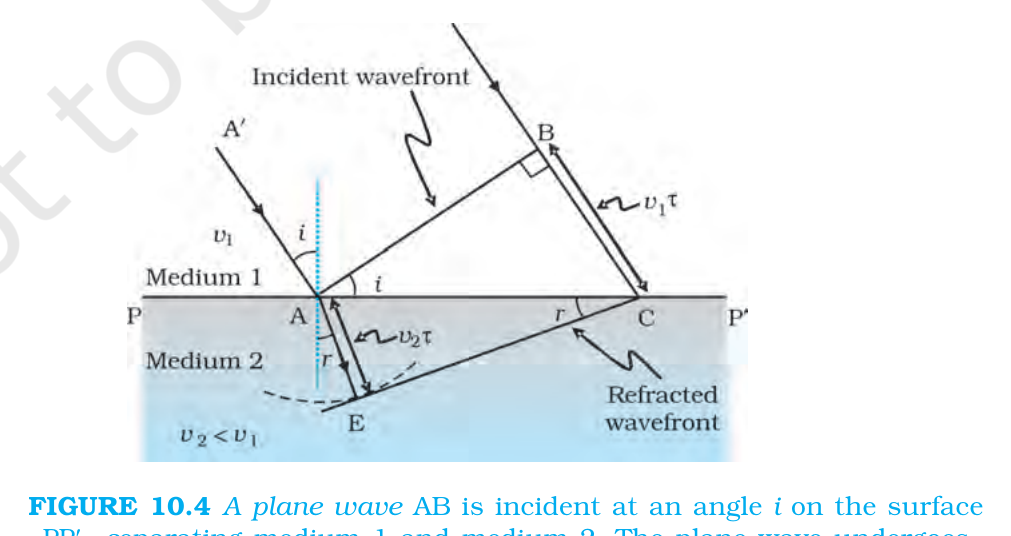
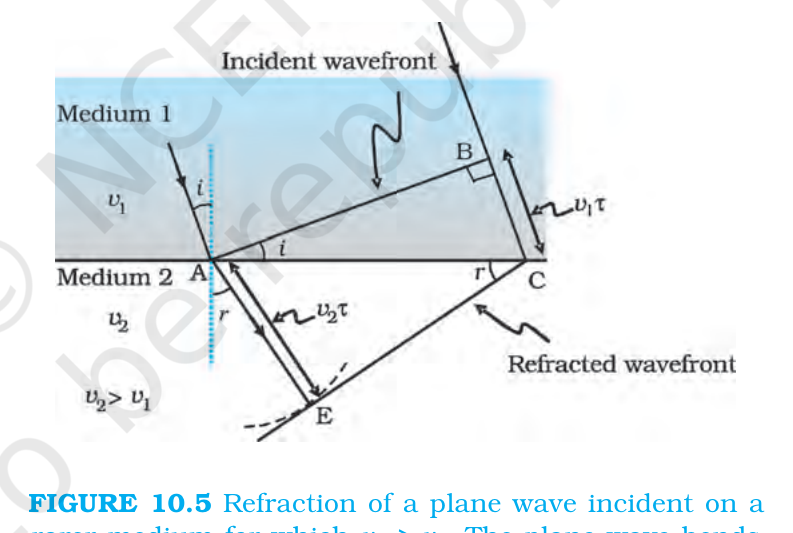
Huygens gave a rule for finding the new position of a wavefront. Every point on a wavefront is treated as a secondary source that emits spherical wavelets. After a time equal to the period, the envelope of all the secondary wavelets gives the next wavefront. The construction works for any wave and gives the law of reflection and the law of refraction by pure geometry. At a reflecting surface the secondary wavelets from the incident wavefront produce a reflected wavefront at an angle equal to the angle of incidence. At a refracting surface the wavelets travel with different speeds in the two media, so the direction of the refracted wavefront changes. ### Reflection and refraction from the construction
The construction for reflection uses two triangles sharing the same hypotenuse, which gives the equality of the angles. That geometry is the reason the law of reflection has no dependence on the colour of light. For refraction the speed ratio is the key. The wave on the two sides keeps the same frequency, but the wavelength changes with the speed. The result is Snell's law written with the ratio of speeds equal to the ratio of refractive indices. A denser medium has a smaller speed and a shorter wavelength inside. ### Total internal reflection and the prism
When light goes from a denser to a rarer medium the refracted wavefront can disappear altogether if the angle of incidence is large enough. For angles beyond the critical angle no refracted wave travels away from the surface, and all the energy is reflected back. The light pipe and the totally reflecting prism are applications of this geometry. A thin prism also follows from the wave construction. A plane wavefront entering at an angle leaves with a small deviation, and the deviation increases with the refractive index. This gives the dispersion of white light by a prism. ## Wavefronts of different shapes and the light pipe
A line source produces cylindrical wavefronts, and a source at infinity produces plane wavefronts. The shape matters in Huygens diagrams because the secondary wavelets travel along the local normals. A light pipe works because the wavefront inside the rod reflects at the walls again and again, which keeps the beam confined even around a bend. The construction also shows why the frequency does not change across a boundary. The incoming wavefront sets the rhythm for the secondary wavelets, and the medium only changes how fast each wavelet advances. ## Direction of propagation and the ray
In a Huygens diagram the secondary wavelets grow outward from each point of the old wavefront. The new wavefront is the surface touching all of them, so it is parallel to the old one in a uniform medium. The ray is the line perpendicular to the wavefront, which is why a plane wave travelling in one direction is drawn with parallel rays. When the medium changes, the speed of the wavelets changes, so the same amount of time produces a tilted wavefront on the other side. The tilt is the origin of refraction, and the same reasoning gives the change of direction at every interface in a layered medium. ## Worked Huygens numerical
A plane wave falls on a plane surface from medium 1 into medium 2. If the speed in medium 1 is 2.0 times 10 to the power 8 m per second and in medium 2 is 1.5 times 10 to the power 8 m per second, then the ratio of the sines of the angles equals the ratio of the speeds, which is 4 to 3. An angle of incidence of 40 degrees then gives sine of the refracted angle equal to 0.643 times 3 divided by 4, about 0.482, so the refracted angle is about 28.8 degrees. In an exam, the wavefront diagram is usually worth one mark on its own, so draw the normals and label the media before doing any calculation. A line source of light produces cylindrical wavefronts, and the same Huygens construction applies to them with the wavelets spreading out as circles in the plane perpendicular to the source line. The construction is reversible, so it works for a wavefront travelling in either direction.
Warning
A wavefront is not a ray. The ray is perpendicular to the wavefront, and confusing the two directions is the most common mistake in this section.