

Concepts: reflection by spherical mirrors: Ray Optics And Optical Instruments
Ray Optics and Optical Instruments24 min readLesson 2 of 6
2.1 Reflection by spherical mirrors
A spherical mirror is a part of a sphere whose inner or outer surface is polished. The centre of curvature is the centre of that sphere, the radius of curvature is its radius, and the pole is the centre of the mirror surface. The principal axis is the line through the pole and the centre of curvature.
The reflection of a ray at the mirror obeys two simple rules. A ray parallel to the principal axis passes, after reflection, through the focus. A ray through the centre of curvature comes back along the same path. The focus is midway between the pole and the centre of curvature, so the focal length is half the radius of curvature.
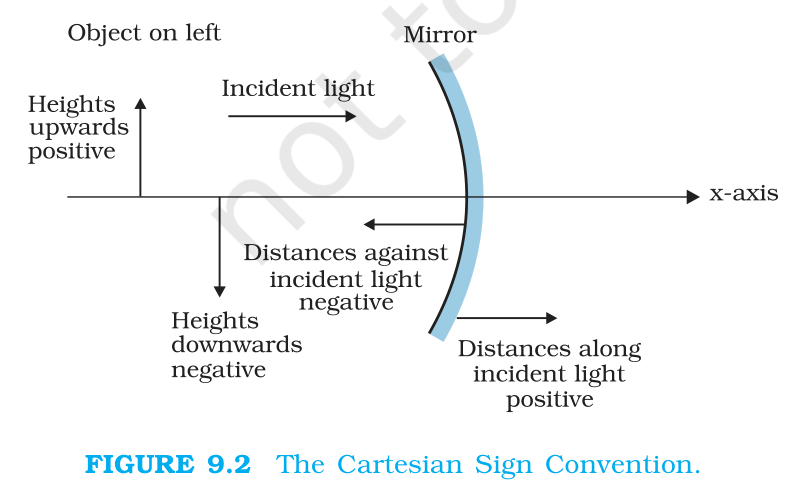
The Cartesian sign convention removes the guesswork from the formulas. Measure every distance from the pole, take the direction of the incident light as positive, and give heights above the principal axis a positive sign. A concave mirror has its centre of curvature on the side of the incident light, so for it u is negative and f is negative. A convex mirror has the centre behind the mirror, so f is positive.
2.1.1 Image formation
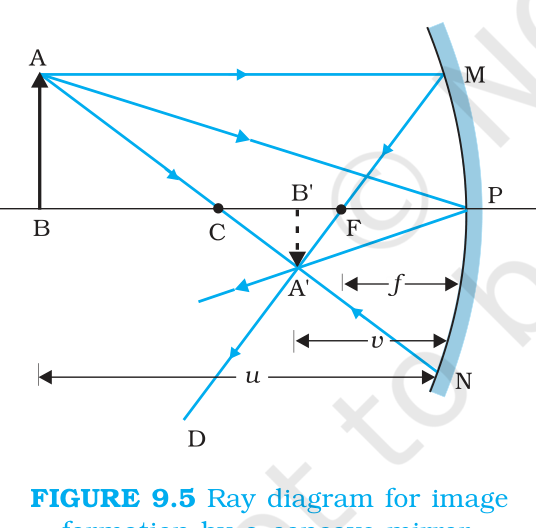
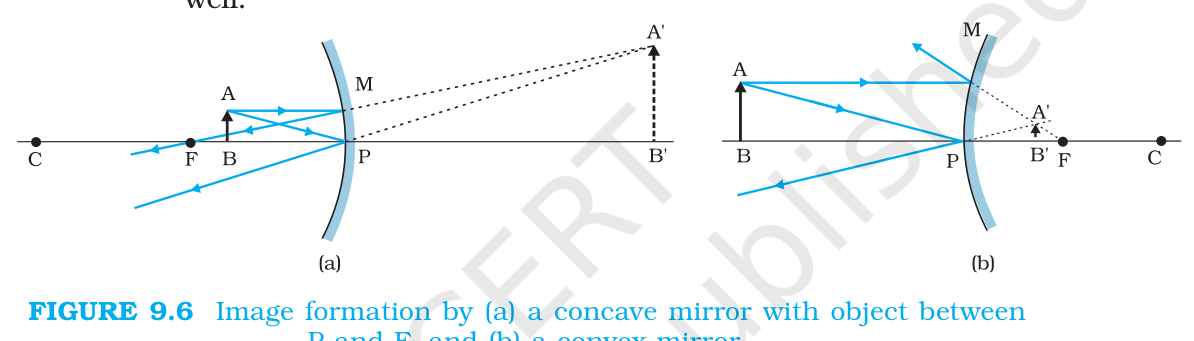
The image position follows from the mirror formula once the signs are fixed. For a concave mirror, an object beyond the centre gives a real inverted diminished image, an object between the centre and the focus gives a real inverted magnified image, an object at the focus produces an image at infinity, and an object between the pole and the focus gives a virtual erect magnified image. A convex mirror always gives a virtual erect diminished image, which is why it is used as a rear-view mirror.
2.1.2 Uses and the mirror equation
Concave mirrors are used in headlights, searchlights and dentist's mirrors because they can concentrate light or magnify an object placed close to them. Convex mirrors are used in vehicles because their wide field of view keeps a smaller virtual image.
The mirror equation is written as one over v plus one over u equals one over f. The magnification is the ratio of the image height to the object height, which also equals minus v over u. A negative magnification means the image is inverted relative to the object.
2.1.3 Exercise coverage
The exercises on this section ask for image positions, nature and size of images, and the relation between the radius of curvature and the focal length. A typical question gives the object distance and the radius of curvature, then asks for the screen position and the magnification. Write the sign convention step, substitute, and interpret the negative sign as a real inverted image.
Slideshow, slide 1 of 3. Use the left and right arrow keys to change slides and the space bar to play or pause.
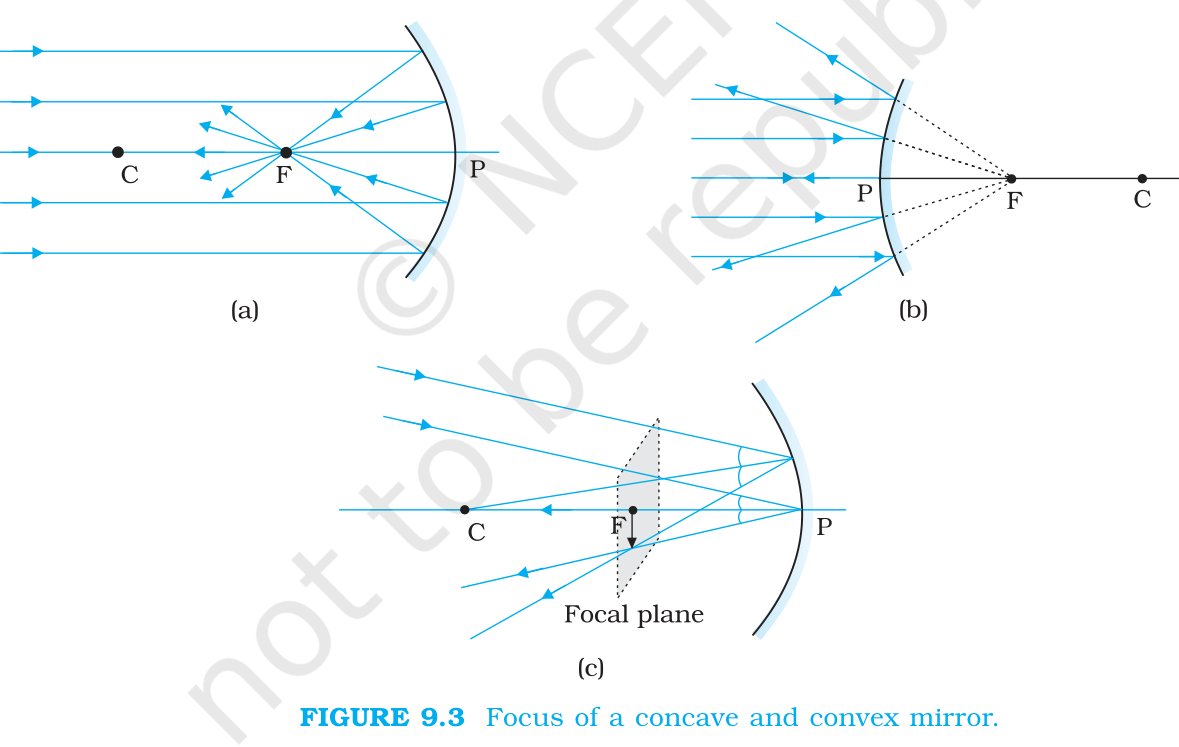
Focus of a concave mirror and of a convex mirror shown by parallel rays
Warning
A virtual image has a positive image distance for a mirror and a negative one for a lens. Do not copy the sign pattern from one device to the other.