

Prism, dispersion and optical instruments: Ray Optics And Optical Instruments
Ray Optics and Optical Instruments24 min readLesson 4 of 6
4.1 Refraction through a prism
A prism has two refracting surfaces meeting at an angle called the refracting angle. A ray enters one face, bends towards the base inside the prism, and bends further on leaving, so the emergent ray is deviated from the incident direction. The angle between the incident ray and the emergent ray is the angle of deviation.
For a given prism and a given colour, the deviation changes with the angle of incidence and reaches a minimum. At minimum deviation the ray passes through the prism symmetrically: the angle of incidence equals the angle of emergence and the ray inside is parallel to the base. This gives the prism formula for the refractive index.
4.1.1 Dispersion of light
The refractive index of glass depends slightly on colour, and this is called dispersion. Violet light slows more than red light, so violet bends more and the prism spreads white light into its spectrum. The angle between the extreme colours in the emergent beam is the angular dispersion, and the ratio of angular dispersion to the mean deviation is the dispersive power.
A rainbow forms because raindrops act like tiny prisms that refract, disperse and internally reflect sunlight. The primary rainbow shows red on the outer edge and violet inside.
4.1.2 Optical instruments: microscopes
A simple magnifier is a convex lens of short focal length. The magnifying power of a compound microscope is the product of the linear magnification of the objective and the angular magnification of the eyepiece. The objective has a very short focal length and forms a real inverted magnified image just inside the focus of the eyepiece, which then acts as a magnifier.
For the final image at the near point the total magnification is larger than for the final image at infinity, and the standard numerical distinguishes the two cases. The tube length is the distance between the two lenses, close to the sum of their focal lengths plus the distance of the image from the objective.
4.1.3 Telescopes
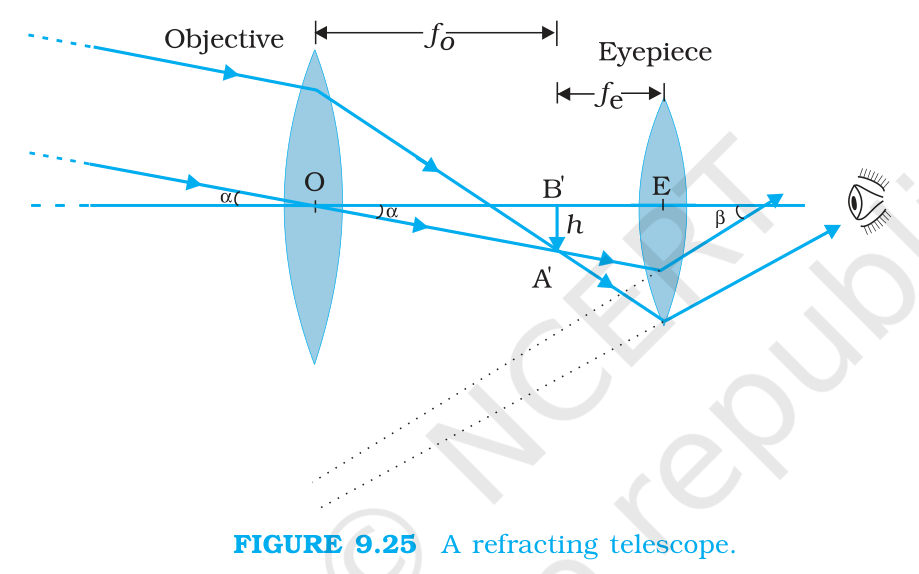
Optical instruments for the sky need to collect plenty of light from far away. The front element has a long focal length and a wide opening, while the viewing lens has a short focal length. The angular magnification is the ratio of the focal length of the objective to that of the eyepiece when the final image is at infinity.
An important practical difference from a microscope is that a telescope does not increase the apparent size by bringing the object closer; it increases the visual angle under which a distant object is seen. A large objective aperture also improves the resolving power, which is why astronomical telescopes are built large.
Reflecting telescopes use a concave mirror instead of an objective lens. They avoid chromatic aberration because a mirror has no dispersion, and they can be built much larger than lens objectives. The Cassegrain design folds the light path with a secondary mirror, keeping the tube short.
4.1.4 Exercise coverage
The exercise set asks for the angle of minimum deviation, the critical angle of the prism material, the magnifying power of a compound microscope and a telescope, and the reasons for choosing a reflecting telescope. Write the formula, identify the case for the final image, then substitute. The reasons for the reflecting telescope are a standard two-mark item.
4.2 Two numericals on prisms and instruments
An equilateral prism of refractive index root 2 has an angle of minimum deviation found from the prism formula. With A equal to 60 degrees, sine of (60 plus delta) by 2 equals root 2 times sine 30, which is 0.707, so the half angle is 45 degrees and the minimum deviation is 30 degrees.
Take a two lens viewing tube: the front lens has focal length 1.5 cm and the rear lens has focal length 4 cm, and the front lens throws its image 18 cm beyond it. The front lens therefore magnifies by 18 divided by 1.5, equal to 12. With the last image formed at the near point of 25 cm, the rear lens adds a factor of 1 plus 25 divided by 4, equal to 7.25. Multiplying the factors gives a total of about 87. For instrument questions, separate the magnification asked for from the resolution; the two quantities are independent and are tested separately.
4.3 Marks pattern for prism and instruments
The prism numerical is usually a short application of the prism formula. The instrument items ask for the magnification with the final image at infinity or at the near point, and often add a reason for a design choice. Writing the formula, the case, and the final value with its unit is enough for full marks.
Warning
For the telescope magnification, use the near-point formula only when the question says the final image is at the least distance of distinct vision. For a final image at infinity use the simple ratio of focal lengths.