

Concepts: refraction, total internal reflection and lenses: Ray Optics And Optical Instruments
Ray Optics and Optical Instruments26 min readLesson 3 of 6
3.1 Refraction and Snell's law
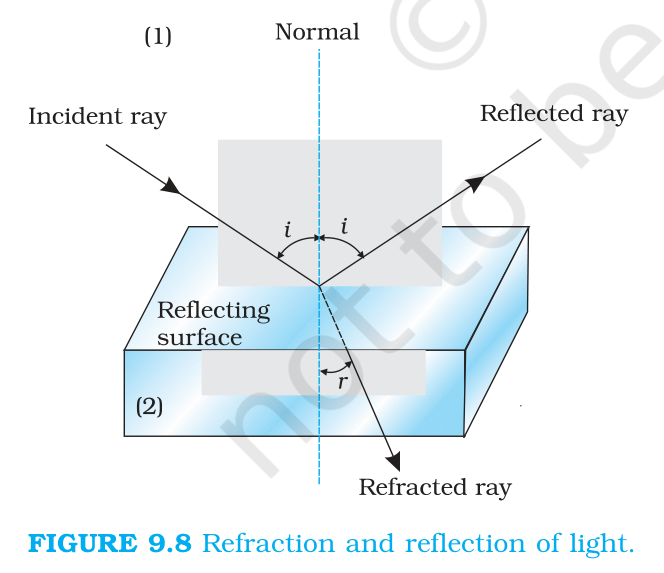
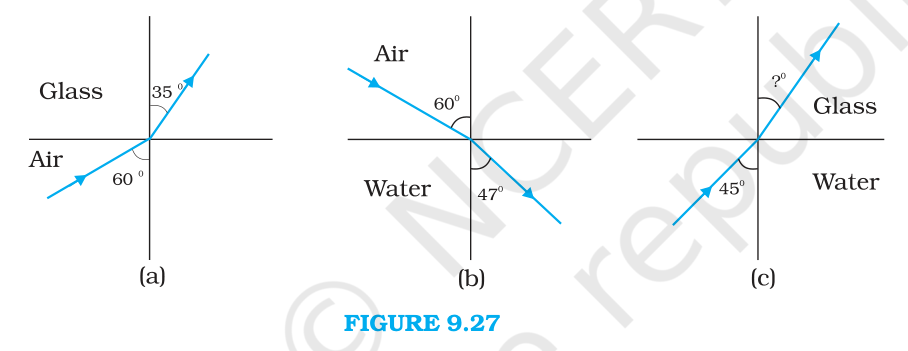
When light crosses from one transparent medium to another, its direction changes because its speed changes. The ratio of the speed in vacuum to the speed in the medium is the refractive index. Snell's law states that the product of the refractive index and the sine of the angle with the normal is the same on both sides of the surface.
A ray going from a denser to a rarer medium bends away from the normal, and a ray going the other way bends towards the normal. At normal incidence the ray passes undeviated because the angle with the normal is zero.
3.1.1 Apparent depth and the shift of objects
An object under water appears closer to the surface than it really is. For near-normal viewing the apparent depth equals the real depth divided by the refractive index. A microscope focused on a coin at the bottom of a beaker has to be raised when water is poured in, and the shift equals the real depth minus the apparent depth.
The same idea explains why a pencil half immersed in water looks bent at the surface. The light from the immersed part bends at the water-air boundary, so the eye traces the rays back to a different apparent position.
3.1.2 Total internal reflection
When light travels from a denser medium to a rarer one, the angle of refraction grows faster than the angle of incidence. At a particular angle, called the critical angle, the refracted ray grazes the surface. Beyond that angle no refracted ray exists and the light is totally internally reflected.
The critical angle satisfies sine C equal to the reciprocal of the refractive index when the rarer medium is air. Total internal reflection is used in optical fibres, in totally reflecting prisms of periscopes and binoculars, and in the sparkle of a diamond.
A diamond sparkles because its critical angle is about 24 degrees, which is small enough to keep much of the entering light bouncing inside before it emerges. An optical fibre works because the core has a higher refractive index than the cladding, so light hitting the boundary at a shallow angle reflects instead of escaping.
3.1.3 Refraction at a spherical surface and lenses
For a single spherical refracting surface, one over v and one over u are replaced by refractive-index weighted terms, and the radius term appears on the right. A lens is two such surfaces combined, which gives the lens maker formula. For a thin lens the two surfaces are close enough that the lens formula uses the object and image distances from the lens itself.
The power of a lens is the reciprocal of its focal length in metres, measured in dioptres. Lenses in contact add their powers, so a convex and a concave lens together can behave as a weak converging or diverging lens depending on which power is larger.
3.1.4 Exercise coverage
Exercise questions here ask for refractive index from apparent depth, the critical angle, the area of the water surface through which a bulb can be seen, and focal lengths from the lens maker formula. A standard numerical gives the radius of curvature and the refractive index and asks for the focal length in air and in a liquid; the same formula applies with the relative refractive index replaced.
3.2 Two numericals on refraction
A glass slab of refractive index 1.5 has a real thickness of 6 cm. For near-normal viewing the apparent thickness is 6 divided by 1.5, which is 4 cm, so the object appears 2 cm closer.
A ray passes from glass into water with an angle of incidence of 30 degrees. Using the refractive indices 1.5 and 1.33, Snell's law gives sine of the angle of refraction equal to 1.5 times sine 30 divided by 1.33, which is about 0.564, so the angle in water is about 34 degrees.
For a glass-air boundary the critical angle satisfies sine C equal to 1/1.5, giving C about 41.8 degrees. Any ray from inside the glass hitting the surface at a larger angle reflects back entirely. A useful check for refraction numericals is to confirm that the ray bends towards the normal when it enters the denser medium and away from it when it leaves.
3.3 Common refraction traps
Mixing the angle with the normal and the angle with the surface is the most common error. Always measure from the normal. In apparent depth questions the observer looks from the rarer medium, so the shift is computed with the index of the denser medium. In critical angle questions the ray must be travelling from the denser medium, otherwise total internal reflection cannot occur.
Exam
For the lens maker formula in a medium, use the relative refractive index of the lens material with respect to the surrounding medium, not the refractive index in air.