

Case study: why is one side of a puri thinner?
Exploring the Investigative World of Science15 min readLesson 3 of 5
3.1 A kitchen mystery
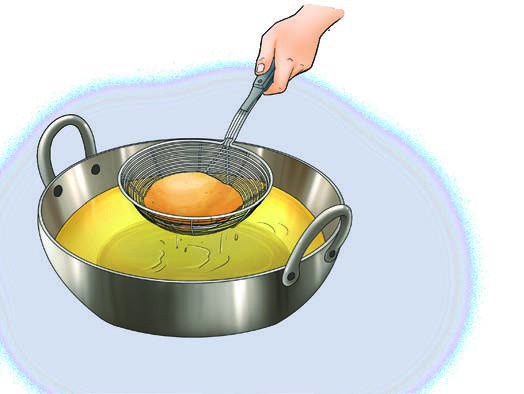
A puri dropped into hot oil puffs up almost at once, and a phulka put directly on a flame swells like a small balloon. Why does this happen, and why is one side of the puri usually thinner than the other? These are ordinary kitchen observations that a scientist could easily make, because the best experiments do not always need special equipment.
3.2 Step 1: turn the observation into a question
The first move is to make the question specific enough to investigate. "Which conditions could change the way a puri puffs up while it fries?" is a question you can act on. It points towards conditions you can control and effects you can watch. A vague question such as "why is cooking interesting?" cannot be tested, because it names neither a condition nor an outcome.
3.3 Step 2: sort what you change from what you observe
An investigator lists two kinds of things. The first kind is what can be changed or controlled during the experiment. The second kind is what can be observed or measured to see whether the change made a difference.
| Things you can change | Things you can observe or measure |
|---|---|
| Thickness of the rolled dough | Whether the puri puffs up at all |
| Size of the puri | Time taken to puff up, in seconds |
| Type of flour, such as atta or maida | Whether one side becomes thinner |
| Temperature of the hot oil | Colour, bubbles, splashing, smell or smoke |
| How the dough is dropped into the oil | Number of puffs that succeed in a batch |
Some observations are yes or no answers, and some are numbers. Both are useful. A yes or no answer tells you whether an effect appears; a number such as the time in seconds lets you compare two batches precisely. A list of what may be changed also reminds you to keep everything else under control.
3.4 Step 3: predict and plan a fair test
Before starting, a scientist often makes a prediction: "I expect a thinner puri to puff faster." A prediction is a guess based on what you already know, and it is useful because it gives the test something to check. If the result matches, the idea becomes stronger; if it does not, the idea needs changing.
To find out how oil temperature affects puffing, use dough circles of the same thickness and size, and drop each one in the same way. Only the oil temperature changes between batches. If you changed the temperature and the thickness at the same time, you would not know which one produced the effect. This rule, alter a single condition and hold the others steady, is what makes a test fair.
3.5 Step 4: watch closely and write it down
During the test, write down everything you notice. Did the oil splatter? Did it smell stronger? Did smoke appear? Did the puri puff evenly, or did one side stay flat? A table with columns for each condition makes patterns easier to see, and repeating each trial a few times tells you whether a result is consistent or happened only once.
Notes should be made while the experiment is running, not from memory at the end. Memory smooths over details, and the small details often matter. A clear record also lets a classmate repeat the same experiment and check whether your result holds.
3.6 Step 5: let the results raise new questions
One round of experiments rarely finishes the enquiry. If fresh dough puffed better than stored dough, that is a new question. If pricking a hole in the puri stops it from puffing, that is another. Each answer narrows the next question, and the investigation grows.
3.7 Working with a partner, and what makes evidence strong
Two people make an investigation more reliable. One can handle the pan while the other records, or one can prepare the dough while the other times the puffing. Partners also check each other's notes and point out a condition that was not held constant.
Evidence becomes stronger when it is repeated, measured with the same method, and compared under conditions that differ in only one way. A single trial can be lucky or unlucky. A pattern that appears again and again across trials is far more convincing. This is why scientists do not announce a result after one attempt.
3.8 Units, repeats and precision
Measurements become comparable when they use the same unit. If one trial times the puff in seconds, the next should also use seconds, not a vague count. A ruler marked in millimetres allows a sharper comparison than a rough guess of thin or thick. Repeating each trial and writing every reading, including the odd ones, makes the pattern visible. Precision is not about long decimals; it is about using an instrument the same way each time.
3.9 When a result surprises you
A result that contradicts the prediction is still useful. First check the method: was only one condition changed, were the tools used the same way, was the time recorded honestly? If the method was fair, repeat the trial. A surprise that appears again is a clue and may lead to a better explanation. Throwing away a result because it feels wrong is a habit worth avoiding.
3.10 What the case study teaches
The puri example shows the shape of all scientific investigations, from simple to complicated. Start with a real observation, sharpen it into a question, decide what to change and what to measure, predict, plan a fair test, record the evidence, and ask what comes next. Surprisingly, even this simple phenomenon is not completely understood by scientists today. That is not a failure of science; it is a sign that ordinary things still have room for curious minds.