Science begins with a question
Exploring the Investigative World of Science13 min readLesson 1 of 5
1.1 A page of questions
The first page of this chapter is unusual. It opens with questions instead of definitions. Why does a puri often turn out thinner on one side? Which number is larger, the grains of sand across all the world's beaches and deserts or the stars in our galaxy? Why does nature make leaves in so many shapes and insects in so many kinds? These are not exam questions. They are invitations to look at the world with curiosity, and the page leaves a blank line for a question of your own, because a good investigation often begins with something you personally want to know.
1.2 From wonder to investigation
Science has always started with wonder. In earlier classes we noticed the variety of plants and animals and asked simple "Why?" and "How?" questions. Later we learned that answers keep changing as people explore further, and that a good answer usually opens new questions. This year the focus shifts to investigation. That means asking sharper questions, planning simple experiments, observing carefully, and using what we find to improve our understanding. Collecting facts matters, and so does learning how new facts are found.
1.3 The root and the kite
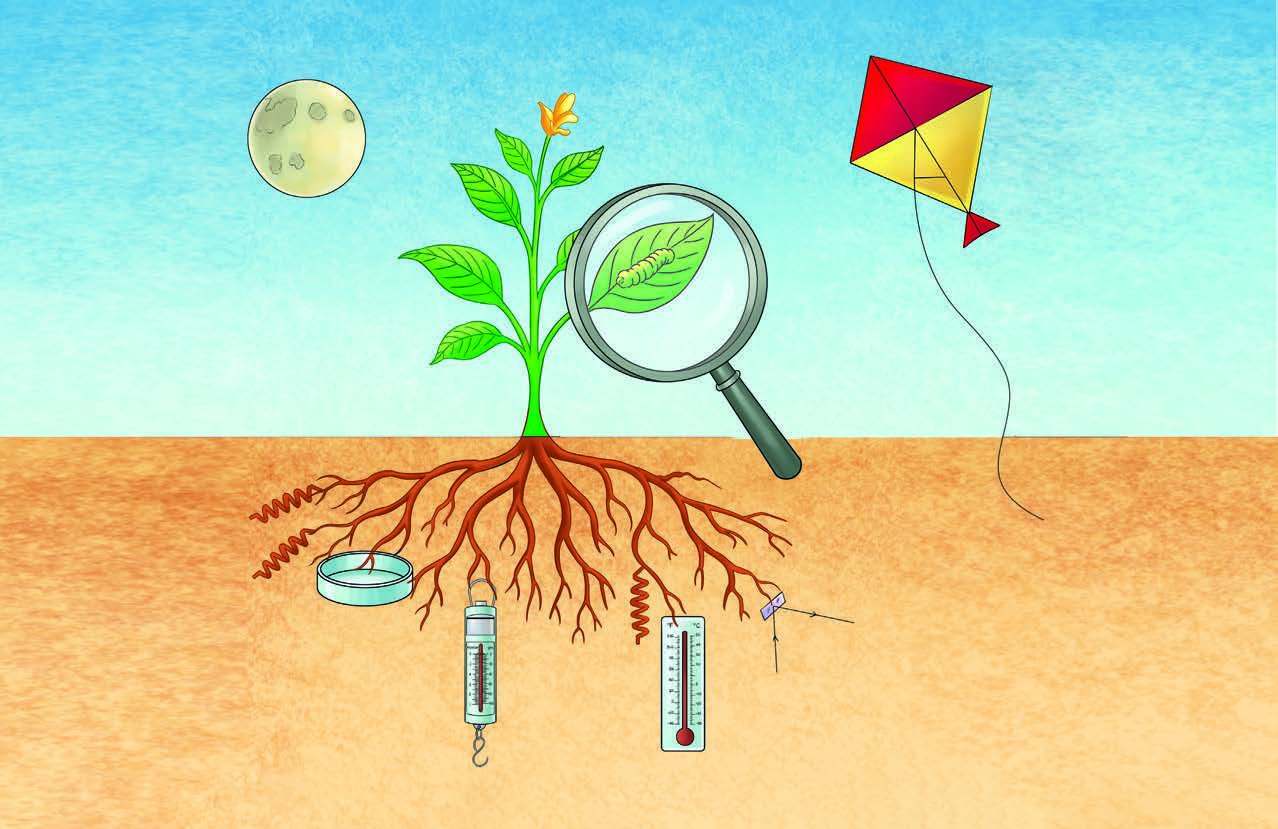
The textbook uses two small pictures to hold this idea together. At the bottom of the left pages is a root, standing for the solid knowledge that ties us to our environment, our traditions and our heritage. At the top corner of the right pages is a kite, standing for curiosity that must take flight. Investigation needs both. Careful observation keeps our thinking grounded, and creative imagination lets it travel beyond what we already know.
1.4 Science is everywhere
An investigation does not need an expensive laboratory. The kitchen is a fine place to begin. A puri puffs up in hot oil, a phulka swells on the flame, dough rises, and sugar disappears into hot tea. Each one is a small puzzle. The scientist's habit is to turn the puzzle into a question and then ask "what happens if...?" Once a question is clear, observations and small experiments can follow.
Some questions are about the very large, such as whether the world is getting warmer. Some are about the very small, such as what lives in a single drop of water. Both kinds need the same habits: looking closely, measuring what can be measured, and writing down what happens.
1.5 A question you can investigate
A question such as "why do plants grow?" is too broad to test in a classroom. A sharper version, "do seeds sprout faster in light or in darkness?", tells you what to change, what to keep the same, and what to observe. Learning to sharpen a question is half the work. The rest is careful looking, a fair comparison, and an honest record of the results.
1.6 Tools that extend the senses
Looking closely is a skill in itself. A magnifying glass can reveal a caterpillar on a leaf, a thermometer can turn "hot" into a number, and a spring balance can compare forces that are hard to judge by hand. Tools do not replace our senses; they extend them and make observations easier to compare. A ruler turns "long" into centimetres, and a clock turns "quickly" into seconds.
1.7 Questions from the world around you
Everyday life supplies an endless supply of questions. Why do wet clothes dry faster on a windy day? Why does a spoon look bent in a glass of water? Why does the Moon seem to change shape? Each question can be tested with simple materials, but only after it is narrowed. "Why does the Moon change?" becomes "does the Moon's lit part change in a repeating pattern over a month?"
Some questions turn out to be about measurement: how much, how fast, how hot, how many. Others are about cause: what makes this happen? A useful habit is to sort a question into one of these kinds before starting, because the kind decides whether you need a stopwatch, a ruler or a set of comparisons.
1.8 Keep a science notebook
A notebook turns scattered observations into a record that can be checked. Write the date, the question, what you changed, what you kept the same, what you observed, and any measurement with its unit. A quick sketch often says more than a paragraph. Months later, the notebook lets you compare a new result with an old one, and it protects you from trusting a memory that has quietly changed.
1.9 A shared adventure
Science is not a solo performance by a genius in a white coat. People work in teams, argue politely, repeat each other's experiments and correct mistakes. A result becomes stronger when other people can repeat the same steps and see the same thing. That is why a school investigation should record the method clearly enough for a classmate to repeat it.
This chapter asks you to be an investigator rather than a spectator. You will not be handed a list of facts to memorise and return. You will be shown how one everyday observation, the puffing of a puri, can be turned into a small research plan, and you will see how the same habits apply to questions about health, weather, light and the whole planet.